Farandzha Dzhem, Shikerova Petranka, Lazarova Gergana, Hazarbasanov Dobri
Department of Cardiology, University Hospital Lozenetz, Kozyak 1, Sofia, 1407, Bulgaria.
Eur Heart J Case Rep. 2021 Aug 2;5(9):ytab312. doi: 10.1093/ehjcr/ytab312. eCollection 2021 Sep.
Infective endocarditis (IE) is a serious infection with high morbidity and mortality that involves the endocardial lining of the heart. Most cases of IE are due to bacteria although other atypical micro-organisms can also be involved. Procalcitonin (PCT) is a biomarker that is used in the diagnosis of bacterial infections.
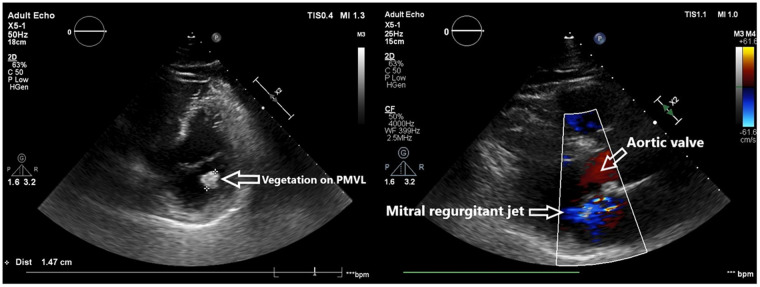
We present the case of a 54-year-old patient with bacterial endocarditis who has been regularly visiting his cardiologist for follow-up on a mitral valve prolapse and moderate mitral regurgitation (MR) for the last 11 years. During his last visit, transthoracic echocardiography (TTE) showed a previously non-existent structure on the posterior mitral valve leaflet with severe MR. Blood cultures were positive for . On admission, he had elevated levels of PCT and C-reactive protein which returned to normal values after 4 weeks of intravenous antibiotic therapy. His follow-up blood cultures, taken after normalization of PCT, did not show bacterial growth; however, on TTE he had severe mitral regurgitation and a persistent vegetation which had slightly increased in size after completion of the full antibiotic course. He was referred for mitral valve replacement surgery.
Normalization of procalcitonin levels may correlate with negative blood cultures in cases of IE with residual vegetations. The optimal time for surgery in such patients is difficult to define but even in circumstances with less infective organisms such as and late in the course of the disease residual vegetations remain a serious risk factor for embolic events. Randomized controlled clinical trials are needed in order to have better recommendations with solid evidence regarding prophylaxis and treatment in IE.
感染性心内膜炎(IE)是一种严重感染,发病率和死亡率高,累及心脏内膜。IE的大多数病例由细菌引起,不过其他非典型微生物也可能涉及。降钙素原(PCT)是一种用于诊断细菌感染的生物标志物。
我们报告一例54岁细菌性心内膜炎患者,在过去11年中,他定期拜访心脏病专家,对二尖瓣脱垂和中度二尖瓣反流(MR)进行随访。在他最后一次就诊时,经胸超声心动图(TTE)显示二尖瓣后叶上有一个先前不存在的结构,伴有严重MR。血培养 呈阳性。入院时,他的PCT和C反应蛋白水平升高,静脉抗生素治疗4周后恢复正常。在PCT恢复正常后采集的后续血培养未显示细菌生长;然而,在TTE检查中,他有严重的二尖瓣反流和持续存在的赘生物,在完成整个抗生素疗程后,赘生物大小略有增加。他被转诊进行二尖瓣置换手术。
在伴有残留赘生物的IE病例中,降钙素原水平正常化可能与血培养阴性相关。此类患者的最佳手术时间难以确定,但即使在感染病原体较少的情况下,如在疾病后期,残留赘生物仍然是栓塞事件的严重危险因素。需要进行随机对照临床试验,以便就IE的预防和治疗提出有充分证据的更好建议。