Dept of Environmental Health, Harvard T.H. Chan School of Public Health, Boston, MA, USA.
Dept of Epidemiology, Harvard T.H. Chan School of Public Health, Boston, MA, USA.
Eur Respir J. 2022 May 26;59(5). doi: 10.1183/13993003.01440-2021. Print 2022 May.
Population studies show that the use of swimming pools is associated with the risk of asthma and allergic diseases among children. Our objective was to explore the associations between blood trihalomethane (THM) concentrations and asthma among US adolescents, and assess to what extent the association is modified by active tobacco smoke exposure.
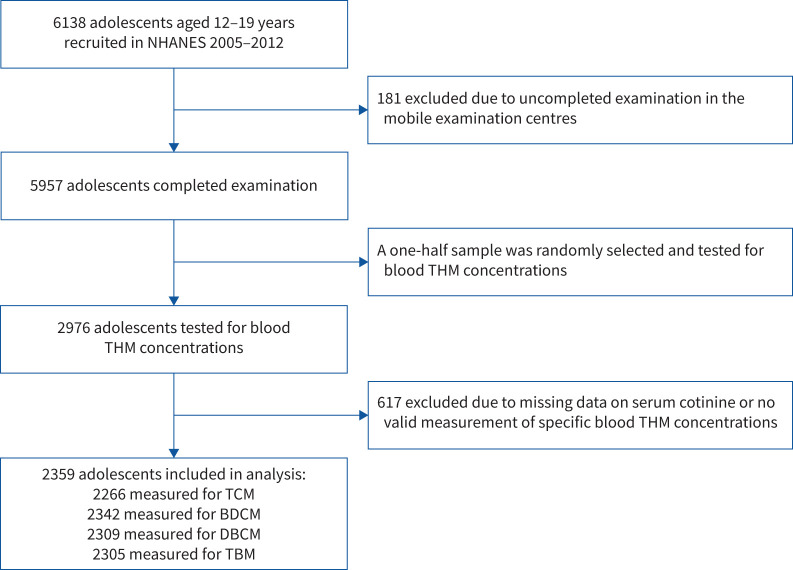
We included 2359 adolescents aged 12-19 years with measured blood concentrations of chloroform (trichloromethane (TCM)), bromodichloromethane (BDCM), dibromochloromethane (DBCM) and bromoform (tribromomethane (TBM)) from the National Health and Nutrition Examination Survey 2005-2012. Logistic regression models were fitted to assess the odds ratios for the association of blood THM concentrations (three or four categories) with the risk of self-reported current and ever (lifetime) asthma.
Blood DBCM concentrations were associated with a higher risk of ever asthma among all adolescents (OR 1.54 (95% CI 1.07-2.21), comparing the extreme exposure categories). The relationship was stronger among adolescents exposed to tobacco smoke (OR 3.96 (95% CI 1.89-8.30), comparing the extreme exposure categories). We also found positive relationships between blood brominated THM concentrations (sum of BDCM, DBCM and TBM) and risk of ever asthma and between blood DBCM and brominated THM concentrations and risk of current asthma among adolescents with tobacco smoke exposure. The relative excess risk of ever asthma due to the interaction between high blood DBCM and brominated THM concentrations and tobacco smoke exposure was 1.87 (95% CI 0.30-3.43) and 0.78 (95% CI 0.07-1.49), respectively.
Exposure to THMs is associated with a higher risk of asthma in adolescents, particularly among those exposed to tobacco smoke.
人群研究表明,游泳池的使用与儿童哮喘和过敏性疾病的风险有关。我们的目的是探讨美国青少年血液三卤甲烷(THM)浓度与哮喘之间的关系,并评估主动吸烟暴露对这种关系的影响程度。
我们纳入了 2359 名年龄在 12-19 岁的青少年,他们的血液样本中测量到了氯仿(三氯甲烷(TCM))、溴二氯甲烷(BDCM)、二溴一氯甲烷(DBCM)和溴仿(三溴甲烷(TBM))的浓度,这些数据来自 2005-2012 年的国家健康和营养调查。使用逻辑回归模型评估血液 THM 浓度(三个或四个类别)与自我报告的当前和终身(终生)哮喘风险之间的比值比。
所有青少年的血液 DBCM 浓度与终身哮喘的风险增加有关(OR 1.54(95% CI 1.07-2.21),比较极端暴露类别)。在接触烟草烟雾的青少年中,这种关系更强(OR 3.96(95% CI 1.89-8.30),比较极端暴露类别)。我们还发现血液溴化 THM 浓度(BDCM、DBCM 和 TBM 的总和)与终身哮喘风险之间存在正相关关系,以及血液 DBCM 与溴化 THM 浓度与有烟草烟雾暴露的青少年当前哮喘风险之间存在正相关关系。由于高血液 DBCM 与溴化 THM 浓度和烟草烟雾暴露之间的相互作用导致的终身哮喘风险的相对超额风险分别为 1.87(95% CI 0.30-3.43)和 0.78(95% CI 0.07-1.49)。
THM 暴露与青少年哮喘风险增加有关,尤其是在接触烟草烟雾的青少年中。