Center for Radiopharmaceutical Sciences, ETH-PSI-USZ, Paul Scherrer Institute, 5232, Villigen-PSI, Switzerland.
Laboratory for Animal Model Pathology, Institute of Veterinary Pathology, Vetsuisse Faculty, University of Zurich, 8057, Zurich, Switzerland.
Eur J Nucl Med Mol Imaging. 2022 Mar;49(4):1113-1126. doi: 10.1007/s00259-021-05564-0. Epub 2021 Oct 8.
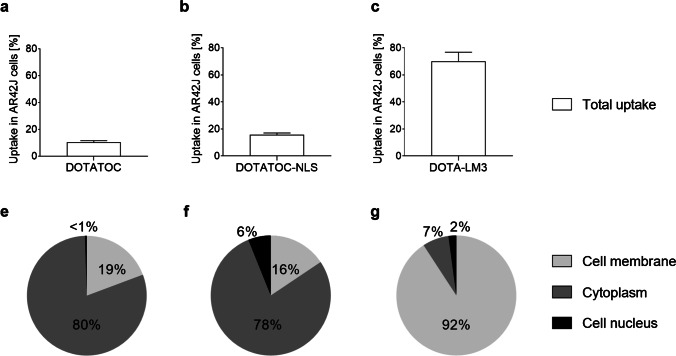
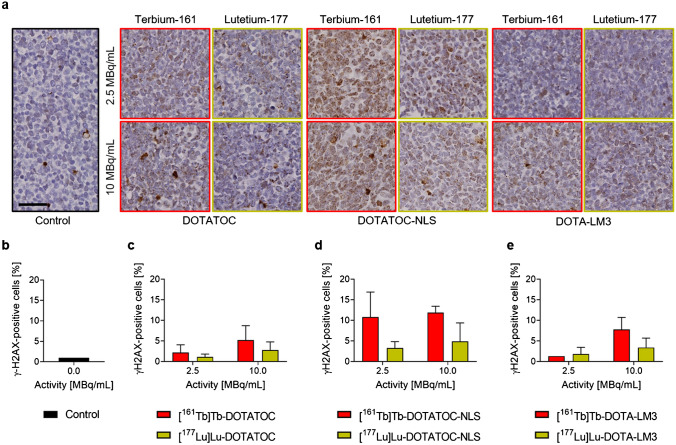
The β-emitting terbium-161 also emits conversion and Auger electrons, which are believed to be effective in killing single cancer cells. Terbium-161 was applied with somatostatin receptor (SSTR) agonists that localize in the cytoplasm (DOTATOC) and cellular nucleus (DOTATOC-NLS) or with a SSTR antagonist that localizes at the cell membrane (DOTA-LM3). The aim was to identify the most favorable peptide/terbium-161 combination for the treatment of neuroendocrine neoplasms (NENs).
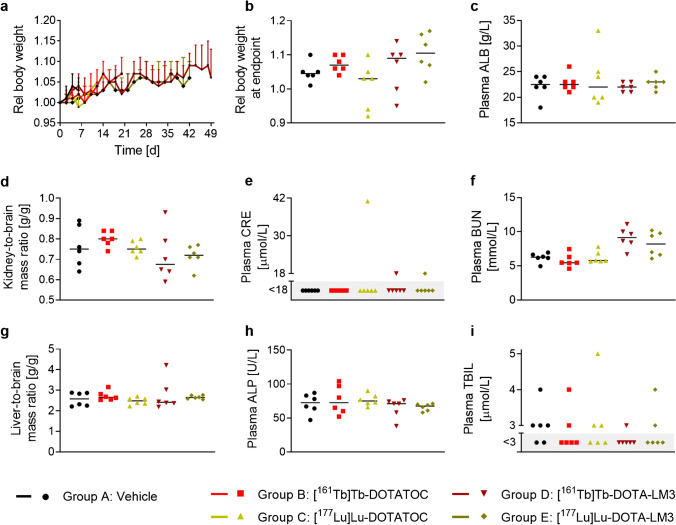
The capability of the Tb- and Lu-labeled somatostatin (SST) analogues to reduce viability and survival of SSTR-positive AR42J tumor cells was investigated in vitro. The radiopeptides' tissue distribution profiles were assessed in tumor-bearing mice. The efficacy of terbium-161 compared to lutetium-177 was investigated in therapy studies in mice using DOTATOC or DOTA-LM3, respectively.
In vitro, [Tb]Tb-DOTA-LM3 was 102-fold more potent than [Lu]Lu-DOTA-LM3; however, Tb-labeled DOTATOC and DOTATOC-NLS were only 4- to fivefold more effective inhibiting tumor cell viability than their Lu-labeled counterparts. This result was confirmed in vivo and demonstrated that [Tb]Tb-DOTA-LM3 was significantly more effective in delaying tumor growth than [Lu]Lu-DOTA-LM3, thereby, prolonging survival of the mice. A therapeutic advantage of terbium-161 over lutetium-177 was also manifest when applied with DOTATOC. Since the nuclear localizing sequence (NLS) compromised the in vivo tissue distribution of DOTATOC-NLS, it was not used for therapy.
The use of membrane-localizing DOTA-LM3 was beneficial and profited from the short-ranged electrons emitted by terbium-161. Based on these preclinical data, [Tb]Tb-DOTA-LM3 may outperform the clinically employed [Lu]Lu-DOTATOC for the treatment of patients with NENs.
发射β射线的铽-161 还会发射转换电子和俄歇电子,据信这些电子在杀死单个癌细胞方面非常有效。铽-161 与定位于细胞质(DOTATOC)和细胞核(DOTATOC-NLS)的生长抑素受体(SSTR)激动剂或定位于细胞膜的 SSTR 拮抗剂(DOTA-LM3)一起应用。目的是确定最适合用于治疗神经内分泌肿瘤(NENs)的肽/铽-161 组合。
体外研究了 Tb 和 Lu 标记的生长抑素(SST)类似物降低 SSTR 阳性 AR42J 肿瘤细胞活力和存活率的能力。评估了放射性肽在荷瘤小鼠中的组织分布特征。在使用 DOTATOC 或 DOTA-LM3 的小鼠治疗研究中,分别研究了铽-161 与镥-177 的疗效。
体外,[Tb]Tb-DOTA-LM3 比[Lu]Lu-DOTA-LM3 强 102 倍;然而,Tb 标记的 DOTATOC 和 DOTATOC-NLS 仅比其 Lu 标记的对应物抑制肿瘤细胞活力有效 4-5 倍。这一结果在体内得到了证实,并表明[Tb]Tb-DOTA-LM3 显著更有效地延迟肿瘤生长,从而延长了小鼠的存活时间。当应用 DOTATOC 时,铽-161 也显示出优于镥-177 的治疗优势。由于核定位序列(NLS)会影响 DOTATOC-NLS 的体内组织分布,因此未将其用于治疗。
使用膜定位的 DOTA-LM3 是有益的,并受益于铽-161 发射的短程电子。基于这些临床前数据,[Tb]Tb-DOTA-LM3 可能优于临床应用的[Lu]Lu-DOTATOC,用于治疗 NENs 患者。