Instituto Federal de Santa Catarina (IFSC), Câmpus Lages, Lages, SC, 88506-400, Brazil.
Kansas Biological Survey, University of Kansas, Lawrence, KS, 66047, USA.
New Phytol. 2022 Jan;233(1):505-514. doi: 10.1111/nph.17787. Epub 2021 Oct 27.
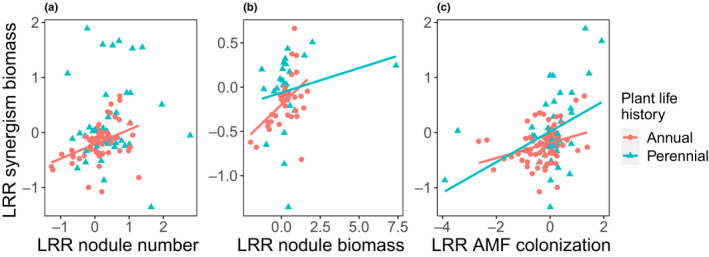
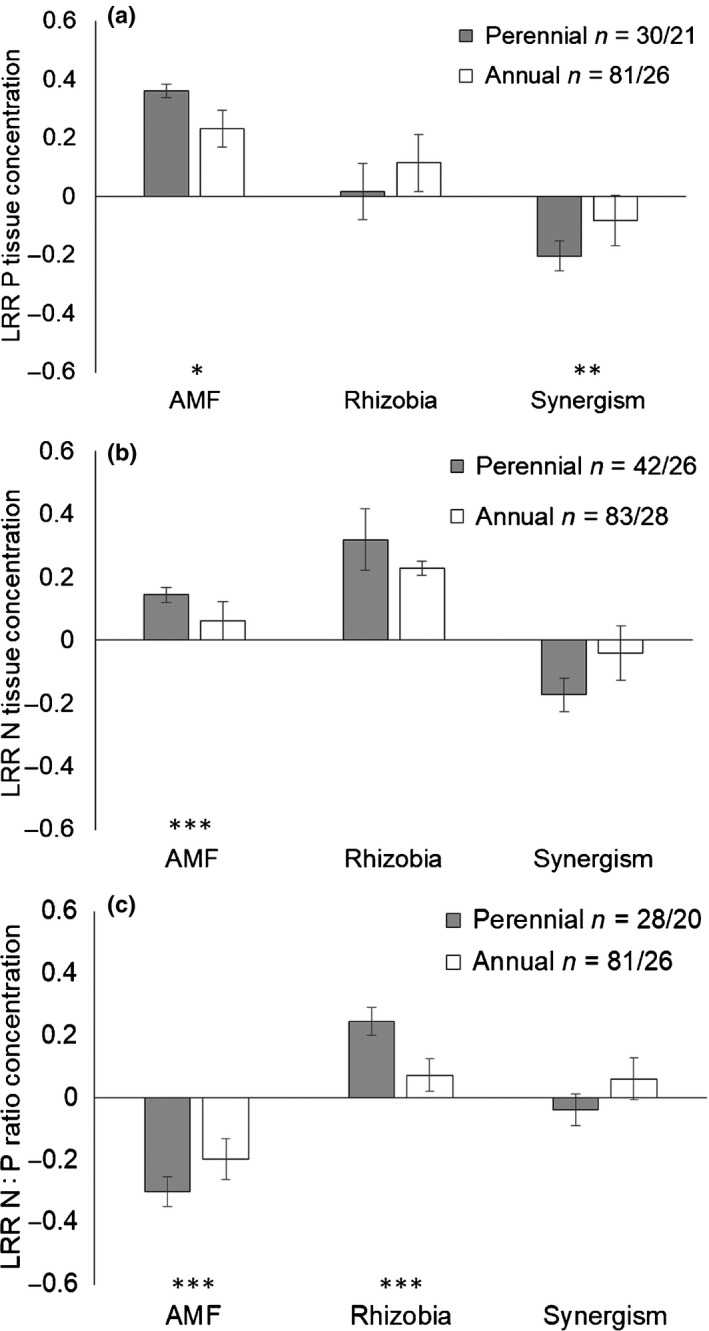
Many plant species simultaneously interact with multiple symbionts, which can, but do not always, generate synergistic benefits for their host. We ask if plant life history (i.e. annual vs perennial) can play an important role in the outcomes of the tripartite symbiosis of legumes, arbuscular mycorrhizal fungi (AMF), and rhizobia. We performed a meta-analysis of 88 studies examining outcomes of legume-AMF-rhizobia interactions on plant and microbial growth. Perennial legumes associating with AMF and rhizobia grew larger than expected based on their response to either symbiont alone (i.e. their response to co-inoculation was synergistic). By contrast, annual legume growth with co-inoculation did not differ from additive expectations. AMF and rhizobia differentially increased phosphorus (P) and nitrogen (N) tissue concentration. Rhizobium nodulation increased with mycorrhizal fungi inoculation, but mycorrhizal fungi colonization did not increase with rhizobium inoculation. Microbial responses to co-infection were significantly correlated with synergisms in plant growth. Our work supports a balanced plant stoichiometry mechanism for synergistic benefits. We find that synergisms are in part driven by reinvestment in complementary symbionts, and that time-lags in realizing benefits of reinvestment may limit synergisms in annuals. Optimization of microbiome composition to maximize synergisms may be critical to productivity, particularly for perennial legumes.
许多植物物种同时与多种共生体相互作用,这些共生体可以但并不总是为其宿主带来协同效益。我们想知道植物的生活史(即一年生植物与多年生植物)是否会在豆科植物、丛枝菌根真菌 (AMF) 和根瘤菌的三方共生关系的结果中发挥重要作用。我们对 88 项研究进行了荟萃分析,这些研究考察了豆科植物-AMF-根瘤菌相互作用对植物和微生物生长的影响。与 AMF 和根瘤菌共生的多年生豆科植物的生长大于仅与单一共生体相互作用时的预期(即它们对共同接种的反应是协同的)。相比之下,共同接种的一年生豆科植物的生长与预期的加性效应没有差异。AMF 和根瘤菌分别增加了磷 (P) 和氮 (N) 组织浓度。根瘤菌的结瘤作用随着菌根真菌的接种而增加,但菌根真菌的定植并不随根瘤菌的接种而增加。微生物对共同感染的反应与植物生长的协同作用显著相关。我们的工作支持协同效益的平衡植物化学计量机制。我们发现协同作用部分是由对互补共生体的再投资驱动的,而再投资实现效益的时间滞后可能会限制一年生植物的协同作用。优化微生物组组成以最大限度地提高协同作用可能对生产力至关重要,特别是对多年生豆科植物而言。