Pegasus Technical Services, Inc., Cincinnati, Ohio, USA.
Office of Research and Development, United States Environmental Protection Agency, Cincinnati, Ohio, USA.
Water Res. 2021 Oct 15;205:117571. doi: 10.1016/j.watres.2021.117571. Epub 2021 Aug 19.
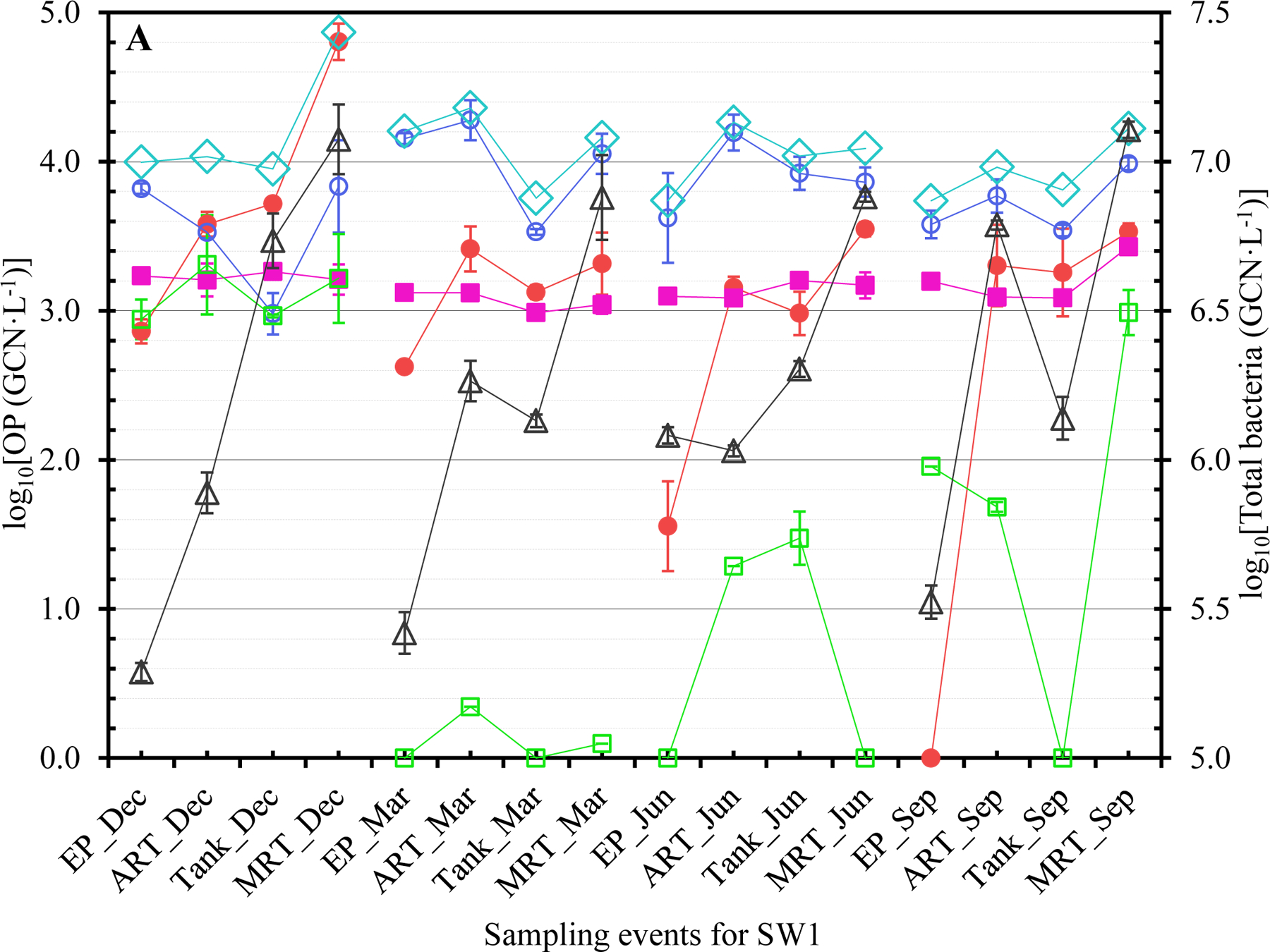
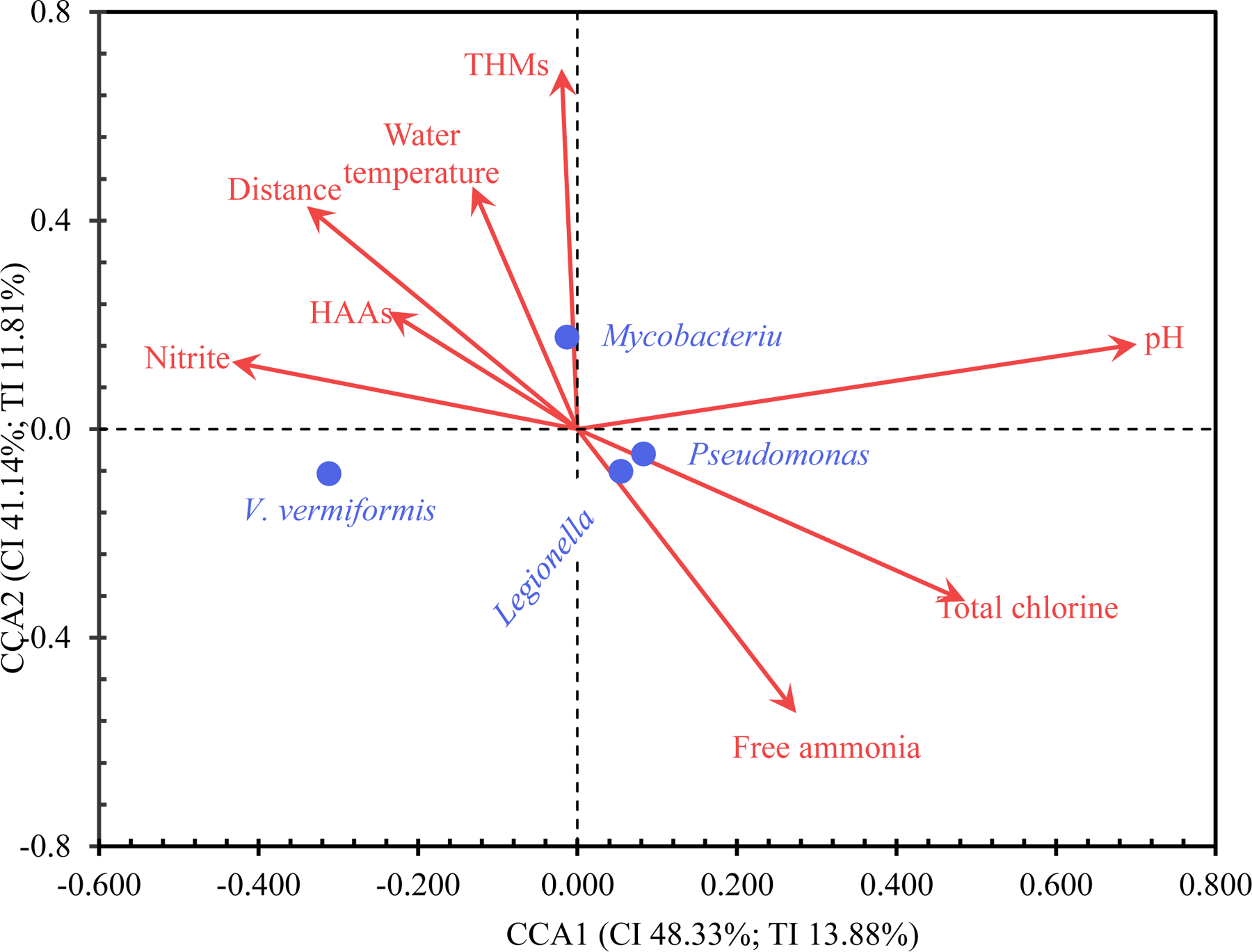
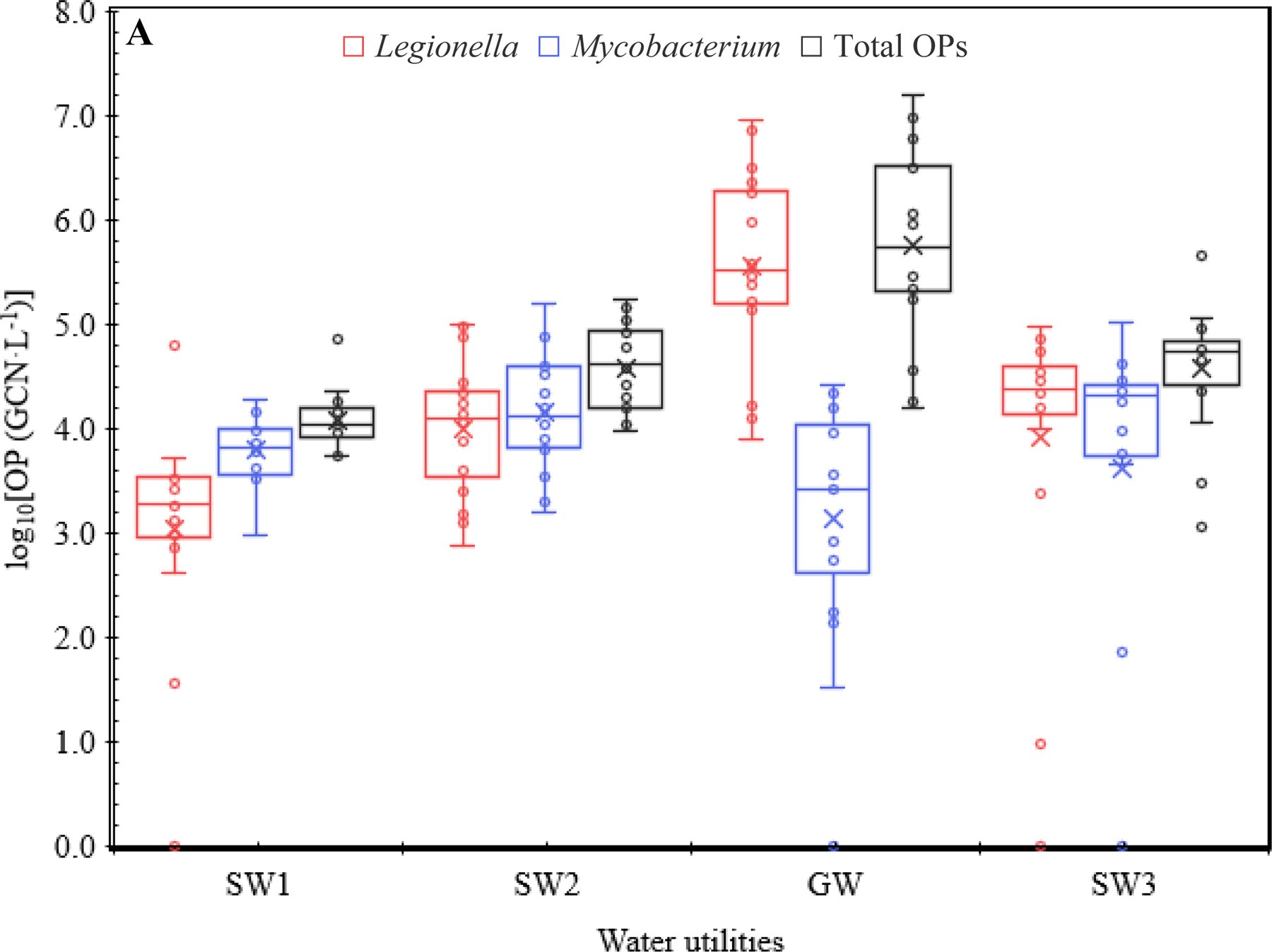
Water-based opportunistic pathogens (OPs) are a leading cause of drinking-water-related disease outbreaks, especially in developed countries such as the United States (US). Physicochemical water quality parameters, especially disinfectant residuals, control the (re)growth, presence, colonization, and concentrations of OPs in drinking water distribution systems (DWDSs), while the relationship between OPs and those parameters remain unclear. This study aimed to quantify how physicochemical parameters, mainly monochloramine residual concentration, hydraulic residence time (HRT), and seasonality, affected the occurrence and concentrations of four common OPs (Legionella, Mycobacterium, Pseudomonas, and Vermamoeba vermiformis) in four full-scale DWDSs in the US. Legionella as a dominant OP occurred in 93.8% of the 64 sampling events and had a mean density of 4.27 × 10 genome copies per liter. Legionella positively correlated with Mycobacterium, Pseudomonas, and total bacteria. Multiple regression with data from the four DWDSs showed that Legionella had significant correlations with total chlorine residual level, free ammonia concentration, and trihalomethane concentration. Therefore, Legionella is a promising indicator of water-based OPs, reflecting microbial water quality in chloraminated DWDSs. The OP concentrations had strong seasonal variations and peaked in winter and/or spring possibly because of reduced water usage (i.e., increased water stagnation or HRT) during cold seasons. The OP concentrations generally increased with HRT presumably because of disinfectant residual decay, indicating the importance of well-maintaining disinfectant residuals in DWDSs for OP control. The concentrations of Mycobacterium, Pseudomonas, and V. vermiformis were significantly associated with total chlorine residual concentration, free ammonia concentration, and pH and trihalomethane concentration, respectively. Overall, this study demonstrates how the significant spatiotemporal variations of OP concentrations in chloraminated DWDSs correlated with critical physicochemical water quality parameters such as disinfectant residual levels. This work also indicates that Legionella is a promising indicator of OPs and microbial water quality in chloraminated DWDSs.
水媒机会性病原体(OPs)是饮用水相关疾病爆发的主要原因,特别是在发达国家如美国(US)。理化水质参数,特别是消毒剂残留,控制(再)生长、存在、定殖和饮用水分配系统(DWDS)中 OPs 的浓度,而 OPs 与这些参数之间的关系尚不清楚。本研究旨在量化主要的理化参数,如单氯胺残留浓度、水力停留时间(HRT)和季节性,如何影响美国四个全规模 DWDS 中四种常见 OPs(军团菌、分枝杆菌、假单胞菌和变形虫)的发生和浓度。作为优势 OP 的军团菌在 64 次采样事件中的 93.8%中出现,平均密度为每升 4.27×10 基因组拷贝。军团菌与分枝杆菌、假单胞菌和总细菌呈正相关。对四个 DWDS 的数据进行多元回归分析表明,军团菌与总氯残留水平、游离氨浓度和三卤甲烷浓度有显著相关性。因此,军团菌是水媒 OPs 的一个有前途的指标,反映了氯胺化 DWDS 中的微生物水质。OP 浓度具有很强的季节性变化,在冬季和/或春季达到峰值,可能是由于寒冷季节用水量减少(即水停滞或 HRT 增加)所致。OP 浓度通常随 HRT 增加,可能是由于消毒剂残留衰减,表明在 DWDS 中保持消毒剂残留良好对于 OP 控制非常重要。分枝杆菌、假单胞菌和变形虫的浓度与总氯残留浓度、游离氨浓度和 pH 值以及三卤甲烷浓度分别显著相关。总体而言,本研究表明,氯胺化 DWDS 中 OP 浓度的显著时空变化如何与关键理化水质参数(如消毒剂残留水平)相关。这项工作还表明,军团菌是氯胺化 DWDS 中 OPs 和微生物水质的一个有前途的指标。