Azimi Mahmoodullah, Dehzad Wazhma Masoom, Atiq Mohammad Asif, Bahain Barin, Asady Abdullah
Department of Clinical Pharmacology, Kabul University of Medical Sciences, Kabul, Afghanistan.
Department of Microbiology, Kabul University of Medical Sciences, Kabul, Afghanistan.
Infect Drug Resist. 2021 Oct 2;14:4077-4083. doi: 10.2147/IDR.S332354. eCollection 2021.
To evaluate the occurrence, extent, and severity of adverse reactions associated with the vaccine of COVID-19 (ChAdOx1 nCoV-19 vaccine or AstraZeneca) among Kabul University of Medical Sciences staff.
A retrospective observational, interview-based study was conducted from 4 to 20 April, 2021, to evaluate the adverse reactions associated with the vaccine of COVID-19 (ChAdOx1 nCoV-19 vaccine or AstraZeneca) among the staff and lecturers of the Kabul University of Medical Sciences, Kabul, Afghanistan. Participants were interviewed following the administration of the first dose of the AstraZeneca vaccines. They were asked to report any adverse reactions that occurred within 8-10 days after vaccination. The frequency, duration, severity, and outcome of the reactions were recorded. Association of the adverse reactions was analysed with the ages of participants and previous infection with SARS CoV-2.
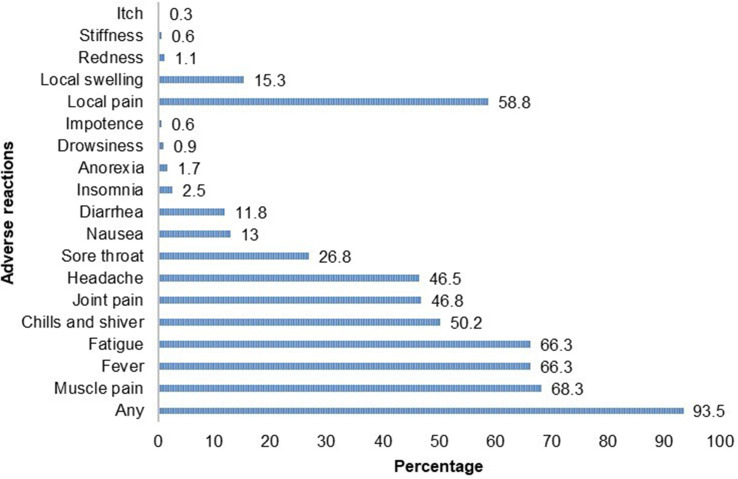
The most common adverse reactions reported by the participants were muscle pain (68.3%), local pain (58.8%) at the site of injection (68.3%), fever (66.3%) and fatigue (66.3%). Almost half of the respondents reported chills, joint pain and headache after receiving the first shot of the vaccine. The frequency of adverse reactions was higher in participants aged 40 years or less, and in those previously infected with SARS CoV-2. The severity of most adverse reactions was mild to moderate. No serious case or death was reported.
The adverse reactions reported by the participants were mild to moderate in severity, and for a short duration. The findings of this study help us to address the vaccine hesitancy caused by worries about severe adverse effects associated with the COVID-19 vaccine.
评估喀布尔医科大学工作人员中与新冠疫苗(ChAdOx1 nCoV-19疫苗或阿斯利康疫苗)相关的不良反应的发生情况、范围和严重程度。
2021年4月4日至20日进行了一项基于访谈的回顾性观察研究,以评估阿富汗喀布尔喀布尔医科大学工作人员和讲师中与新冠疫苗(ChAdOx1 nCoV-19疫苗或阿斯利康疫苗)相关的不良反应。在接种第一剂阿斯利康疫苗后对参与者进行访谈。要求他们报告接种疫苗后8至10天内出现的任何不良反应。记录反应的频率、持续时间、严重程度和结果。分析不良反应与参与者年龄和既往感染SARS-CoV-2的相关性。
参与者报告的最常见不良反应为肌肉疼痛(68.3%)、注射部位局部疼痛(58.8%)、发热(66.3%)和疲劳(66.3%)。几乎一半的受访者在接种第一剂疫苗后报告有寒战、关节疼痛和头痛。40岁及以下的参与者以及既往感染SARS-CoV-2的参与者中不良反应的发生率更高。大多数不良反应的严重程度为轻度至中度。未报告严重病例或死亡。
参与者报告的不良反应严重程度为轻度至中度,且持续时间较短。本研究结果有助于我们解决因担心新冠疫苗的严重不良反应而导致的疫苗犹豫问题。