Lee Kwang-Ho, Ju Hyo-Myeong, Yang Woo-Hwi
Graduate School of Sports Medicine, CHA University, Seongnam, South Korea.
Front Physiol. 2021 Sep 24;12:743859. doi: 10.3389/fphys.2021.743859. eCollection 2021.
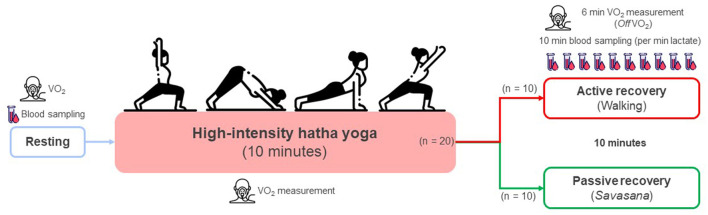
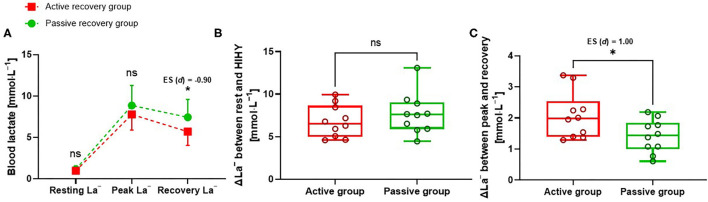
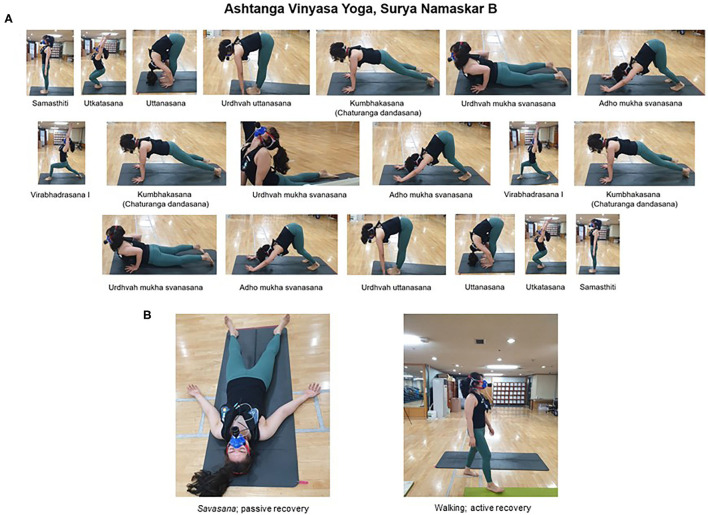
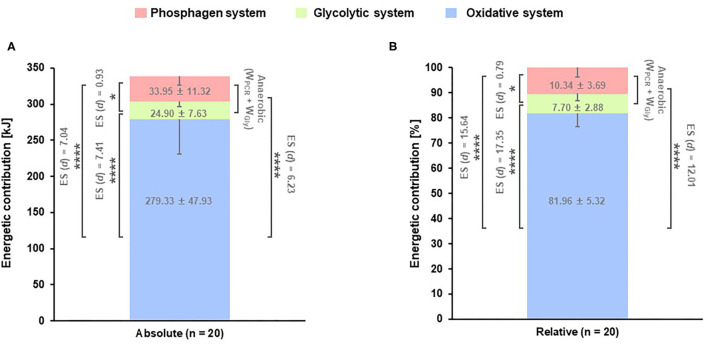
The objective of this study was to investigate metabolic energy contributions during high-intensity hatha yoga (HIHY) and to compare changes in physiological variables between active and passive recovery methods. The study involved 20 women yoga instructors ( = 20) who performed 10 min of HIHY (vigorous sun salutation). Upon completion, they were randomly assigned to either active (walking; = 10) or passive (; = 10) recovery groups for a period of 10 min. During HIHY, physiological variables such as heart rate (HR and HR), oxygen uptake (VO and VO), and blood lactate concentrations (peak La) were measured. Energetic contributions (phosphagen; W, glycolytic; W, and oxidative; W) in kJ and % were estimated using VO and La data. Furthermore, the metabolic equivalents (METs) of VO and VO were calculated. To compare different recovery modes, HR, ΔHR, VO, ΔVO, recovery La, and recovery ΔLa were analyzed. The results revealed that HR, VO, and peak La during HIHY showed no differences between the two groups ( > 0.05). Values of HR, HR, METs of VO and VO, and La during HIHY were 95.6% of HR, 88.7% of HR, 10.54 ± 1.18, 8.67 ±.98 METs, and 8.31 ± 2.18 mmol·L, respectively. Furthermore, W was significantly higher compared with W, W, and anaerobic contribution (W + W), in kJ and % ( < 0.0001). VO and recovery ΔLa were significantly higher in the active recovery group ( < 0.0001, = 0.0369, respectively). Values of ΔVO and recovery La were significantly lower in the active group compared with the passive group ( = 0.0115, = 0.0291, respectively). The study concluded that high-intensity hatha yoga which was performed for 10 min is a suitable option for relatively healthy people in the modern workplace who may have hatha yoga experience but do not have time to perform a prolonged exercise. Following active recovery, they can participate in further HIHY sessions during short breaks. Furthermore, a faster return to work can be supported by physiological recovery.
本研究的目的是调查高强度哈他瑜伽(HIHY)期间的代谢能量贡献,并比较主动恢复和被动恢复方法之间生理变量的变化。该研究纳入了20名女性瑜伽教练(n = 20),她们进行了10分钟的HIHY(剧烈的拜日式)。完成后,她们被随机分配到主动恢复组(步行;n = 10)或被动恢复组(n = 10),为期10分钟。在HIHY期间,测量了心率(HR和HR)、摄氧量(VO和VO)以及血乳酸浓度(峰值La)等生理变量。使用VO和La数据估算了以千焦(kJ)和百分比表示的能量贡献(磷酸原;W、糖酵解;W和氧化;W)。此外,还计算了VO和VO的代谢当量(METs)。为比较不同的恢复模式,分析了HR、ΔHR、VO、ΔVO、恢复La和恢复ΔLa。结果显示,两组在HIHY期间的HR、VO和峰值La无差异(P > 0.05)。HIHY期间HR、HR、VO和VO的METs以及La的值分别为HR的95.6%、HR的88.7%、10.54±1.18、8.67±0.98 METs和8.31±2.18 mmol·L。此外,以kJ和百分比表示,W与W、W以及无氧贡献(W + W)相比显著更高(P < 0.0001)。主动恢复组的VO和恢复ΔLa显著更高(分别为P < 0.0001、P = 0.0369)。与被动组相比,主动组的ΔVO和恢复La的值显著更低(分别为P = 0.0115、P = 0.0291)。该研究得出结论,对于现代职场中相对健康、可能有哈他瑜伽经验但没有时间进行长时间锻炼的人来说,进行10分钟的高强度哈他瑜伽是一个合适的选择。主动恢复后,他们可以在短时间休息期间参加更多的HIHY课程。此外,生理恢复有助于更快地重返工作岗位。