Treff Gunnar, Winkert Kay, Sareban Mahdi, Steinacker Jürgen M, Sperlich Billy
Division of Sports and Rehabilitation Medicine, Ulm University Hospital, Ulm, Germany.
Institute of Sports Medicine, Prevention and Rehabilitation, Paracelsus Medical University, Salzburg, Austria.
Front Physiol. 2019 Jun 12;10:707. doi: 10.3389/fphys.2019.00707. eCollection 2019.
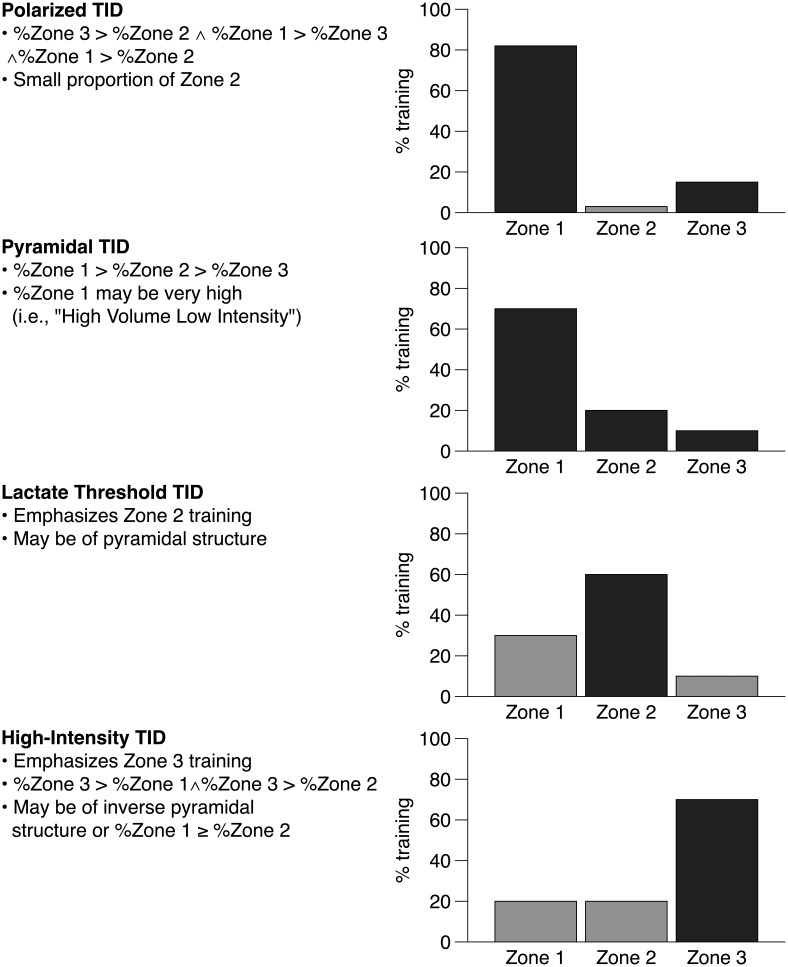
The training intensity distribution (TID) of endurance athletes has retrieved substantial scientific interest since it reflects a vital component of training prescription: (i) the intensity of exercise and its distribution over time are essential components for adaptation to endurance training and (ii) the training volume (at least for most endurance disciplines) is already near or at maximum, so optimization of training procedures including TID have become paramount for success. This paper aims to elaborate the polarization-index (PI) which is calculated as log(Zone 1/Zone 2Zone 3100), where Zones 1-3 refer to aggregated volume (time or distance) spent with low, mid, or high intensity training. PI allows to distinguish between non-polarized and polarized TID using a cut-off > 2.00 a.U. and to quantify the level of a polarized TID. Within this hypothesis paper, examples from the literature illustrating the usefulness of PI-calculation are discussed as well as its limitations. Further it is elucidated how the PI may contribute to a more precise definition of TID descriptors.
耐力运动员的训练强度分布(TID)已引起了大量科学关注,因为它反映了训练处方的一个重要组成部分:(i)运动强度及其随时间的分布是适应耐力训练的关键组成部分;(ii)训练量(至少对于大多数耐力项目而言)已接近或达到最大值,因此包括TID在内的训练程序优化对于取得成功变得至关重要。本文旨在阐述极化指数(PI),其计算方法为log(第1区/第2区第3区100),其中第1 - 3区指的是在低、中、高强度训练中花费的总训练量(时间或距离)。PI能够使用大于2.00任意单位的临界值区分非极化和极化的TID,并量化极化TID的水平。在这篇假说论文中,讨论了文献中说明PI计算有用性的示例及其局限性。此外,还阐明了PI如何有助于更精确地定义TID描述符。