Joshi Tejas P, Ren Vicky
School of Medicine, Baylor College of Medicine.
Department of Dermatology, Baylor College of Medicine.
Dermatol Pract Concept. 2021 Sep 1;11(4):e2021130. doi: 10.5826/dpc.1104a130. eCollection 2021 Sep.
Neglected tropical diseases (NTDs) include a group of about 20 illnesses that have garnered relatively little attention, despite their ability to inflict significant suffering and disability. Skin neglected tropical diseases (sNTDs) are a subset of NTDs that present with cutaneous manifestations and are well known for their ability to generate stigma and promote poverty. Teledermatology (TD) represents a potential method to control sNTDs.
We sought to analyze the potential for TD to ease the burden of sNTDs.
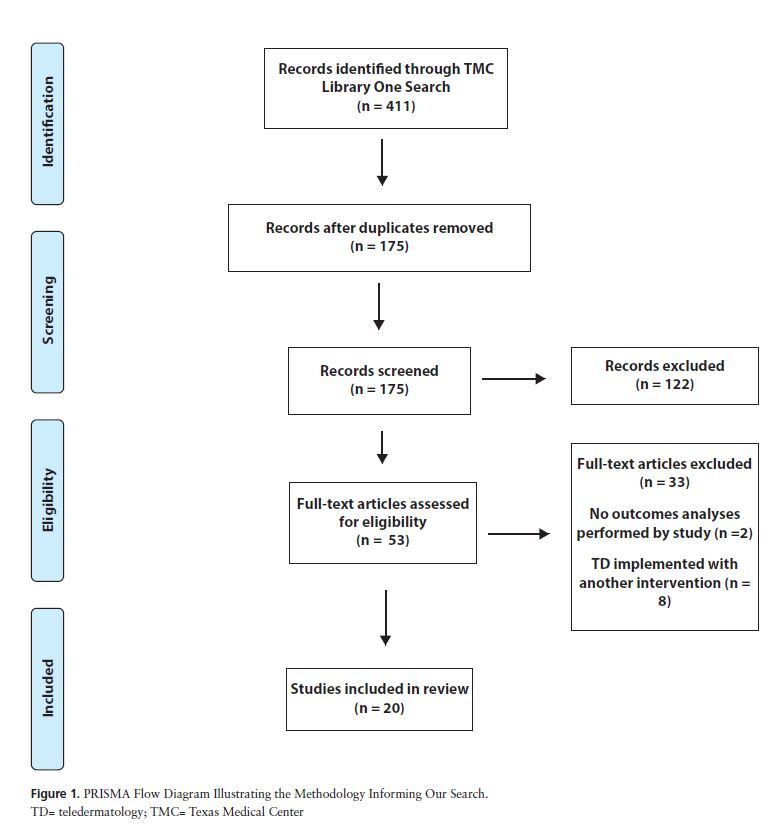
We performed a systematic literature search using the Texas Medical Center Library One Search, which scans 167 databases, including Embase, PubMed, and Scopus. We included all original investigations published after 2011 that assessed the impact of TD intervention in the control of one or more sNTDs. We excluded studies not written in English and studies that did not perform any outcome analyses.
Twenty studies met our search criteria, and 18 expressed positive attitudes towards TD. Overall, we found that TD may be a sustainable, cost-effective strategy for expanding access to care for individuals afflicted with sNTDs. However, poor image quality, lack of access to further diagnostic tests, and ethical, legal, and cultural issues pose as barriers to TD utilization.
TD may be helpful in achieving control of sNTDs but has its limitations. An integrated approach, which employs TD in conjunction with other strategies, represents a realistic path for alleviating sNTDs.
被忽视的热带病(NTDs)包括约20种疾病,尽管它们会造成巨大痛苦和残疾,但相对而言却很少受到关注。皮肤被忽视的热带病(sNTDs)是NTDs的一个子集,表现为皮肤症状,并且因其会产生耻辱感和加剧贫困而广为人知。远程皮肤病学(TD)是控制sNTDs的一种潜在方法。
我们试图分析TD减轻sNTDs负担的潜力。
我们使用德克萨斯医学中心图书馆一站式搜索进行了系统的文献检索,该搜索可扫描167个数据库,包括Embase、PubMed和Scopus。我们纳入了2011年以后发表的所有评估TD干预对一种或多种sNTDs控制影响的原始研究。我们排除了非英文撰写的研究以及未进行任何结果分析的研究。
20项研究符合我们的检索标准,其中18项对TD持积极态度。总体而言,我们发现TD可能是一种可持续、具有成本效益的策略,有助于扩大对患有sNTDs的个体的护理服务可及性。然而,图像质量差、无法获得进一步的诊断测试以及伦理、法律和文化问题构成了TD应用的障碍。
TD可能有助于实现对sNTDs的控制,但存在局限性。采用TD与其他策略相结合的综合方法是减轻sNTDs负担的现实途径。