Che Hailuo, Long Dunmei, Sun Qian, Wang Lina, Li Yunbin
Department of Obstetrics, Zaozhuang Municipal Hospital, Zaozhuang, China.
Department of Obstetrics and Gynecology, Maternal and Child Health Care of Zaozhuang, Zaozhuang, China.
Front Pediatr. 2021 Sep 23;9:722471. doi: 10.3389/fped.2021.722471. eCollection 2021.
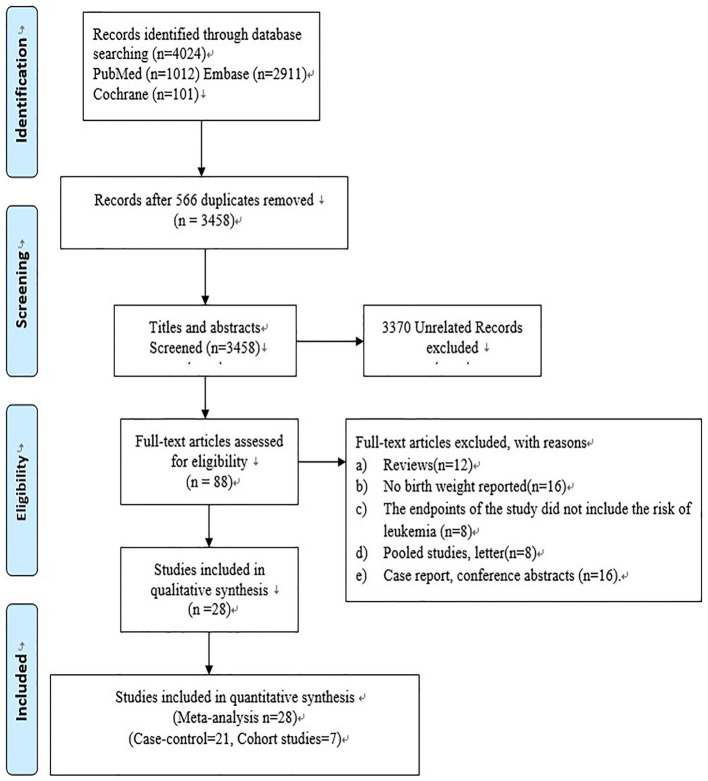
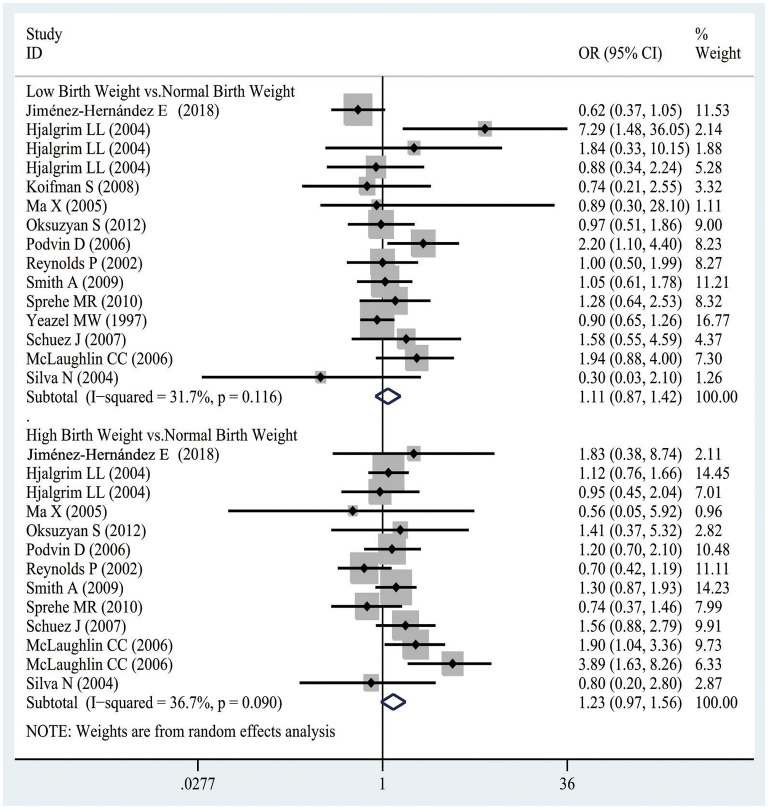
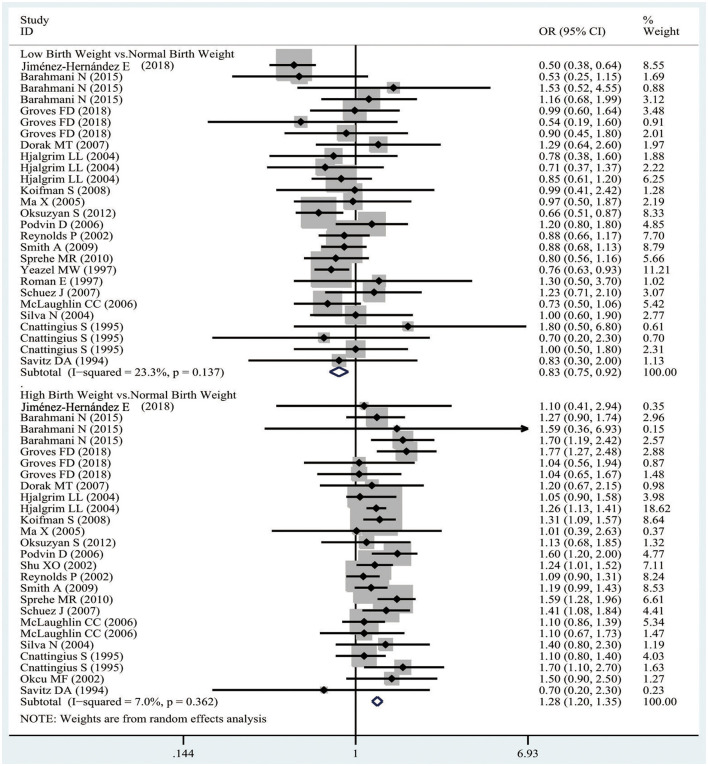
Birth weight, an important indicator of fetal nutrition and degree of development, may affect the risk of subsequent leukemia. At present, little is known about the effect of birth weight on acute myeloid leukemia (AML) and whether there is a dose-dependent relationship of birth weight with acute lymphoid leukemia (ALL) and AML. To address these questions, the present work aimed to systematically investigate the relationship between birth weight and the risk of subsequent leukemia based on the current epidemiological studies Relevant studies were systematically retrieved from electronic databases PubMed, Embase, and Cochrane Library, from inception to May 15th, 2021. Finally, 28 studies (including 21 case-control studies and 7 cohort studies) were included for the final meta-analysis. Results in cohort studies were performed by risk ratios (RRs), while those in case-control studies by odds ratios (ORs), and all results were assessed by adopting the random-effect model. Besides, a dose-dependent analysis was conducted based on the cohort studies. Compared with the population with normal birth weight (NBW), the population with high birth weight (HBW) might have an increased risk of leukemia (OR 1.33, 95%CI 1.20-1.49; 0%). Meanwhile, low birth weight (LBW) was associated with a decreased risk of ALL, as evidenced from the pooled analysis of case-control studies (OR 0.83, 95% CI 0.75-0.92; 23.3%). However, relative to NBW population, the HBW population might have an increased risk of ALL (OR 1.28, 95% CI 1.20-1.35; 7%). There was no obvious evidence supporting the relationship between LBW and the risk of AML from the pooled analysis of case-control studies (OR, 1.11 95% CI 0.87-1.42; 31.7%). Overall, in children and young adults, HBW population may be associated with the risks of subsequent leukemia and AML relative to NBW population, but the supporting dose-dependent evidence is lacking. In addition, compared with NBW population, there is stronger evidence supporting a significantly increased risk of subsequent ALL in HBW population, and a decreased risk in LBW population in a dose-dependent manner. More prospective studies with large samples are warranted in the future to validate and complement these findings.
出生体重是胎儿营养和发育程度的重要指标,可能会影响后续患白血病的风险。目前,关于出生体重对急性髓系白血病(AML)的影响以及出生体重与急性淋巴细胞白血病(ALL)和AML之间是否存在剂量依赖关系知之甚少。为了解决这些问题,本研究旨在基于当前的流行病学研究系统地探究出生体重与后续白血病风险之间的关系。从电子数据库PubMed、Embase和Cochrane图书馆中系统检索了从创刊到2021年5月15日的相关研究。最终,纳入28项研究(包括21项病例对照研究和7项队列研究)进行最终的荟萃分析。队列研究的结果采用风险比(RRs)进行分析,病例对照研究的结果采用比值比(ORs)进行分析,所有结果均采用随机效应模型进行评估。此外,基于队列研究进行了剂量反应分析。与出生体重正常(NBW)的人群相比,出生体重高(HBW)的人群患白血病的风险可能增加(OR 1.33,95%CI 1.20 - 1.49;P < 0.001)。同时,低出生体重(LBW)与ALL风险降低相关,病例对照研究的汇总分析证明了这一点(OR 0.83,95%CI 0.75 - 0.92;P = 0.001)。然而,相对于NBW人群,HBW人群患ALL的风险可能增加(OR 1.28,95%CI 1.20 - 1.35;P < 0.001)。病例对照研究的汇总分析没有明显证据支持LBW与AML风险之间的关系(OR 1.11,95%CI 0.87 - 1.42;P = 0.317)。总体而言,在儿童和年轻人中,相对于NBW人群,HBW人群可能与后续白血病和AML的风险相关,但缺乏支持剂量依赖关系的证据。此外,与NBW人群相比,有更强的证据支持HBW人群后续患ALL的风险显著增加,以及LBW人群风险呈剂量依赖性降低。未来需要更多大样本的前瞻性研究来验证和补充这些发现。