Department of Pathology, Medical Institute, Sumy State University, SUMY, UKRAINE.
Turk Patoloji Derg. 2022;38(3):205-212. doi: 10.5146/tjpath.2021.01559.
Our study investigated the morphological and immunohistochemical characteristics of invasive breast carcinoma of no special type (IBC-NST) with medullary pattern to explore the inconsistencies between the structural and clinical traits of this category of tumor.
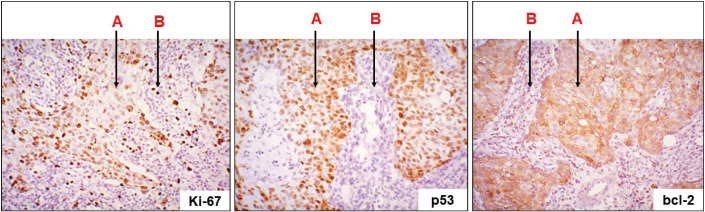
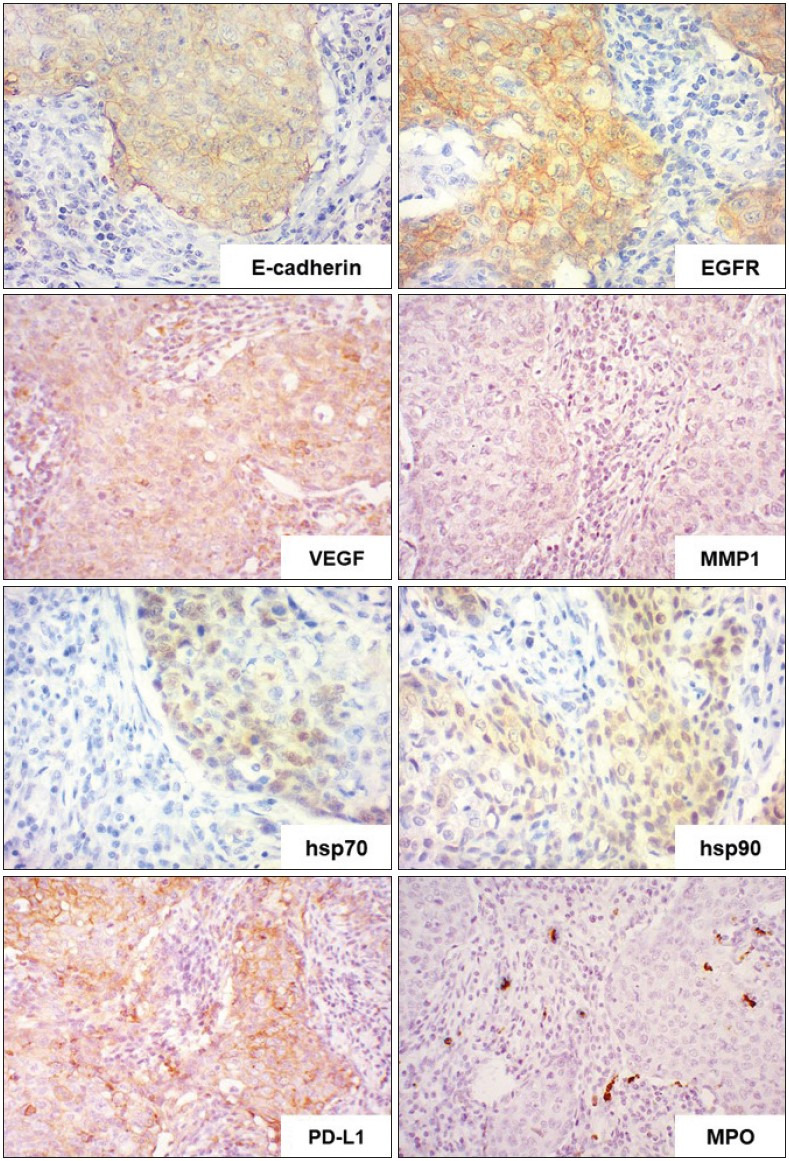
The breast carcinoma samples (n = 26) with medullary pattern (defined according to established criteria) were subjected to immunohistochemical assays of the following receptors: ER, PR, HER2/neu, Ki-67, p53, Bcl-2, VEGF, MMP1, E-cadherin, EGFR, Hsp70, Hsp90, CD20, CD3, CD4, CD8, CD68, CD163, CD56, CD138, MPO, S100, IgG, IgM, and PD-L1.
IBC-NST with medullary pattern was found to have negative expression of ER, PR, and HER2/neu; strong positive expression of Kі-67, mutant р53, Bcl-2, E-cadherin, EGFR, and PD-L1; moderate positive expression of Hsp70 and Hsp90; and low or negative expression of VEGF and MMP1. Furthermore, there was pronounced variability in the qualitative composition of tumor immune infiltrates with regards to T-lymphocytes, B-lymphocytes, macrophages, plasmocytes, and granulocytes.
IBC-NST with medullary pattern has many unfavourable morphological and immunohistochemical prognostic characteristics, which are balanced against the pronounced protective properties of the tumor cells and the qualitative characteristics of the tumor microenvironment. These can lead to a favourable disease course despite the relatively adverse features of the carcinoma cells.
本研究调查了特殊类型浸润性乳腺癌(IBC-NST)伴髓样模式的形态学和免疫组织化学特征,以探讨此类肿瘤的结构和临床特征之间的不一致性。
根据既定标准,对具有髓样模式的乳腺癌样本(n=26)进行以下受体的免疫组织化学检测:ER、PR、HER2/neu、Ki-67、p53、Bcl-2、VEGF、MMP1、E-cadherin、EGFR、Hsp70、Hsp90、CD20、CD3、CD4、CD8、CD68、CD163、CD56、CD138、MPO、S100、IgG、IgM 和 PD-L1。
发现 IBC-NST 伴髓样模式的 ER、PR 和 HER2/neu 表达阴性;Kі-67、突变 p53、Bcl-2、E-cadherin、EGFR 和 PD-L1 强阳性表达;Hsp70 和 Hsp90 中度阳性表达;VEGF 和 MMP1 低或阴性表达。此外,肿瘤免疫浸润的定性组成在 T 淋巴细胞、B 淋巴细胞、巨噬细胞、浆细胞和粒细胞方面存在显著的可变性。
IBC-NST 伴髓样模式具有许多不良的形态学和免疫组织化学预后特征,但肿瘤细胞具有明显的保护特性和肿瘤微环境的定性特征,这使得尽管癌细胞具有相对不利的特征,但疾病过程仍可能良好。