Department of Neurology and Neurological Sciences, Stanford University School of Medicine, Stanford, California, USA.
Department of Neurosurgery, Kaiser Permanente, Redwood City, California, USA.
Ann Clin Transl Neurol. 2021 Nov;8(11):2110-2120. doi: 10.1002/acn3.51463. Epub 2021 Oct 11.
To investigate the progression of neural and motor features of Parkinson's disease in a longitudinal study, after washout of medication and bilateral subthalamic nucleus deep brain stimulation (STN DBS).
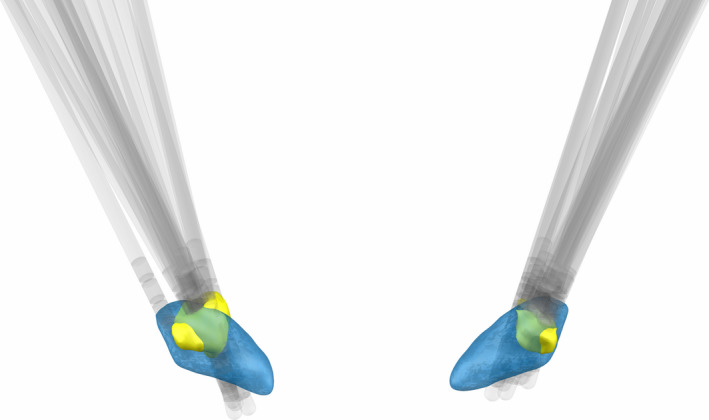
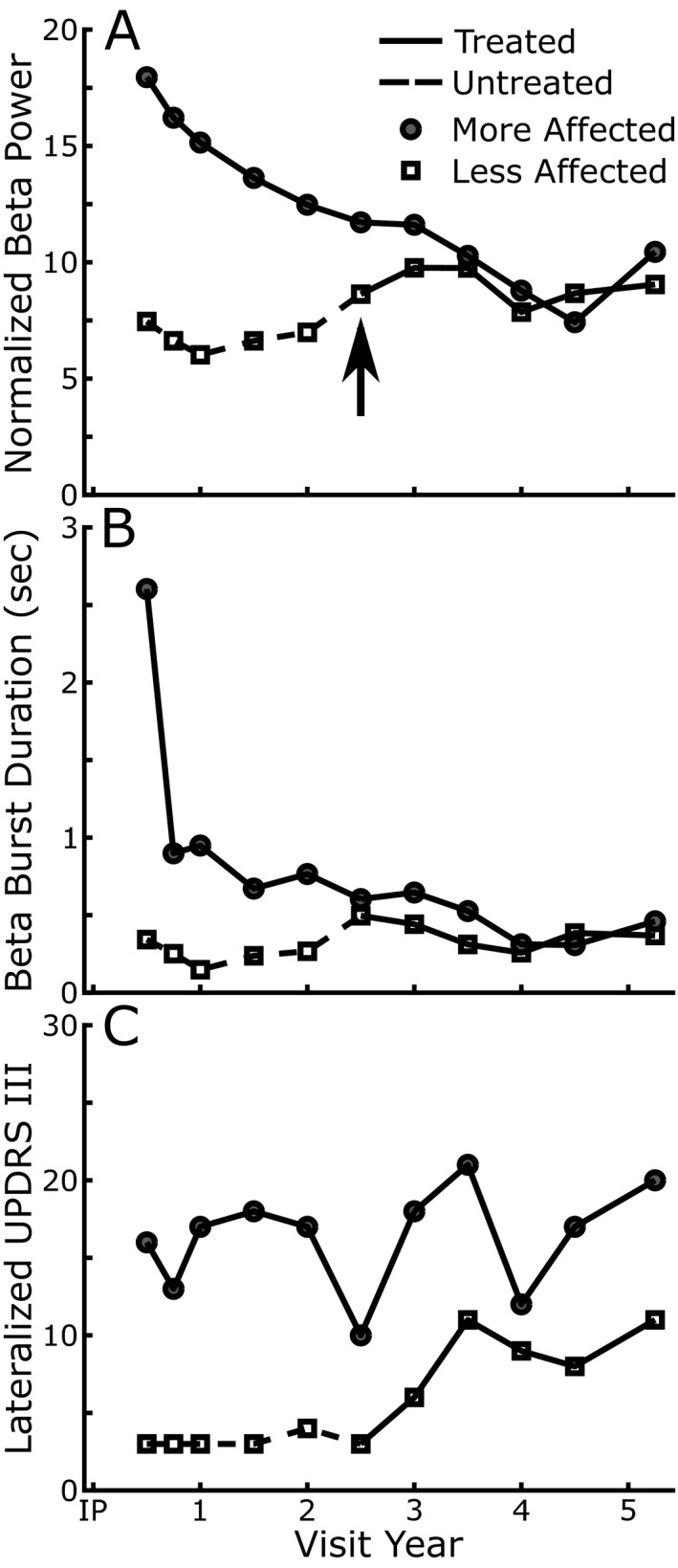
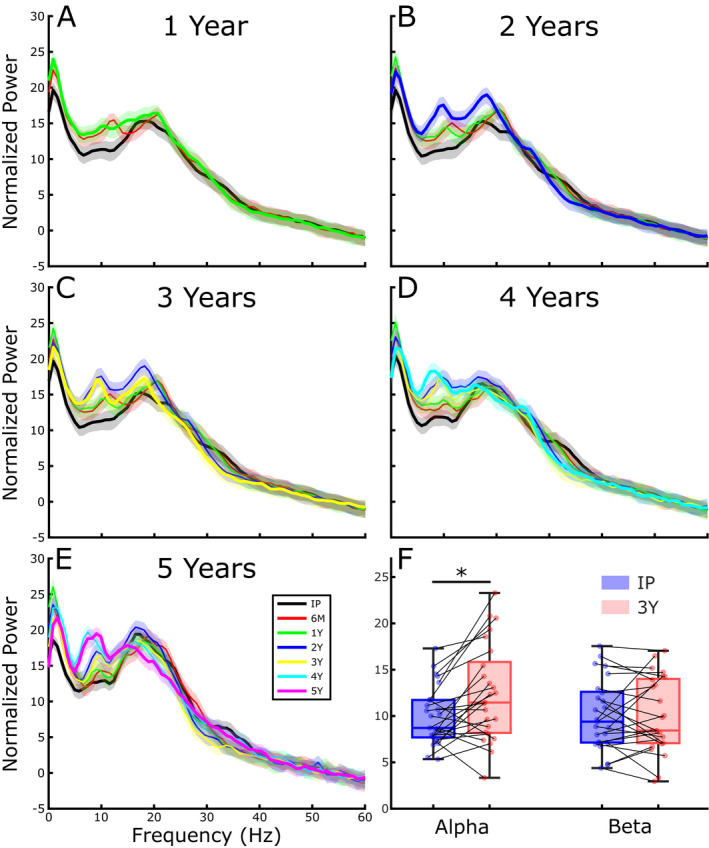
Participants with clinically established Parkinson's disease underwent bilateral implantation of DBS leads (18 participants, 13 male) within the STN using standard functional frameless stereotactic technique and multi-pass microelectrode recording. Both DBS leads were connected to an implanted investigative sensing neurostimulator (Activa™ PC + S, Medtronic, PLC). Resting state STN local field potentials (LFPs) were recorded and motor disability, (the Movement Disorder Society-Unified Parkinson's Disease Rating Scale - motor subscale, MDS-UPDRS III) was assessed off therapy at initial programming, and after 6 months, 1 year, and yearly out to 5 years of treatment. The primary endpoint was measured at 3 years. At each visit, medication had been held for over 12/24 h and DBS was turned off for at least 60 min, by which time LFP spectra reached a steady state.
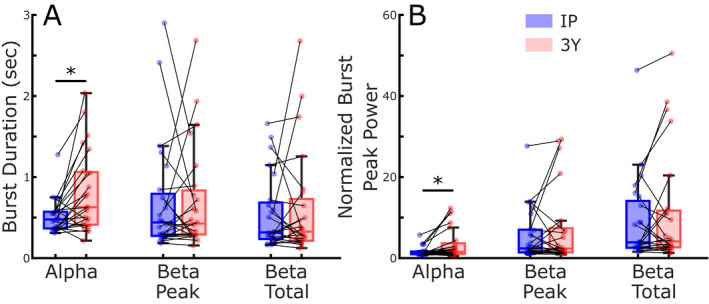
After 3 years of chronic DBS, there were no increases in STN beta band dynamics (p = 0.98) but there were increases in alpha band dynamics (p = 0.0027, 25 STNs). Similar results were observed in a smaller cohort out to 5 years. There was no increase in the MDS-UPDRS III score.
These findings provide evidence that the beta oscillopathy does not substantially progress following combined STN DBS plus medication in moderate to advanced Parkinson's disease.
在停药和双侧丘脑底核深部脑刺激(STN DBS)后,通过纵向研究来探究帕金森病的神经和运动特征的进展。
使用标准的无框架立体定向技术和多通道微电极记录,对临床确诊的帕金森病患者进行双侧 STN 深部脑刺激电极植入(18 名参与者,13 名男性)。将两个 DBS 电极都连接到植入的研究性感应神经刺激器(Activa™ PC + S,美敦力公司)。在初始编程时,在停药状态下记录 STN 局部场电位(LFPs),并评估运动障碍(运动障碍协会统一帕金森病评定量表-运动子量表,MDS-UPDRS III),然后在 6 个月、1 年和每年随访至 5 年治疗后进行评估。主要终点在 3 年时测量。每次就诊时,药物已停药超过 12/24 小时,DBS 至少关闭 60 分钟,此时 LFP 谱达到稳定状态。
在慢性 DBS 3 年后,STN 贝塔波段动力学没有增加(p = 0.98),但阿尔法波段动力学增加(p = 0.0027,25 个 STN)。在随访至 5 年的较小队列中也观察到了类似的结果。MDS-UPDRS III 评分没有增加。
这些发现提供了证据,表明在中重度至晚期帕金森病中,联合 STN DBS 和药物治疗后,β 振荡病不会显著进展。