37908National Cancer Institute of Brazil, Brazil.
42499Sergio Arouca National School of Public Health, Brazil.
J Oncol Pharm Pract. 2022 Dec;28(8):1737-1748. doi: 10.1177/10781552211040494. Epub 2021 Oct 12.
Cancer patients with Covid-19 are exposed to treatment combinations that can potentially result in interactions that adversely affect patient outcomes. This study aimed to identify potential drug-drug interactions between antineoplastic agents and medicines used to treat Covid-19.
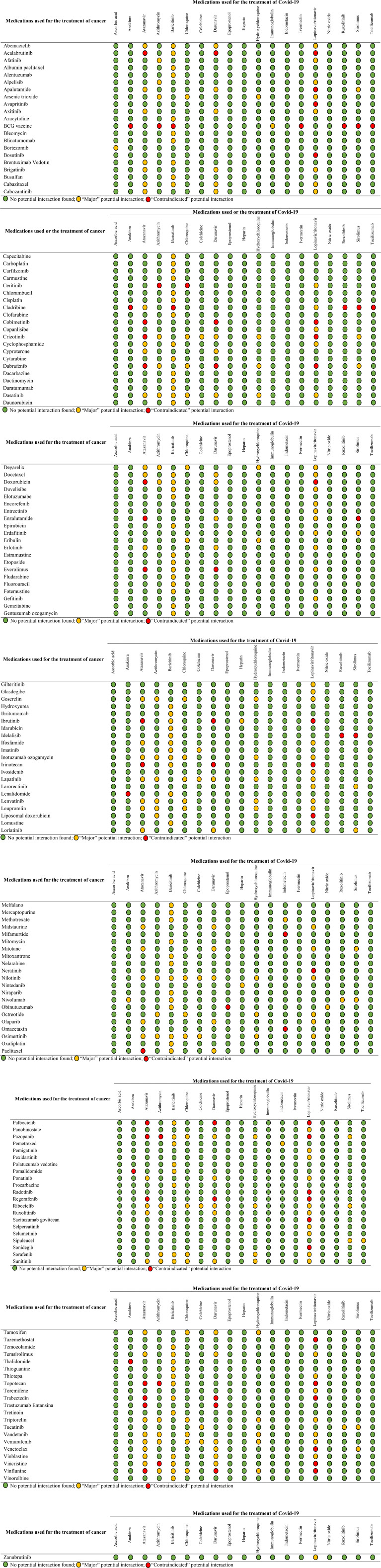
We conducted a search for potential interactions between 201 antineoplastic agents and 26 medicines used to treat Covid-19 on the Lexicomp and Micromedex databases. The following data were extracted: interaction severity ("major" and "contraindicated") and interaction effects (pharmacokinetic and pharmacodynamic). We also sought to identify the therapeutic indication of the antineoplastic drugs involved in the potential drug-drug interactions.
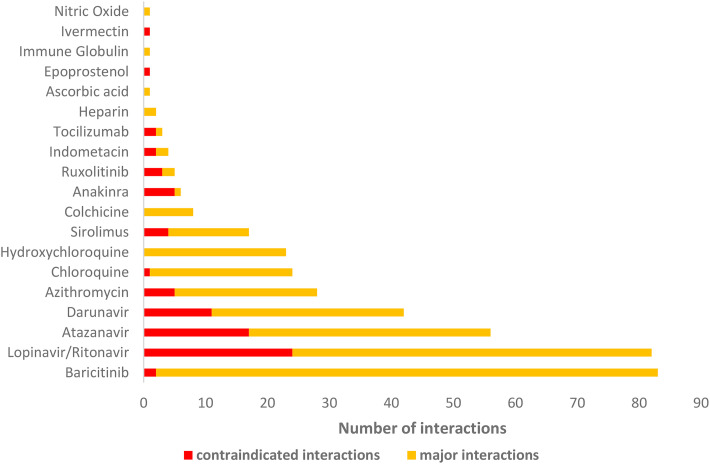
A total of 388 "major" or "contraindicated" drug-drug interactions were detected. Eight drugs or combinations (baricitinib, lopinavir/ritonavir, atazanavir, darunavir, azithromycin, chloroquine, hydroxychloroquine, and sirolimus) accounted for 91.5% of these interactions. The class of antineoplastic agents with the greatest potential for interaction was tyrosine kinase inhibitors (accounting for 46.4% of all interactions). The findings show that atazanavir, baricitinib, and lopinavir/ritonavir can affect the treatment of all common types of cancer. The most common pharmacokinetic effect of the potential drug-drug interactions was increased plasma concentration of the antineoplastic medicine (39.4%).
Covid-19 is a recent disease and pharmacological interventions are undergoing constant modification. This study identified a considerable number of potential drug-drug interactions. In view of the vulnerability of patients with cancer, it is vital that health professionals carefully assess the risks and benefits of drug combinations.
患有 COVID-19 的癌症患者可能会接受潜在的治疗组合,这些组合可能会导致相互作用,从而对患者的预后产生不利影响。本研究旨在确定抗肿瘤药物与用于治疗 COVID-19 的药物之间可能存在的药物相互作用。
我们在 Lexicomp 和 Micromedex 数据库中搜索了 201 种抗肿瘤药物和 26 种用于治疗 COVID-19 的药物之间可能存在的相互作用。提取了以下数据:相互作用的严重程度(“主要”和“禁忌”)和相互作用的影响(药代动力学和药效动力学)。我们还试图确定涉及潜在药物相互作用的抗肿瘤药物的治疗适应症。
共检测到 388 种“主要”或“禁忌”药物相互作用。八种药物或组合(巴瑞替尼、洛匹那韦/利托那韦、阿扎那韦、达芦那韦、阿奇霉素、氯喹、羟氯喹和西罗莫司)占这些相互作用的 91.5%。具有最大相互作用潜力的抗肿瘤药物类别是酪氨酸激酶抑制剂(占所有相互作用的 46.4%)。研究结果表明,阿扎那韦、巴瑞替尼和洛匹那韦/利托那韦可能会影响所有常见类型癌症的治疗。潜在药物相互作用最常见的药代动力学效应是抗肿瘤药物的血浆浓度增加(39.4%)。
COVID-19 是一种新发疾病,药物干预正在不断改变。本研究发现了相当数量的潜在药物相互作用。鉴于癌症患者的脆弱性,医疗保健专业人员必须仔细评估药物组合的风险和益处。