Department of Medicine II, Gastroenterology, Hepatology, Endocrinology, and Infectious Diseases, Faculty of Medicine, Medical Center, University of Freiburg, 79106 Freiburg, Germany.
Institute for Exercise and Occupational Medicine, Faculty of Medicine, Medical Center, University of Freiburg, 79106 Freiburg, Germany.
Int J Mol Sci. 2021 Sep 26;22(19):10372. doi: 10.3390/ijms221910372.
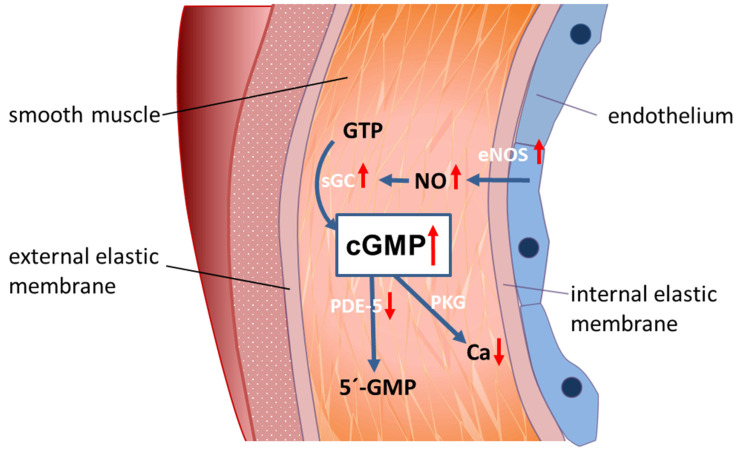
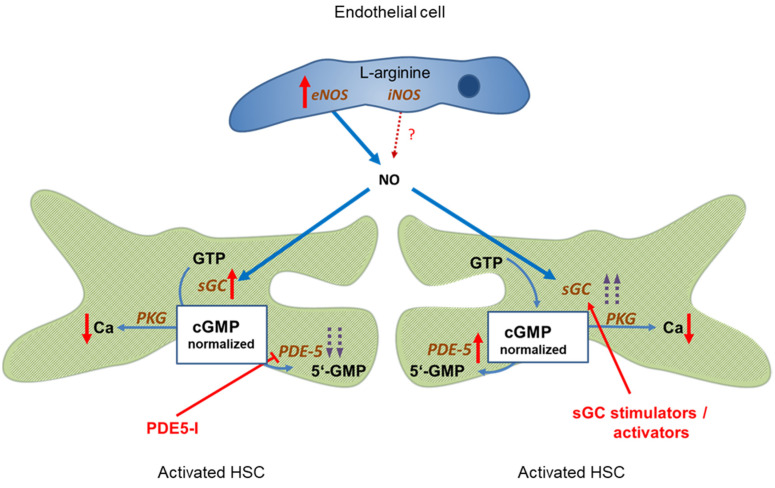
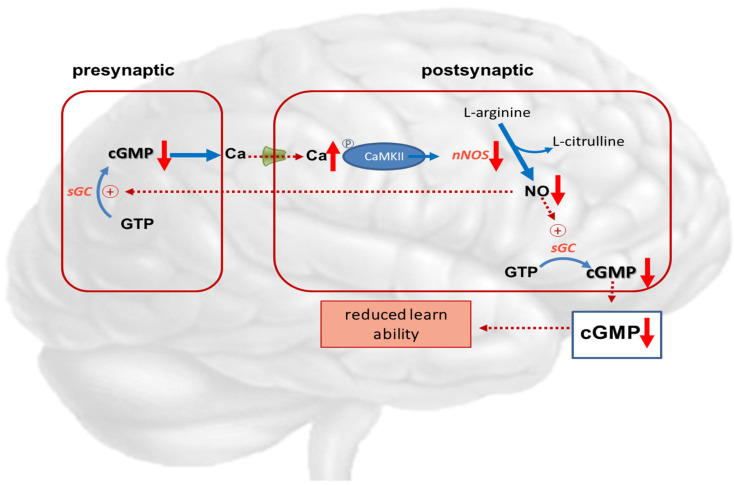
The NO-cGMP signal transduction pathway plays a crucial role in tone regulation in hepatic sinusoids and peripheral blood vessels. In a cirrhotic liver, the key enzymes endothelial NO synthase (eNOS), soluble guanylate cyclase (sGC), and phosphodiesterase-5 (PDE-5) are overexpressed, leading to decreased cyclic guanosine-monophosphate (cGMP). This results in constriction of hepatic sinusoids, contributing about 30% of portal pressure. In contrast, in peripheral arteries, dilation prevails with excess cGMP due to low PDE-5. Both effects eventually lead to circulatory dysfunction in progressed liver cirrhosis. The conventional view of portal hypertension (PH) pathophysiology has been described using the "NO-paradox", referring to reduced NO availability inside the liver and elevated NO production in the peripheral systemic circulation. However, recent data suggest that an altered availability of cGMP could better elucidate the contrasting findings of intrahepatic vasoconstriction and peripheral systemic vasodilation than mere focus on NO availability. Preclinical and clinical data have demonstrated that targeting the NO-cGMP pathway in liver cirrhosis using PDE-5 inhibitors or sGC stimulators/activators decreases intrahepatic resistance through dilation of sinusoids, lowering portal pressure, and increasing portal venous blood flow. These results suggest further clinical applications in liver cirrhosis. Targeting the NO-cGMP system plays a role in possible reversal of liver fibrosis or cirrhosis. PDE-5 inhibitors may have therapeutic potential for hepatic encephalopathy. Serum/plasma levels of cGMP can be used as a non-invasive marker of clinically significant portal hypertension. This manuscript reviews new data about the role of the NO-cGMP signal transduction system in pathophysiology of cirrhotic portal hypertension and provides perspective for further studies.
NO-cGMP 信号转导通路在肝窦和外周血管的张力调节中起着至关重要的作用。在肝硬化肝脏中,关键酶内皮型一氧化氮合酶 (eNOS)、可溶性鸟苷酸环化酶 (sGC) 和磷酸二酯酶-5 (PDE-5) 过度表达,导致环鸟苷酸 (cGMP) 减少。这导致肝窦收缩,导致门静脉压力增加约 30%。相比之下,在外周动脉中,由于 PDE-5 水平低,cGMP 过量导致扩张。这两种效应最终导致进展性肝硬化的循环功能障碍。门静脉高压 (PH) 病理生理学的传统观点是使用“NO 悖论”来描述的,即肝内 NO 可用性降低和外周全身循环中 NO 产生增加。然而,最近的数据表明,cGMP 的可用性改变可能比单纯关注 NO 可用性更好地阐明肝内血管收缩和外周全身血管扩张的对比发现。临床前和临床数据表明,使用 PDE-5 抑制剂或 sGC 刺激剂/激活剂靶向肝硬化中的 NO-cGMP 通路,通过扩张窦状隙降低门静脉压力和增加门静脉血流来降低肝内阻力。这些结果表明在肝硬化中具有进一步的临床应用。靶向 NO-cGMP 系统在肝纤维化或肝硬化的可能逆转中发挥作用。PDE-5 抑制剂可能对肝性脑病具有治疗潜力。cGMP 的血清/血浆水平可作为临床显著门静脉高压的非侵入性标志物。这篇综述文章回顾了关于 NO-cGMP 信号转导系统在肝硬化门静脉高压病理生理学中的作用的新数据,并为进一步的研究提供了视角。