Sorz-Nechay Thomas, Brusilovskaya Ksenia, Königshofer Philipp, Hofer Benedikt S, Petrenko Oleksandr, Simbrunner Benedikt, Taru Vlad, Bonitz Katharina, Horstmeier Henriette, Zinober Kerstin, Regnat Katharina, Lackner Carolin, Trauner Michael, Sun Peng, Truebenbach Ines, Kauschke Stefan G, Schwabl Philipp, Reiberger Thomas
Division of Gastroenterology and Hepatology, Department of Medicine III, Medical University of Vienna, Vienna, Austria.
Vienna Hepatic Hemodynamic Lab (HEPEX), Medical University of Vienna, Vienna, Austria.
Sci Rep. 2025 Jul 25;15(1):27051. doi: 10.1038/s41598-025-12381-0.
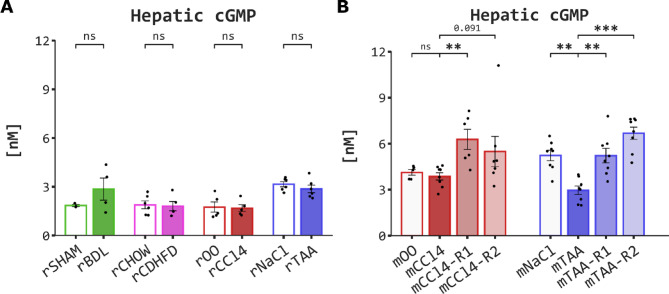
The nitric oxide (NO)-soluble guanylate cyclase (sGC)-cyclic guanosine-monophosphate (cGMP) pathway is impaired in liver fibrosis. We investigated expression patterns of NO-sGC-cGMP components via RT-qPCR in various rat models of liver fibrosis and murine models of liver fibrosis regression. Hepatic cGMP-levels were measured chromatographically. All models demonstrated portal-hypertension and liver fibrosis, which significantly regressed in murine models. The rat models showed etiology-specific differences in NO-sGC-cGMP pathway regulation. We observed strong upregulation of sGCa1 and sGCb1 subunits in a rat choline-deficient high-fat diet model (1.75-fold, p = 0.004 and 2.04-fold, p = 0.004, respectively). The sGCa2 subunit was markedly downregulated in a rat thioacetamide model (0.66-fold, p = 0.026). The rat bile-duct-ligation model was characterized by strong upregulation of inducible nitric oxide synthetase (28.10-fold, p = 0.029). The rat thioacetamide and bile-duct-ligation models displayed downregulation of sGCb2 (0.15-fold, p = 0.002, and 0.19-fold, p = 0.029, respectively). Regardless, hepatic cGMP-levels in rat models remained unchanged. Both mouse models demonstrated upregulation of NO-sGC-cGMP pathway nodes during regression, further accompanied by increased hepatic cGMP-levels in murine carbon tetrachloride (peak-fibrosis: 3.86 nM vs. 1-week regression: 6.28 nM, p = 0.006; vs. 2-week regression: 5.49 nM, p = 0.091) and thioacetamide (peak-fibrosis: 2.87 nM vs. 1-week regression: 5.22 nM, p = 0.007; vs. 2-week regression: 6.68 nM, p < 0.001) models. The NO-sGC-cGMP pathway exhibits etiology-specific and temporal regulation patterns during liver fibrogenesis and fibrosis regression. We further highlight the functional contribution of the pathway via increases in hepatic cGMP during fibrosis regression.
一氧化氮(NO)-可溶性鸟苷酸环化酶(sGC)-环磷酸鸟苷(cGMP)信号通路在肝纤维化中受损。我们通过逆转录定量聚合酶链反应(RT-qPCR)研究了该信号通路各组分在多种大鼠肝纤维化模型和小鼠肝纤维化消退模型中的表达模式。采用色谱法测定肝脏cGMP水平。所有模型均表现出门脉高压和肝纤维化,在小鼠模型中这些病变显著消退。大鼠模型在NO-sGC-cGMP信号通路调节方面表现出病因特异性差异。我们观察到,在大鼠胆碱缺乏高脂饮食模型中,sGCα1和sGCβ1亚基显著上调(分别为1.75倍,p = 0.004;2.04倍,p = 0.004)。在大鼠硫代乙酰胺模型中,sGCα2亚基显著下调(0.66倍,p = 0.026);大鼠胆管结扎模型的特征是诱导型一氧化氮合酶显著上调(28.10倍,p = 0.029)。大鼠硫代乙酰胺和胆管结扎模型中,sGCβ2均下调(分别为0.15倍,p = 0.002;0.19倍,p = 0.029)。尽管如此,大鼠模型中的肝脏cGMP水平保持不变。两种小鼠模型在纤维化消退过程中均表现出NO-sGC-cGMP信号通路节点上调,同时小鼠四氯化碳模型(纤维化高峰期:3.86 nM vs. 消退1周:6.28 nM,p = 0.006;vs. 消退2周:5.49 nM,p = 0.091)和硫代乙酰胺模型(纤维化高峰期:2.87 nM vs. 消退1周:5.22 nM,p = 0.007;vs. 消退2周:6.68 nM,p < 0.001)的肝脏cGMP水平升高。在肝纤维化形成和消退过程中,NO-sGC-cGMP信号通路呈现出病因特异性和时间依赖性调节模式。我们进一步强调了该信号通路在纤维化消退过程中通过肝脏cGMP升高所发挥的功能作用。