Śledzińska Paulina, Bebyn Marek G, Furtak Jacek, Kowalewski Janusz, Lewandowska Marzena A
Department of Thoracic Surgery and Tumors, Ludwik Rydygier Collegium Medicum in Bydgoszcz, Nicolaus Copernicus University, 85-067 Torun, Poland.
The F. Lukaszczyk Oncology Center, Molecular Oncology and Genetics Department, Innovative Medical Forum, 85-796 Bydgoszcz, Poland.
Int J Mol Sci. 2021 Sep 26;22(19):10373. doi: 10.3390/ijms221910373.
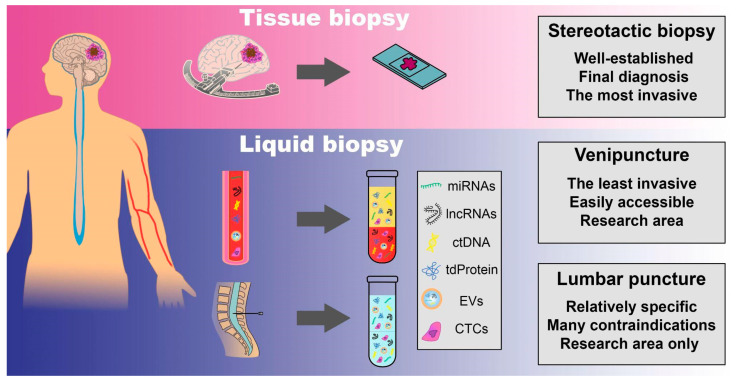
Gliomas are the most common central nervous system tumors. New technologies, including genetic research and advanced statistical methods, revolutionize the therapeutic approach to the patient and reveal new points of treatment options. Moreover, the 2021 World Health Organization Classification of Tumors of the Central Nervous System has fundamentally changed the classification of gliomas and incorporated many molecular biomarkers. Given the rapid progress in neuro-oncology, here we compile the latest research on prognostic and predictive biomarkers in gliomas. In adult patients, mutations are positive prognostic markers and have the greatest prognostic significance. However, deletion, in IDH-mutant astrocytomas, is a marker of the highest malignancy grade. Moreover, the presence of promoter mutations, alterations, or a combination of chromosome 7 gain and 10 loss upgrade IDH-wildtype astrocytoma to glioblastoma. In pediatric patients, alterations are the most important markers which predict the worse outcome. promoter methylation has the greatest clinical significance in predicting responses to temozolomide (TMZ). Conversely, mismatch repair defects cause hypermutation phenotype predicting poor response to TMZ. Finally, we discussed liquid biopsies, which are promising diagnostic, prognostic, and predictive techniques, but further work is needed to implement these novel technologies in clinical practice.
胶质瘤是最常见的中枢神经系统肿瘤。包括基因研究和先进统计方法在内的新技术彻底改变了对患者的治疗方法,并揭示了新的治疗选择要点。此外,2021年世界卫生组织中枢神经系统肿瘤分类从根本上改变了胶质瘤的分类,并纳入了许多分子生物标志物。鉴于神经肿瘤学的快速进展,在此我们汇总了胶质瘤预后和预测生物标志物的最新研究。在成年患者中, 突变是阳性预后标志物,具有最大的预后意义。然而,在异柠檬酸脱氢酶(IDH)突变型星形细胞瘤中, 缺失是最高恶性等级的标志物。此外, 启动子突变、 改变,或7号染色体增加和10号染色体缺失的组合会将IDH野生型星形细胞瘤升级为胶质母细胞瘤。在儿科患者中, 改变是预测预后较差的最重要标志物。 启动子甲基化在预测对替莫唑胺(TMZ)的反应方面具有最大的临床意义。相反,错配修复缺陷会导致高突变表型,预示对TMZ反应不佳。最后,我们讨论了液体活检,这是很有前景的诊断、预后和预测技术,但需要进一步开展工作以在临床实践中应用这些新技术。