Department of Neurosurgery, Beijing Tiantan Hospital, Capital Medical University, China.
China National Clinical Research Center for Neurological Diseases, China.
Dis Markers. 2020 Nov 22;2020:8888085. doi: 10.1155/2020/8888085. eCollection 2020.
The overall survival of patients with recurrent glioblastoma (rGBM) is quite different, so clinical outcome prediction is necessary to guide personalized clinical treatment for patients with rGBM. The expression level of lncRNA was analyzed to determine its prognostic value in rGBMs.
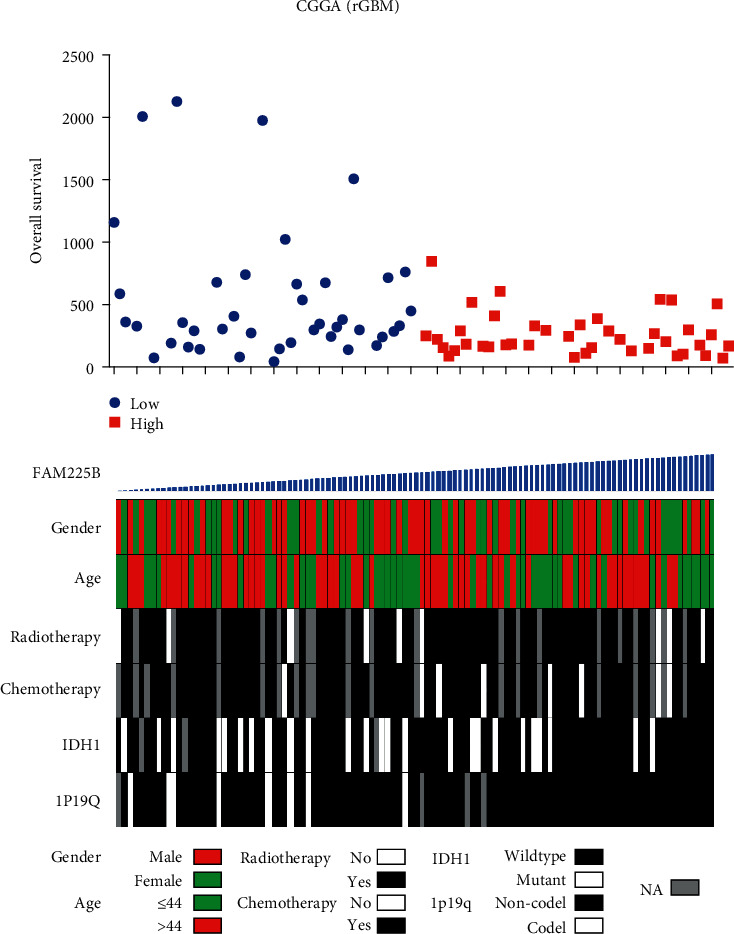
We collected 109 samples of Chinese Glioma Genome Atlas (CGGA) RNA sequencing dataset and divided into training set and validation set. Then, we analyzed the expression of , clinical characteristics, and overall survival (OS) information. Kaplan-Meier survival analysis was used to estimate the OS distributions. The prognostic value of in rGBMs was tested by univariate and multivariate Cox regression analyses. Moreover, we analyzed the biological processes and signaling pathways of .
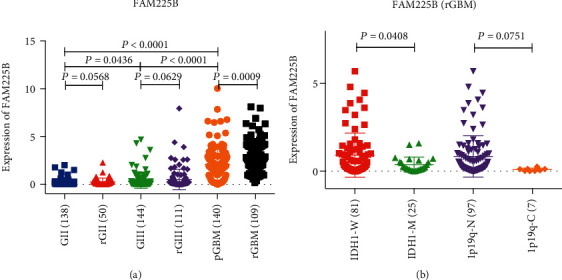
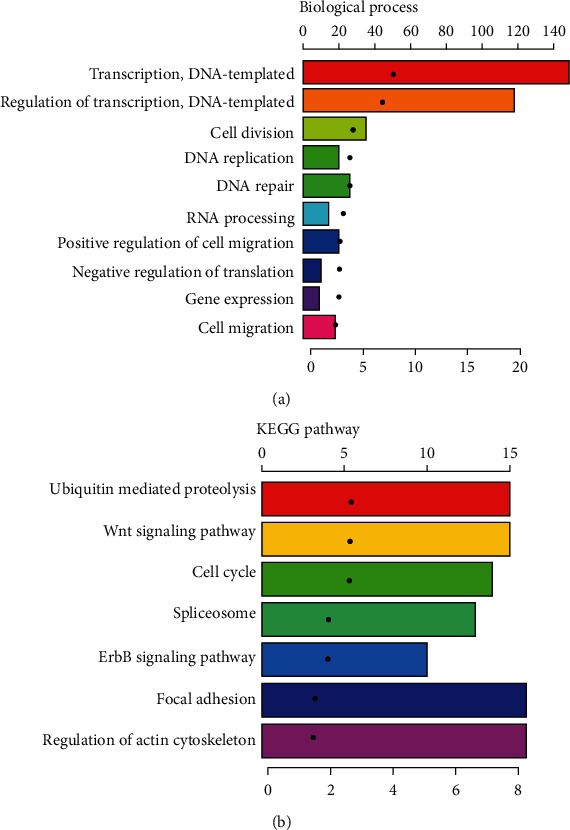
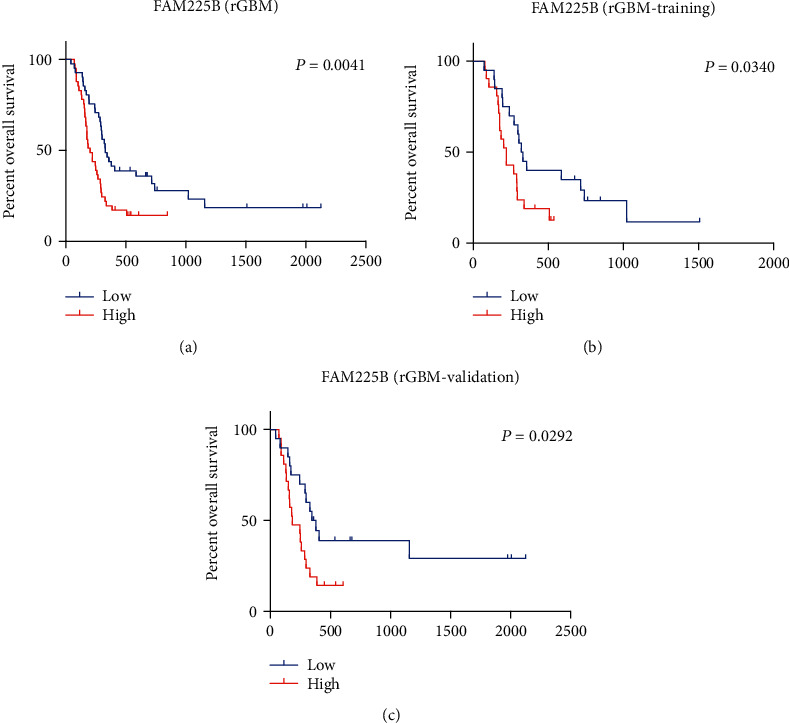
We found that was upregulated in rGBMs ( = 0.0009). The expression of increased with the grades of gliomas ( < 0.0001). The OS of rGBMs in the low-expression group was significantly longer than that in the high-expression group ( = 0.0041). Similar result was found in the training set ( = 0.0340) and verified in the validation set ( = 0.0292). In multivariate Cox regression analysis, was identified to be an independent prognostic factor for rGBMs ( = 0.003). Biological process and KEGG pathway analyses implied mainly played a functional role on transcription, regulation of transcription, cell migration, focal adhesion, etc.
is expected to be as a new prognostic biomarker for the identification of rGBM patients with poor outcome. And our study provided a potential therapeutic target for rGBMs.
复发性胶质母细胞瘤(rGBM)患者的总体生存率存在较大差异,因此需要进行临床预后预测,以指导 rGBM 患者的个体化临床治疗。分析长链非编码 RNA 的表达水平,以确定其在 rGBM 中的预后价值。
我们收集了中国脑胶质瘤基因组图谱(CGGA)RNA 测序数据集的 109 个样本,并将其分为训练集和验证集。然后,我们分析了 的表达、临床特征和总生存期(OS)信息。Kaplan-Meier 生存分析用于估计 OS 分布。通过单因素和多因素 Cox 回归分析来检验 在 rGBM 中的预后价值。此外,我们还分析了 的生物学过程和信号通路。
我们发现 在 rGBM 中呈上调表达( = 0.0009)。 的表达随着胶质瘤的分级而增加( < 0.0001)。低表达组 rGBM 患者的 OS 明显长于高表达组( = 0.0041)。在训练集中也得到了类似的结果( = 0.0340),并在验证集中得到了验证( = 0.0292)。在多因素 Cox 回归分析中, 被确定为 rGBM 的独立预后因素( = 0.003)。生物过程和 KEGG 通路分析表明, 主要在转录、转录调控、细胞迁移、焦点黏附等方面发挥功能作用。
有望成为识别 rGBM 患者不良预后的新的预后生物标志物。本研究为 rGBM 提供了一个潜在的治疗靶点。