Medina-Galvez Raul, Cantó-Navés Oriol, Marimon Xavier, Cerrolaza Miguel, Ferrer Miquel, Cabratosa-Termes Josep
Faculty of Dentistry, Universitat Internacional de Catalunya (UIC), 08017 Barcelona, Spain.
Bioengineering Institute of Technology, Universitat Internacional de Catalunya (UIC), 08190 Barcelona, Spain.
Materials (Basel). 2021 Oct 4;14(19):5801. doi: 10.3390/ma14195801.
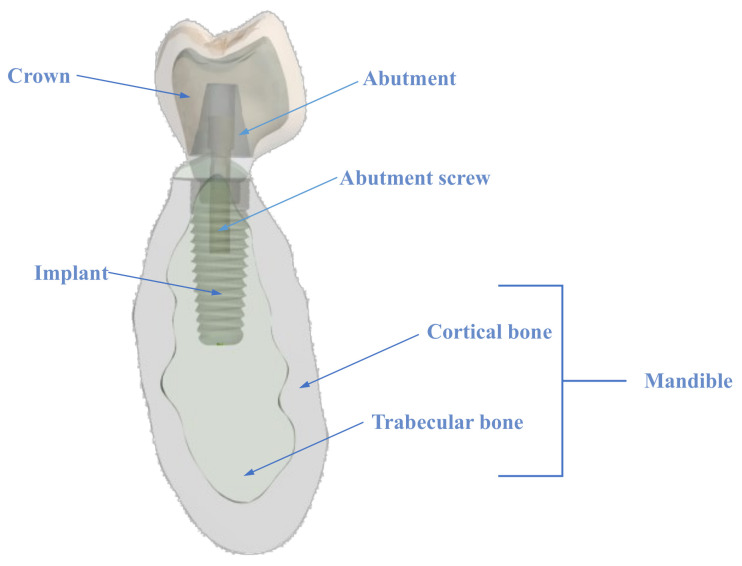
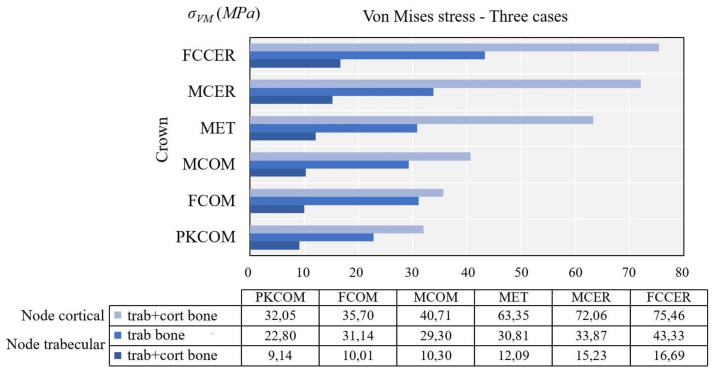
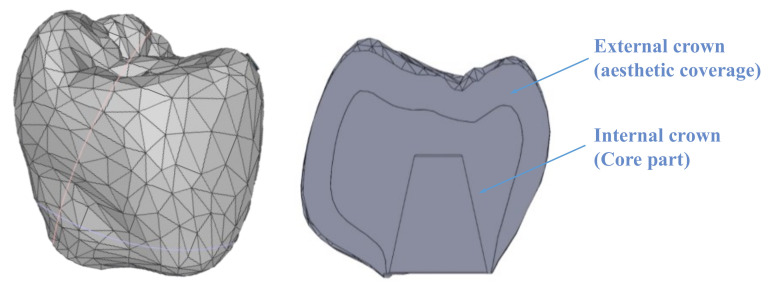
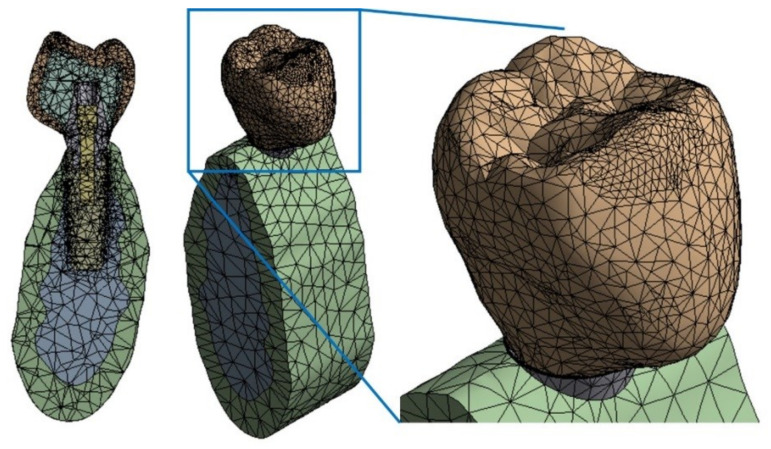
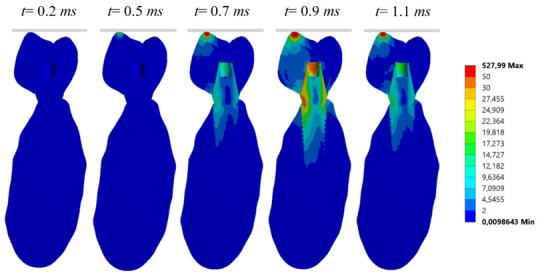
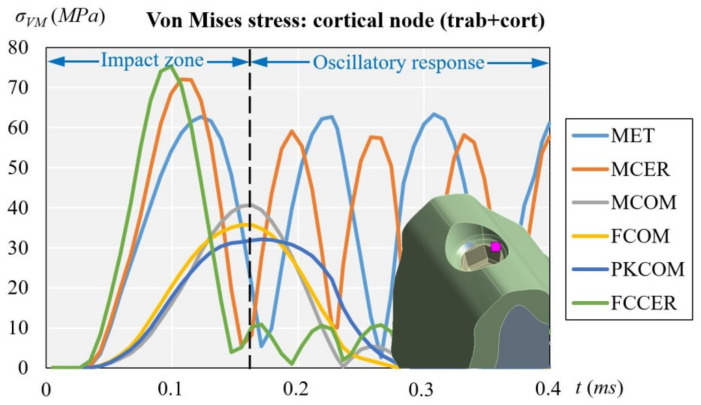
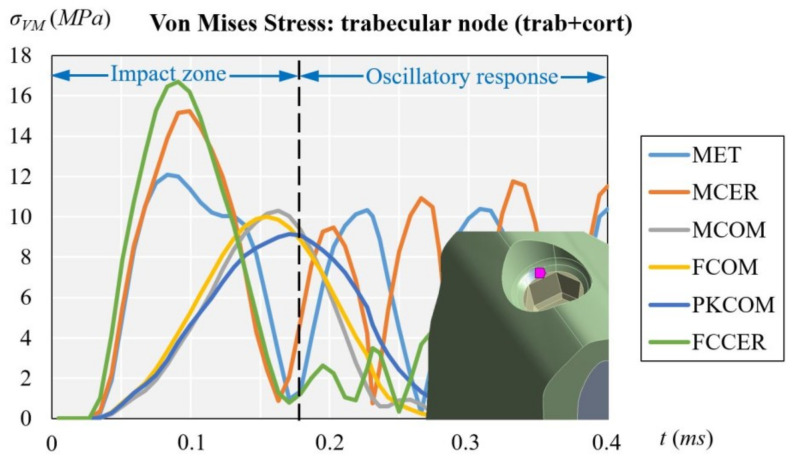
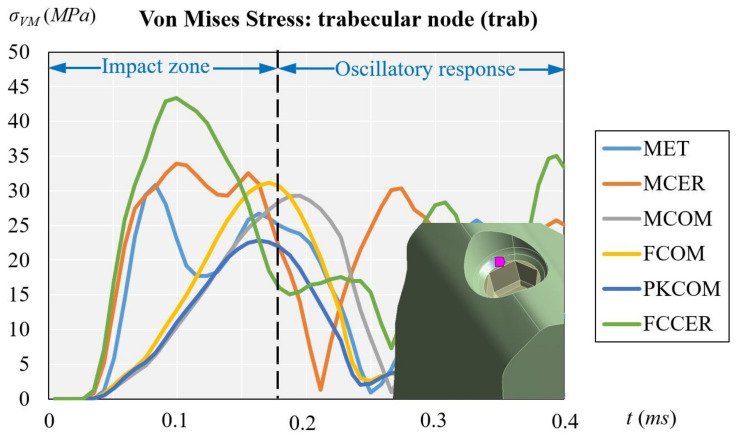
. Previous peri-implantitis, peri-implant bone regeneration, or immediate implant placement postextraction may be responsible for the absence of cortical bone. Single crown materials are then relevant when dynamic forces are transferred into bone tissue and, therefore, the presence (or absence) of cortical bone can affect the long-term survival of the implant. : the purpose of this study is to assess the biomechanical response of dental rehabilitation when selecting different crown materials in models with and without cortical bone. : several crown materials were considered for modeling six types of crown rehabilitation: full metal (MET), metal-ceramic (MCER), metal-composite (MCOM), peek-composite (PKCOM), carbon fiber-composite (FCOM), and carbon fiber-ceramic (FCCER). An impact-load dynamic finite-element analysis was carried out on all the 3D models of crowns mentioned above to assess their mechanical behavior against dynamic excitation. Implant-crown rehabilitation models with and without cortical bone were analyzed to compare how the load-impact actions affect both type of models. : numerical simulation results showed important differences in bone tissue stresses. The results show that flexible restorative materials reduce the stress on the bone and would be especially recommendable in the absence of cortical bone. : this study demonstrated that more stress is transferred to the bone when stiffer materials (metal and/or ceramic) are used in implant supported rehabilitations; conversely, more flexible materials transfer less stress to the implant connection. Also, in implant-supported rehabilitations, more stress is transferred to the bone by dynamic forces when cortical bone is absent.
先前存在的种植体周围炎、种植体周围骨再生或拔牙后即刻种植可能是皮质骨缺失的原因。当动态力传递到骨组织中时,单冠材料就显得至关重要,因此,皮质骨的存在(或缺失)会影响种植体的长期存活。本研究的目的是评估在有和没有皮质骨的模型中选择不同冠材料时牙齿修复的生物力学反应。考虑了几种冠材料来模拟六种类型的冠修复:全金属(MET)、金属陶瓷(MCER)、金属复合材料(MCOM)、聚醚醚酮复合材料(PKCOM)、碳纤维复合材料(FCOM)和碳纤维陶瓷(FCCER)。对上述所有冠的三维模型进行了冲击载荷动态有限元分析,以评估它们在动态激励下的力学行为。分析了有和没有皮质骨的种植体-冠修复模型,以比较载荷冲击作用如何影响这两种类型的模型。数值模拟结果显示骨组织应力存在重要差异。结果表明,柔性修复材料可降低骨头上的应力,在没有皮质骨的情况下尤其值得推荐。本研究表明,在种植体支持的修复中使用较硬的材料(金属和/或陶瓷)时,更多的应力会传递到骨头上;相反,较柔性的材料传递到种植体连接的应力较少。此外,在种植体支持的修复中,当没有皮质骨时,动态力会将更多的应力传递到骨头上。