Tichy Antonin, Simkova Marketa, Schweiger Josef, Bradna Pavel, Güth Jan-Frederik
Institute of Dental Medicine, First Faculty of Medicine, Charles University, General University Hospital, Karlovo Namesti 32, 121 11 Prague, Czech Republic.
Institute of Endocrinology, Narodni 139/8, 116 94 Prague, Czech Republic.
Materials (Basel). 2021 Oct 7;14(19):5868. doi: 10.3390/ma14195868.
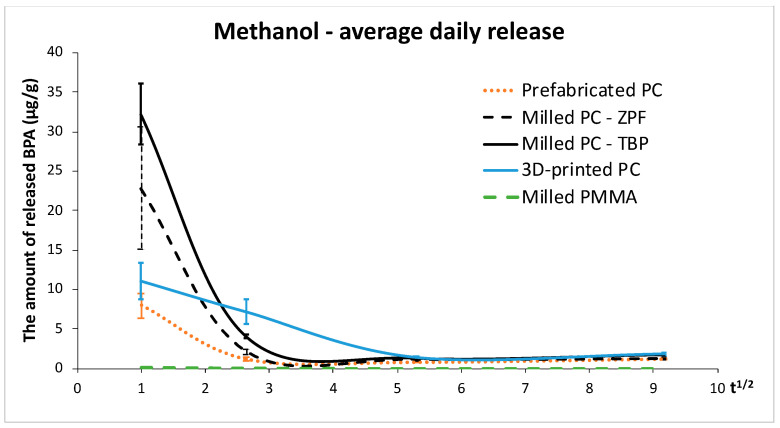
Polycarbonates are polymers of bisphenol A (BPA), a well-known endocrine disruptor. This study evaluated the release of BPA from polycarbonate crowns that were (1) milled from Temp Premium Flexible (ZPF, Zirkonzahn, Italy) or Tizian Blank Polycarbonate (TBP, Schütz Dental, Germany), or (2) 3D-printed (Makrolon 2805, Covestro, Germany). Commercial prefabricated polycarbonate crowns (3M, USA) and milled poly(methyl methacrylate) (PMMA) crowns (Temp Basic, Zirkonzahn, Italy) were included for comparison. The crowns were stored at 37 °C in artificial saliva (AS) or methanol, which represented the worst-case scenario of BPA release. Extracts were collected after 1 day, 1 week, 1 month and 3 months. BPA concentrations were measured using liquid chromatography-tandem mass spectrometry. The amounts of released BPA were expressed in micrograms per gram of material (μg/g). After 1 day, the highest amounts of BPA were measured from milled polycarbonates, TBP (methanol: 32.2 ± 3.8 μg/g, AS: 7.1 ± 0.9 μg/g) and ZPF (methanol 22.8 ± 7.7 μg/g, AS: 0.3 ± 0.03 μg/g), followed by 3D-printed crowns (methanol: 11.1 ± 2.3 μg/g, AS: 0.1 ± 0.1 μg/g) and prefabricated crowns (methanol: 8.0 ± 1.6 μg/g, AS: 0.07 ± 0.02 μg/g). Between 1 week and 3 months, the average daily release of BPA in methanol and AS decreased below 2 μg/g and 0.6 μg/g, respectively. No BPA was released from PMMA in AS, and the cumulative amount released in methanol was 0.2 ± 0.06 μg/g. In conclusion, polycarbonates could be a relevant source of BPA, but the current tolerable daily intake of BPA (4 μg/kg body weight) should not be exceeded.
聚碳酸酯是双酚A(BPA,一种著名的内分泌干扰物)的聚合物。本研究评估了双酚A从聚碳酸酯牙冠中的释放情况,这些聚碳酸酯牙冠分别为:(1)由Temp Premium Flexible(ZPF,意大利Zirkonzahn公司)或Tizian Blank聚碳酸酯(TBP,德国Schütz Dental公司)铣削而成,或(2)3D打印而成(德国科思创公司的模克隆2805)。研究纳入了市售预制聚碳酸酯牙冠(美国3M公司)和铣削而成的聚甲基丙烯酸甲酯(PMMA)牙冠(意大利Zirkonzahn公司的Temp Basic)作为对照。牙冠在37℃下保存在人工唾液(AS)或甲醇中,甲醇代表了双酚A释放的最坏情况。在1天、1周、1个月和3个月后收集提取物。使用双双使用液相色谱 - 串联质谱法测量双酚A浓度。释放的双酚A量以每克材料微克数(μg/g)表示。1天后,从铣削的聚碳酸酯、TBP(甲醇:32.2±3.8μg/g,人工唾液:7.1±0.9μg/g)和ZPF(甲醇22.8±7.7μg/g,人工唾液:0.3±0.03μg/g)中测得的双酚A量最高,其次是3D打印牙冠(甲醇:11.1±2.3μg/g,人工唾液:0.1±0.1μg/g)和预制牙冠(甲醇:8.0±1.6μg/g,人工唾液:0.07±0.02μg/g)。在1周和3个月之间,双酚A在甲醇和人工唾液中的日均释放量分别降至2μg/g和0.6μg/g以下。在人工唾液中PMMA未释放双酚A,在甲醇中累积释放量为0.2±0.06μg/g。总之,聚碳酸酯可能是双酚A的一个相关来源,但目前双酚A的每日可耐受摄入量(4μg/kg体重)不应被超过。