Kelm Detlev H, Toelch Ulf, Jones Mirkka M
Zoology 2, University of Erlangen-Nuremberg, Erlangen, Germany.
Leibniz-Institute for Zoo and Wildlife Research, Berlin, Germany.
Front Zool. 2021 Oct 12;18(1):53. doi: 10.1186/s12983-021-00437-6.
Mixed-species groups in animals have been shown to confer antipredator, foraging and other benefits to their members that may provide selective advantages. In most cases, however, it is unclear whether functional benefits are a principal driver of heterospecific groups, or whether groups simply result from simultaneous exploitation of common resources. Mixed-species groups that form independently of environmental conditions may, however, evidence direct benefits of species associations. Bats are among the most gregarious mammals, with sometimes thousands of individuals of various species roosting communally. Despite numerous potential functional benefits of such mixed-species roosting groups, interspecific attraction has never been shown. To explore alternative explanations for mixed-species roosting, we studied roost selection in a speciose neotropical understory bat community in lowland rainforest in Costa Rica. Long term roost data were recorded over 10 years in a total of 133 roosts comprising both natural roosts and structurally uniform artificial roosts. We modelled bat roost occupancy and abundance in each roost type and in forest and pasture habitats to quantify the effects of roost- and environmental variability.
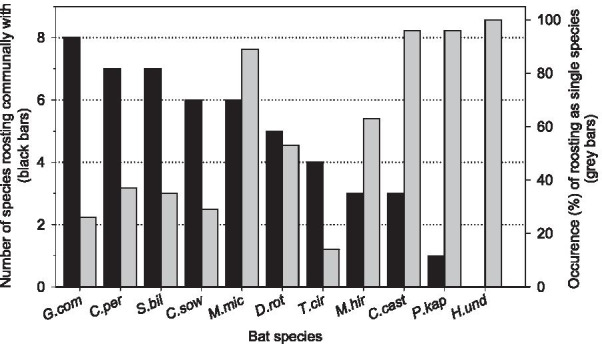
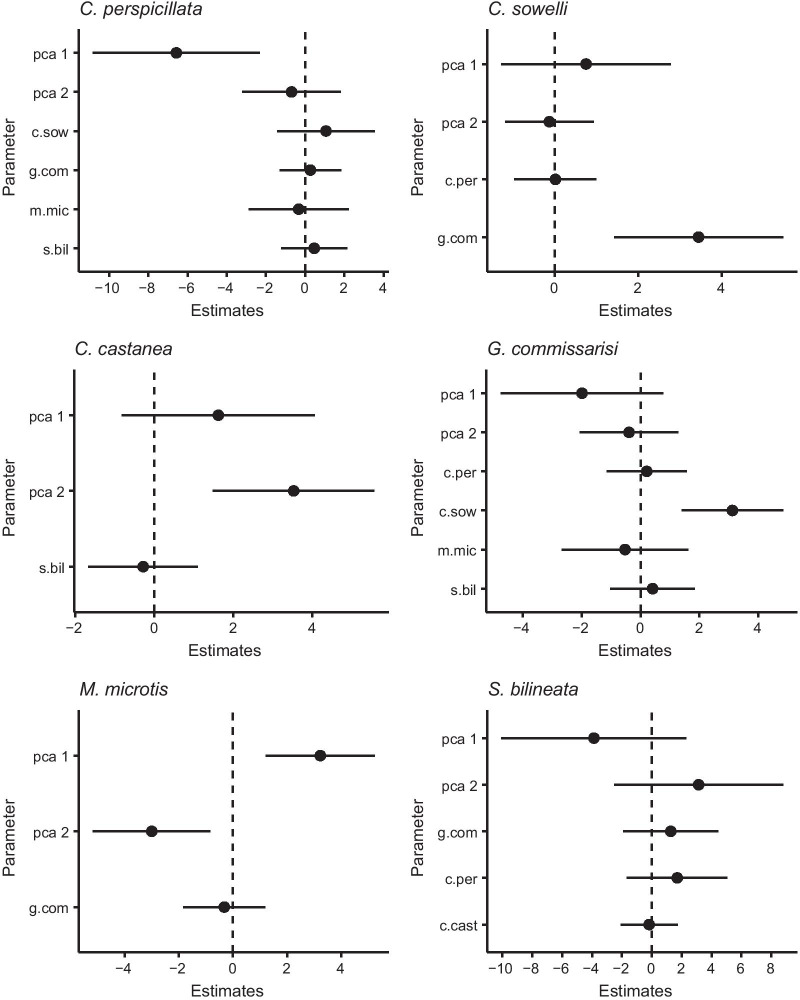
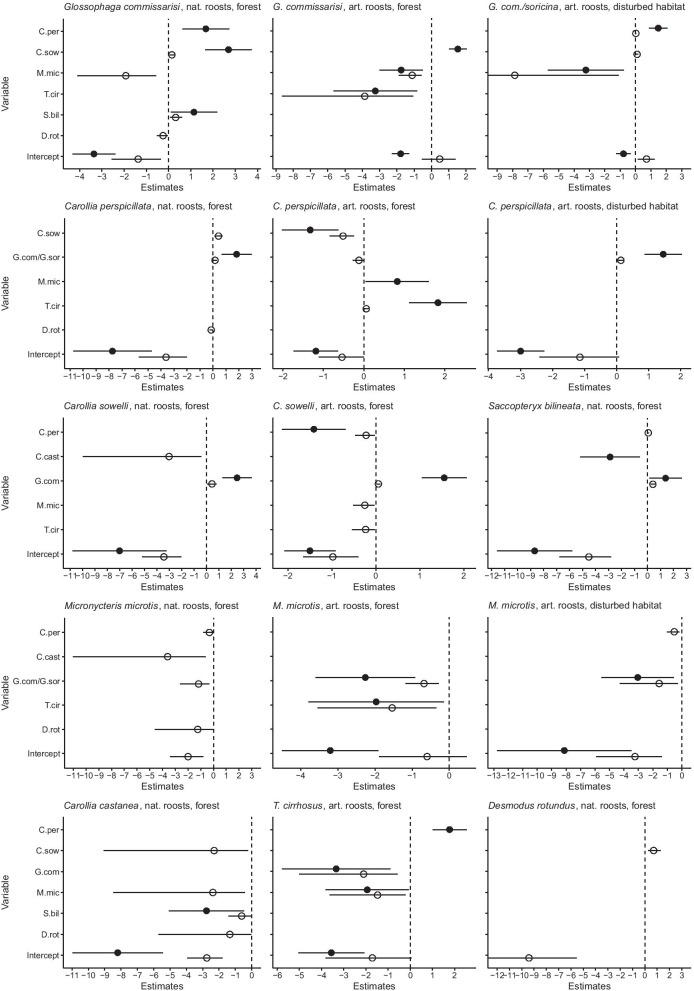
We found that bat species presence in natural roosts is predictable from habitat and structural roost parameters, but that the presence and abundance of other bat species further modifies roost choice. One third of the 12 study species were found to actively associate with selected other bat species in roosts (e.g. Glossophaga commissarisi with Carollia sowelli). Other species did not engage in communal roosting, which in some cases indicates a role for negative interspecific interactions, such as roost competition.
Mixed-species roosting may provide thermoregulatory benefits, reduce intraspecific competition and promote interspecific information transfer, and hence some heterospecific associations may be selected for in bats. Overall, our study contributes to an improved understanding of the array of factors that shape diverse tropical bat communities and drive the dynamics of heterospecific grouping in mammals more generally.
动物中的混合物种群体已被证明能为其成员带来反捕食、觅食等益处,这些益处可能提供选择优势。然而,在大多数情况下,尚不清楚功能益处是否是异种群体形成的主要驱动因素,或者群体是否仅仅是同时利用共同资源的结果。然而,独立于环境条件形成的混合物种群体可能证明了物种关联的直接益处。蝙蝠是最群居的哺乳动物之一,有时会有数千只不同物种的个体共同栖息。尽管这种混合物种栖息群体有许多潜在的功能益处,但种间吸引力从未得到证实。为了探索混合物种栖息的其他解释,我们研究了哥斯达黎加低地雨林中一个物种丰富的新热带林下层蝙蝠群落的栖息地选择。在10年时间里,我们记录了总共133个栖息地的长期栖息数据,这些栖息地包括自然栖息地和结构统一的人工栖息地。我们对每种栖息地类型以及森林和牧场栖息地中的蝙蝠栖息地占用情况和数量进行了建模,以量化栖息地和环境变异性的影响。
我们发现,根据栖息地和栖息地结构参数可以预测自然栖息地中蝙蝠物种的存在,但其他蝙蝠物种的存在和数量会进一步改变栖息地选择。在12个研究物种中,有三分之一被发现会在栖息地中与选定的其他蝙蝠物种积极关联(例如,康氏长舌蝠与索氏长耳蝠)。其他物种不进行群居栖息,在某些情况下,这表明种间负面相互作用(如栖息地竞争)发挥了作用。
混合物种栖息可能提供体温调节益处,减少种内竞争并促进种间信息传递,因此蝙蝠中可能会选择一些异种关联。总体而言,我们的研究有助于更好地理解塑造多样热带蝙蝠群落的一系列因素,并更广泛地推动哺乳动物异种群体形成的动态变化。