McMahon Taegan A, Fernandez-Denmark Shannon, Grim Jeffrey M
Department of Biology, University of Tampa, Tampa, FL, United States of America.
PLoS One. 2021 Oct 13;16(10):e0258185. doi: 10.1371/journal.pone.0258185. eCollection 2021.
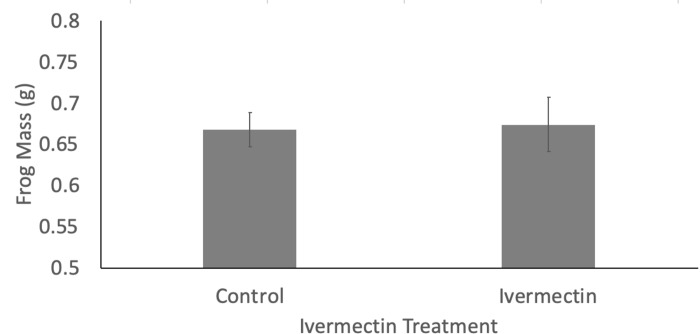
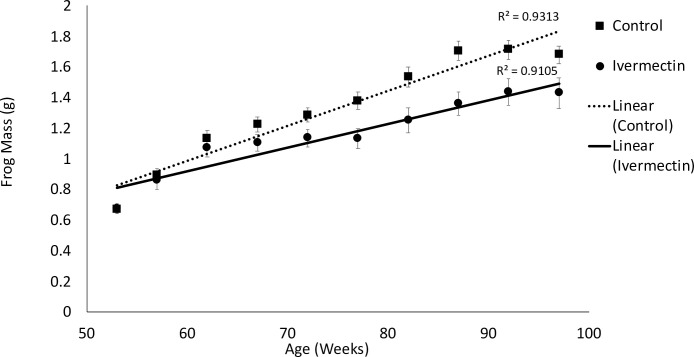
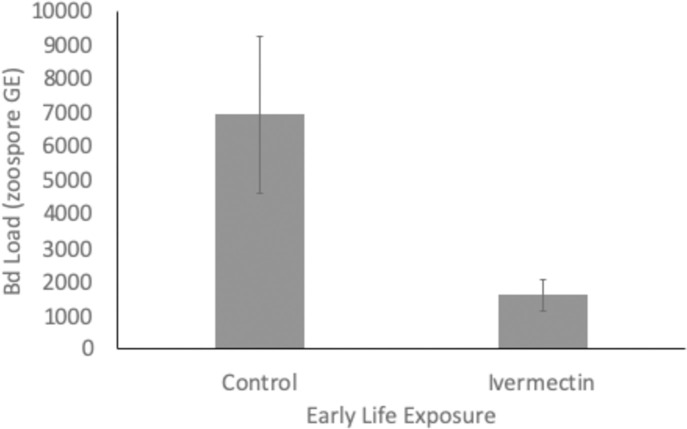
Ivermectin is a broad-spectrum antiparasitic medicine, which is often used as a treatment for parasites or as a prophylaxis. While studies have looked at the long-term effects of Ivermectin on helminths, studies have not considered the long-term impacts of this treatment on host health or disease susceptibility. Here, we tracked the effects of early life Ivermectin treatment in Cuban tree frogs (Osteopilus septentrionalis) on growth rates, mortality, metabolically expensive organ size, and susceptibility to Batrachochytrium dendrobatidis (Bd) infection. One year after exposure, there was no effect of Ivermectin exposure on frog mass (X21 = 0.904, p = 0.34), but when tracked through the exponential growth phase (~2.5 years) the Ivermectin exposed individuals had lower growth rates and were ultimately smaller (X21 = 7.78, p = 0.005; X21 = 5.36, p = 0.02, respectively). These results indicate that early life exposure is likely to have unintended impacts on organismal growth and potentially reproductive fitness. Additionally, we exposed frogs to Bd, a pathogenic fungus that has decimated amphibian populations globally, and found early life exposure to Ivermectin decreased disease susceptibility (disease load: X21 = 17.57, p = 0.0002) and prevalence (control: 55%; Ivermectin: 22%) over 2 years after exposure. More research is needed to understand the underlying mechanism behind this phenomenon. Given that Ivermectin exposure altered disease susceptibility, proper controls should be implemented when utilizing this drug as an antiparasitic treatment in research studies.
伊维菌素是一种广谱抗寄生虫药物,常用于治疗寄生虫或作为预防用药。虽然已有研究关注伊维菌素对蠕虫的长期影响,但尚未考虑这种治疗方法对宿主健康或疾病易感性的长期影响。在此,我们追踪了古巴树蛙(Osteopilus septentrionalis)幼年期接受伊维菌素治疗对其生长速率、死亡率、代谢成本高昂的器官大小以及感染蛙壶菌(Batrachochytrium dendrobatidis,Bd)易感性的影响。暴露一年后,伊维菌素暴露对蛙的体重没有影响(χ²₁ = 0.904,p = 0.34),但在追踪其指数生长期(约2.5年)时,接受伊维菌素治疗的个体生长速率较低,最终体型较小(χ²₁分别为7.78,p = 0.005;χ²₁为5.36,p = 0.02)。这些结果表明,幼年期暴露可能会对生物体的生长以及潜在的繁殖适应性产生意外影响。此外,我们让青蛙接触蛙壶菌,这种致病性真菌已使全球两栖动物数量大幅减少,结果发现幼年期接触伊维菌素可降低暴露后两年的疾病易感性(疾病负荷:χ²₁ = 17.57,p = 0.0002)和患病率(对照组:55%;伊维菌素组:22%)。需要更多研究来了解这一现象背后的潜在机制。鉴于伊维菌素暴露改变了疾病易感性,在研究中将这种药物用作抗寄生虫治疗时应实施适当的对照措施。