From the Department of Psychiatry and Behavioral Sciences (L. Sikich, M.S., T.C., C.A., A.S.), the Duke Clinical Research Institute (L. Sikich, C.A., S.L., L. She, M.B.), the Duke Molecular Physiology Institute (S.K.S., S.N.G., S.G.G.), and the Departments of Biostatistics and Bioinformatics (S.L.) and Neurology (S.G.G.), Duke University, Durham, the Department of Psychiatry, University of North Carolina at Chapel Hill, Chapel Hill (L. Sikich, M.S., T.C., C.A., R.D., A.S., J.L.J.), and SAS Institute, Cary (J.L.J.) - all in North Carolina; the Department of Psychiatry, Icahn School of Medicine at Mount Sinai (A.K., M.D.P.T., P.S., J.W.), the Department of Psychiatry, Columbia University (A.M., L.C.S., N.H., J.V.-V.), and New York State Psychiatric Institute (J.V.-V.), New York, and the Center for Autism and the Developing Brain, Weill Cornell Medicine, White Plains (J.V.-V.) - all in New York; the Department of Psychiatry, University of California San Francisco, San Francisco (B.H.K.); the Department of Psychiatry, Seattle Children's Hospital and the University of Washington, Seattle (B.H.K., S.-J.K., C.M.R., M.M., B.Z.); the Department of Psychiatry, Massachusetts General Hospital and Harvard Medical School, Boston (C.J.M., M.L.P., L.A.N., J.E.M.), and the Lurie Center for Autism, Lexington (C.J.M., M.L.P., L.A.N., J.E.M.) - all in Massachusetts; Hoffmann-La Roche, Basel, Switzerland (K.B.S.); the Department of Psychiatry, Vanderbilt University, Nashville (K.B.S., A.W.C., S.M., H.C.); the University of New South Wales, Sydney (A.M.); and Florida International University, Miami (N.H.).
N Engl J Med. 2021 Oct 14;385(16):1462-1473. doi: 10.1056/NEJMoa2103583.
Experimental studies and small clinical trials have suggested that treatment with intranasal oxytocin may reduce social impairment in persons with autism spectrum disorder. Oxytocin has been administered in clinical practice to many children with autism spectrum disorder.
We conducted a 24-week, placebo-controlled phase 2 trial of intranasal oxytocin therapy in children and adolescents 3 to 17 years of age with autism spectrum disorder. Participants were randomly assigned in a 1:1 ratio, with stratification according to age and verbal fluency, to receive oxytocin or placebo, administered intranasally, with a total target dose of 48 international units daily. The primary outcome was the least-squares mean change from baseline on the Aberrant Behavior Checklist modified Social Withdrawal subscale (ABC-mSW), which includes 13 items (scores range from 0 to 39, with higher scores indicating less social interaction). Secondary outcomes included two additional measures of social function and an abbreviated measure of IQ.
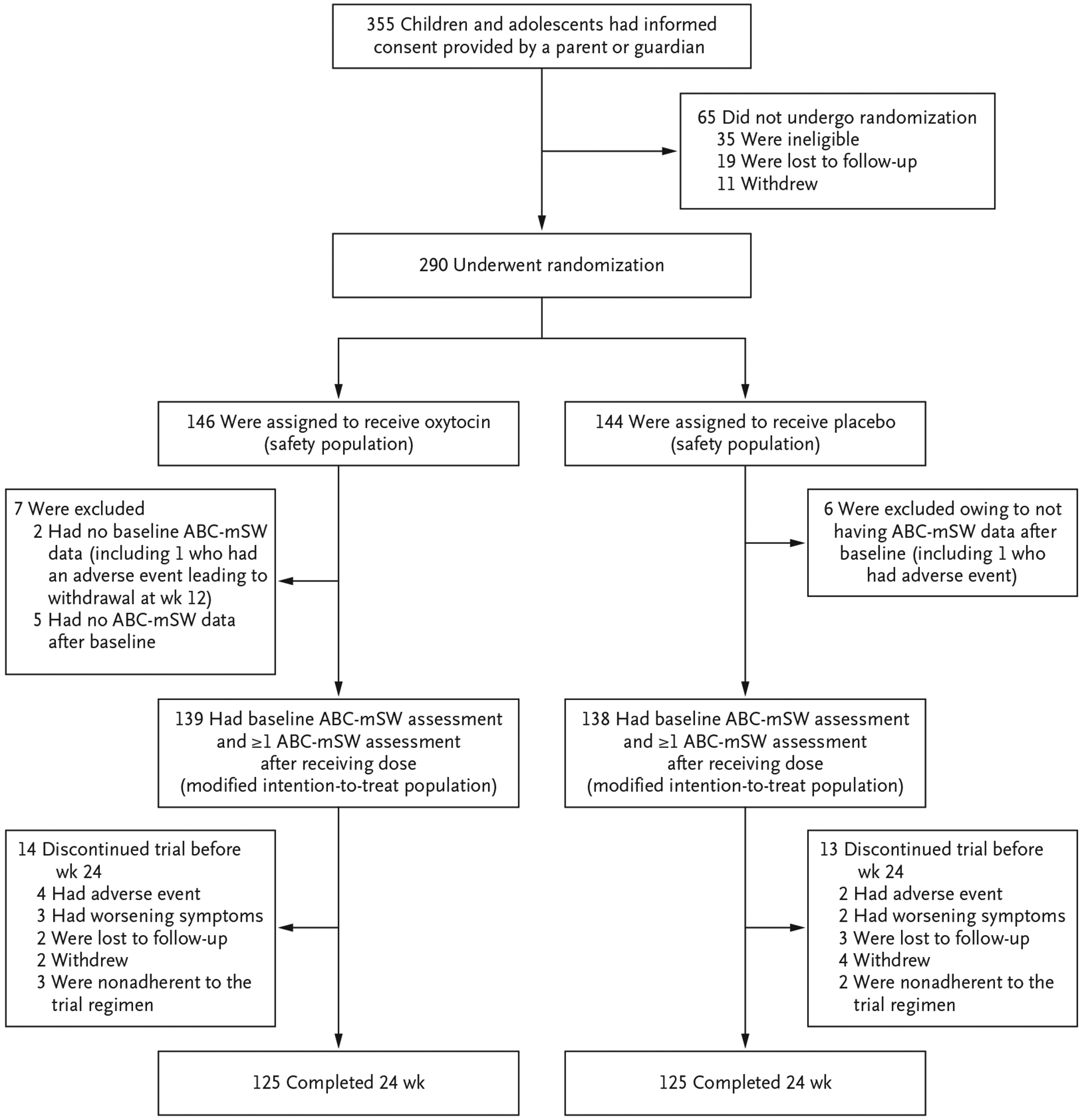
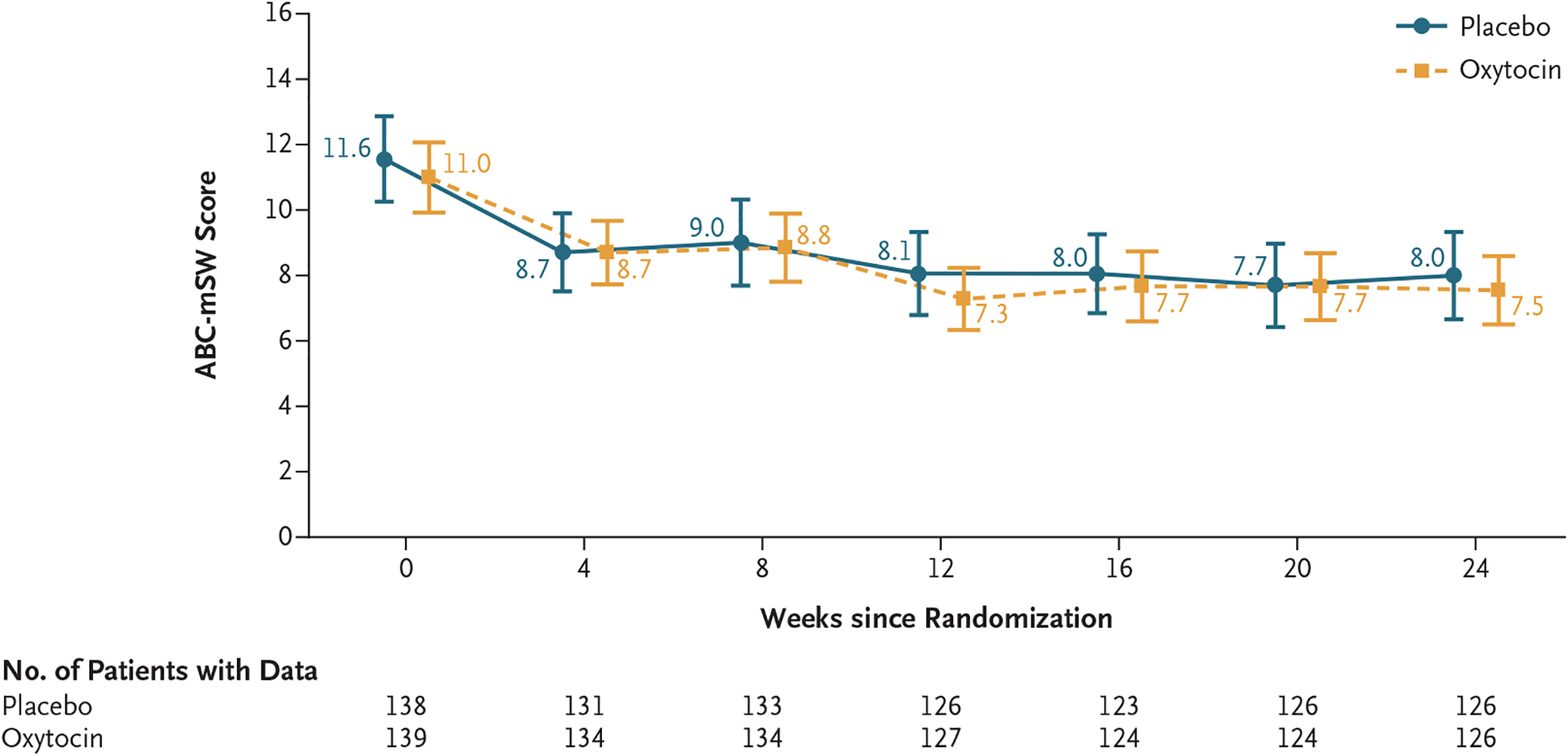
Of the 355 children and adolescents who underwent screening, 290 were enrolled. A total of 146 participants were assigned to the oxytocin group and 144 to the placebo group; 139 and 138 participants, respectively, completed both the baseline and at least one postbaseline ABC-mSW assessments and were included in the modified intention-to-treat analyses. The least-squares mean change from baseline in the ABC-mSW score (primary outcome) was -3.7 in the oxytocin group and -3.5 in the placebo group (least-squares mean difference, -0.2; 95% confidence interval, -1.5 to 1.0; P = 0.61). Secondary outcomes generally did not differ between the trial groups. The incidence and severity of adverse events were similar in the two groups.
This placebo-controlled trial of intranasal oxytocin therapy in children and adolescents with autism spectrum disorder showed no significant between-group differences in the least-squares mean change from baseline on measures of social or cognitive functioning over a period of 24 weeks. (Funded by the National Institute of Child Health and Human Development; SOARS-B ClinicalTrials.gov number, NCT01944046.).
实验研究和小型临床试验表明,鼻内给予催产素治疗可能会减轻自闭症谱系障碍患者的社交障碍。催产素已在临床实践中用于许多自闭症谱系障碍儿童。
我们开展了一项为期 24 周、安慰剂对照的 2 期临床试验,评估了鼻内给予催产素治疗 3 至 17 岁自闭症谱系障碍儿童和青少年的效果。参与者以 1:1 的比例随机分组,按年龄和语言流畅性分层,接受鼻内给予催产素或安慰剂治疗,每日总目标剂量为 48 个国际单位。主要结局是从基线到自闭症行为量表改良社交回避分量表(ABC-mSW)的最小二乘均数变化,该量表包括 13 个条目(评分范围为 0 至 39,得分越高表示社交互动越少)。次要结局包括另外两项社交功能测量指标和一项简短的智商测量指标。
在 355 名接受筛查的儿童和青少年中,有 290 名入组。共有 146 名参与者被分配到催产素组,144 名参与者被分配到安慰剂组;分别有 139 名和 138 名参与者完成了基线和至少一次基线后 ABC-mSW 评估,并被纳入改良意向治疗分析。催产素组从基线到 ABC-mSW 评分的最小二乘均数变化(主要结局)为-3.7,安慰剂组为-3.5(最小二乘均数差值,-0.2;95%置信区间,-1.5 至 1.0;P=0.61)。次要结局在试验组之间通常没有差异。两组的不良事件发生率和严重程度相似。
这项在自闭症谱系障碍儿童和青少年中开展的鼻内给予催产素治疗的安慰剂对照试验显示,在 24 周的时间内,两组在社交或认知功能测量指标的从基线到最小二乘均数变化上没有显著差异。(由国家儿童健康与人类发育研究所资助;SOARS-B 临床试验.gov 编号,NCT01944046)。