Department of Bioengineering and Therapeutic Sciences, University of California San Francisco, San Francisco, CA, USA.
Quantitative Biosciences Institute (QBI), University of California San Francisco, San Francisco, CA, USA.
Nature. 2021 Nov;599(7883):152-157. doi: 10.1038/s41586-021-03982-6. Epub 2021 Oct 13.
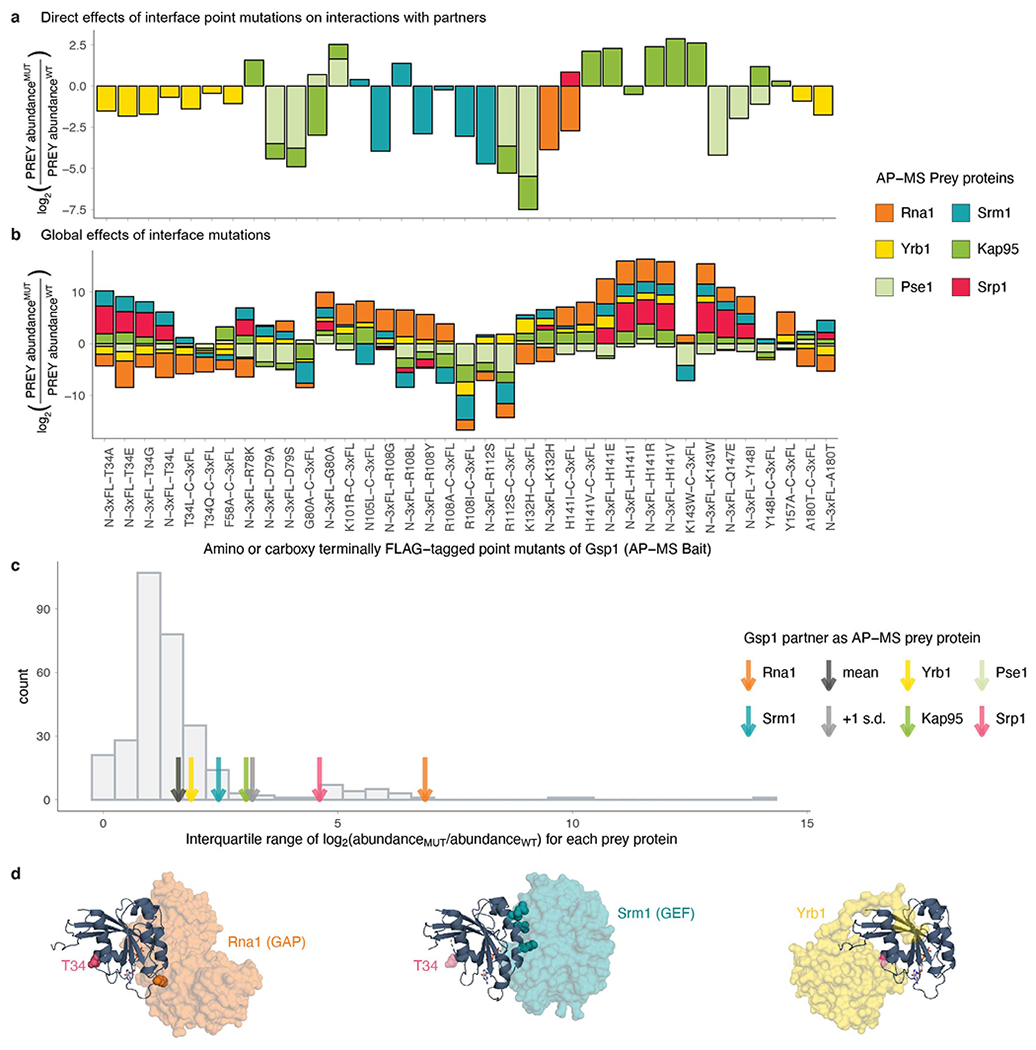
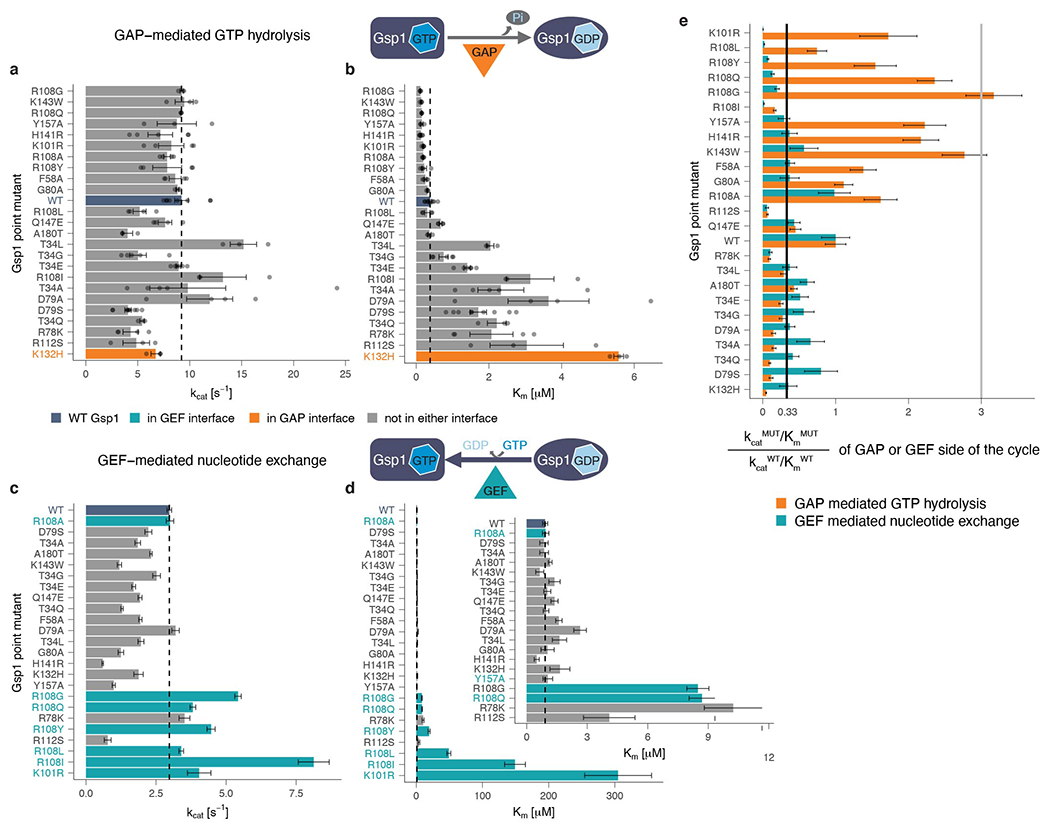
Molecular switch proteins whose cycling between states is controlled by opposing regulators are central to biological signal transduction. As switch proteins function within highly connected interaction networks, the fundamental question arises of how functional specificity is achieved when different processes share common regulators. Here we show that functional specificity of the small GTPase switch protein Gsp1 in Saccharomyces cerevisiae (the homologue of the human protein RAN) is linked to differential sensitivity of biological processes to different kinetics of the Gsp1 (RAN) switch cycle. We make 55 targeted point mutations to individual protein interaction interfaces of Gsp1 (RAN) and show through quantitative genetic and physical interaction mapping that Gsp1 (RAN) interface perturbations have widespread cellular consequences. Contrary to expectation, the cellular effects of the interface mutations group by their biophysical effects on kinetic parameters of the GTPase switch cycle and not by the targeted interfaces. Instead, we show that interface mutations allosterically tune the GTPase cycle kinetics. These results suggest a model in which protein partner binding, or post-translational modifications at distal sites, could act as allosteric regulators of GTPase switching. Similar mechanisms may underlie regulation by other GTPases, and other biological switches. Furthermore, our integrative platform to determine the quantitative consequences of molecular perturbations may help to explain the effects of disease mutations that target central molecular switches.
分子开关蛋白的状态循环受相反调节剂控制,是生物信号转导的核心。由于开关蛋白在高度连接的相互作用网络中发挥作用,因此出现了一个基本问题,即当不同的过程共享共同的调节剂时,如何实现功能特异性。在这里,我们表明酿酒酵母(人类蛋白 RAN 的同源物)中的小 GTP 酶开关蛋白 Gsp1 的功能特异性与 Gsp1(RAN)开关循环的不同动力学对不同生物过程的敏感性有关。我们对 Gsp1(RAN)的单个蛋白质相互作用界面进行了 55 次靶向点突变,并通过定量遗传学和物理相互作用图谱显示,Gsp1(RAN)界面扰动对细胞有广泛的影响。与预期相反,界面突变根据它们对 GTP 酶开关循环动力学参数的生物物理影响而不是针对的界面分组,具有细胞效应。相反,我们表明界面突变变构调节 GTP 酶循环动力学。这些结果表明,蛋白伴侣结合或远端位点的翻译后修饰可能作为 GTP 酶开关的别构调节剂。类似的机制可能是其他 GTP 酶和其他生物开关调节的基础。此外,我们确定分子扰动的定量后果的综合平台可能有助于解释针对中央分子开关的疾病突变的影响。