Ješeta Michal, Navrátilová Jana, Franzová Kateřina, Fialková Sandra, Kempisty Bartozs, Ventruba Pavel, Žáková Jana, Crha Igor
Department of Obstetrics and Gynecology, Faculty of Medicine Masaryk University and University Hospital Brno, Brno, Czechia.
Department of Veterinary Sciences, Czech University of Life Sciences Prague, Prague, Czechia.
Front Genet. 2021 Sep 27;12:692897. doi: 10.3389/fgene.2021.692897. eCollection 2021.
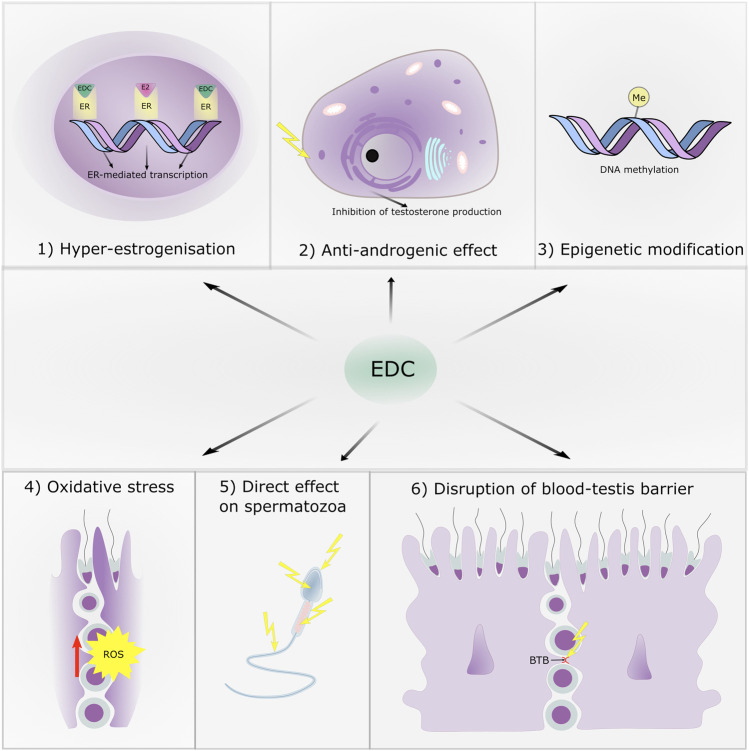
Male fertility has been deteriorating worldwide for considerable time, with the greatest deterioration recorded mainly in the United States, Europe countries, and Australia. That is, especially in countries where an abundance of chemicals called endocrine disruptors has repeatedly been reported, both in the environment and in human matrices. Human exposure to persistent and non-persistent chemicals is ubiquitous and associated with endocrine-disrupting effects. This group of endocrine disrupting chemicals (EDC) can act as agonists or antagonists of hormone receptors and can thus significantly affect a number of physiological processes. It can even negatively affect human reproduction with an impact on the development of gonads and gametogenesis, fertilization, and the subsequent development of embryos. The negative effects of endocrine disruptors on sperm gametogenesis and male fertility in general have been investigated and repeatedly demonstrated in experimental and epidemiological studies. Male reproduction is affected by endocrine disruptors via their effect on testicular development, impact on estrogen and androgen receptors, potential epigenetic effect, production of reactive oxygen species or direct effect on spermatozoa and other cells of testicular tissue. Emerging scientific evidence suggests that the increasing incidence of male infertility is associated with the exposure to persistent and non-persistent endocrine-disrupting chemicals such as bisphenols and perfluoroalkyl chemicals (PFAS). These chemicals may impact men's fertility through various mechanisms. This study provides an overview of the mechanisms of action common to persistent (PFAS) and nonpersistent (bisphenols) EDC on male fertility.
在全球范围内,男性生育能力下降已有相当长一段时间,其中下降最为明显的主要是在美国、欧洲国家和澳大利亚。也就是说,特别是在那些环境和人体样本中多次报告存在大量被称为内分泌干扰物的化学物质的国家。人类接触持久性和非持久性化学物质的情况普遍存在,且与内分泌干扰效应有关。这类内分泌干扰化学物质(EDC)可作为激素受体的激动剂或拮抗剂,从而可显著影响许多生理过程。它甚至会对人类生殖产生负面影响,影响性腺发育、配子发生、受精以及随后的胚胎发育。内分泌干扰物对精子配子发生和一般男性生育能力的负面影响已在实验和流行病学研究中得到调查并反复证实。男性生殖受到内分泌干扰物的影响,是通过它们对睾丸发育的作用、对雌激素和雄激素受体的影响、潜在的表观遗传效应、活性氧的产生或对精子及睾丸组织其他细胞的直接作用。新出现的科学证据表明,男性不育发病率的上升与接触持久性和非持久性内分泌干扰化学物质(如双酚和全氟烷基化合物(PFAS))有关。这些化学物质可能通过多种机制影响男性生育能力。本研究概述了持久性(PFAS)和非持久性(双酚)EDC对男性生育能力的共同作用机制。