Yu Yeuni, Sung Soon Ki, Lee Chi Hyung, Ha Mihyang, Kang Junho, Kwon Eun Jung, Kang Ji Wan, Kim Youngjoo, Kim Ga Hyun, Heo Hye Jin, Lee Hansong, Kim Tae Woo, Lee Yoonsung, Myung Kyungjae, Oh Chang-Kyu, Kim Yun Hak
Department of Biomedical Informatics, School of Medicine, Pusan National University, Busan, South Korea.
Department of Neurosurgery, Pusan National University Yangsan Hospital, Yangsan, South Korea.
Front Genet. 2021 Sep 27;12:743786. doi: 10.3389/fgene.2021.743786. eCollection 2021.
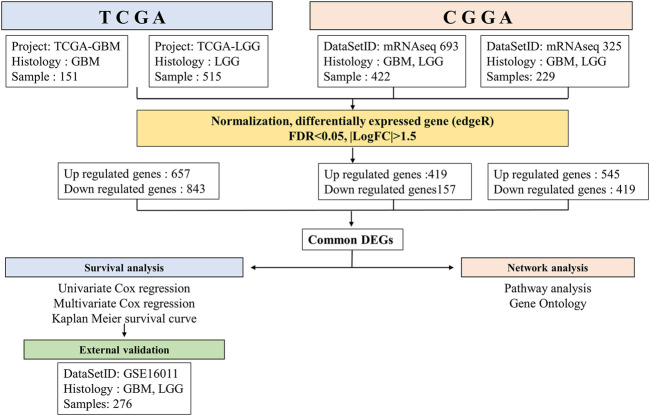
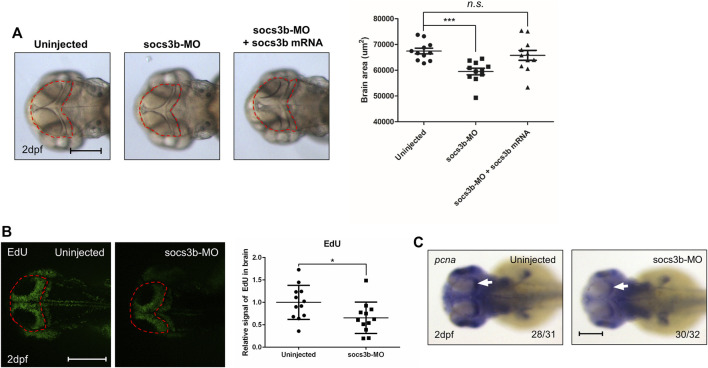
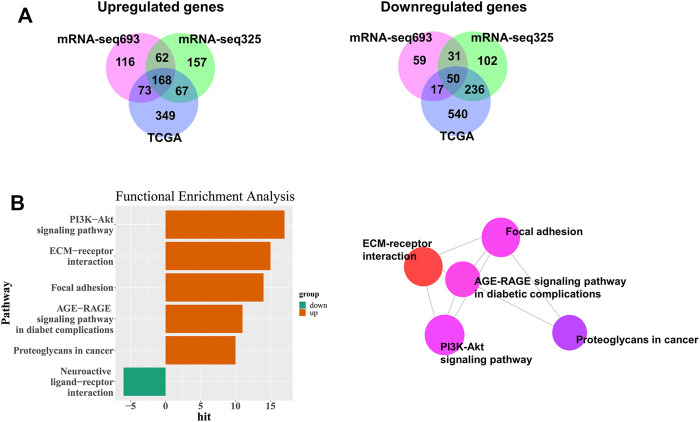
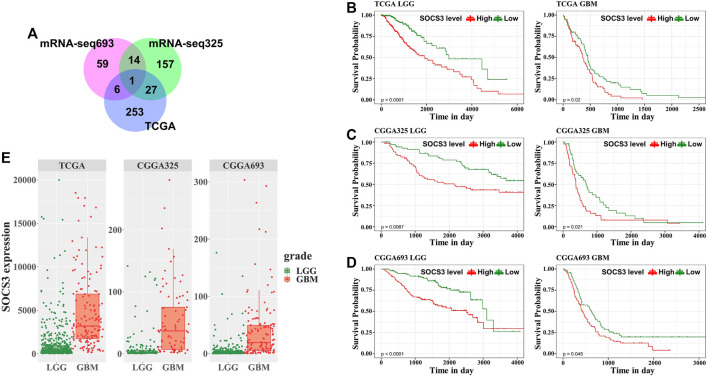
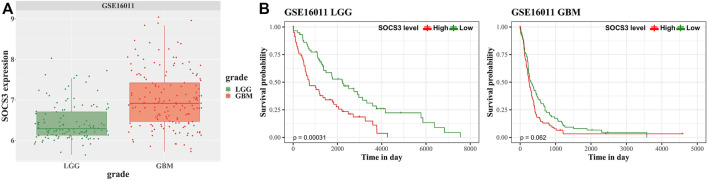
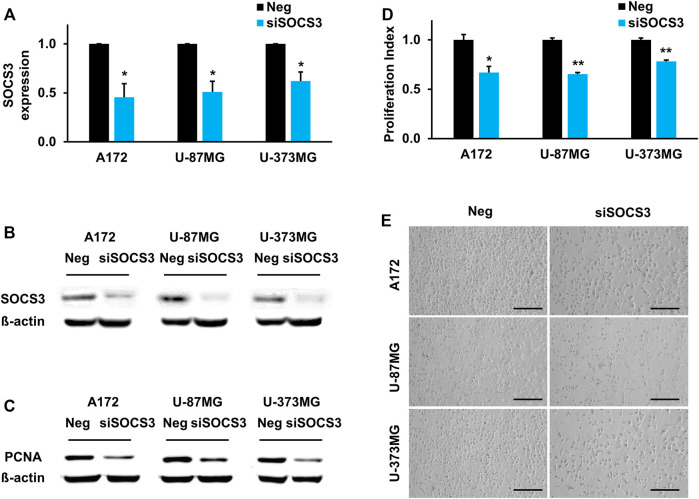
Glioma is the most common primary malignant tumor that occurs in the central nervous system. Gliomas are subdivided according to a combination of microscopic morphological, molecular, and genetic factors. Glioblastoma (GBM) is the most aggressive malignant tumor; however, efficient therapies or specific target molecules for GBM have not been developed. We accessed RNA-seq and clinical data from The Cancer Genome Atlas, the Chinese Glioma Genome Atlas, and the GSE16011 dataset, and identified differentially expressed genes (DEGs) that were common to both GBM and lower-grade glioma (LGG) in three independent cohorts. The biological functions of common DEGs were examined using NetworkAnalyst. To evaluate the prognostic performance of common DEGs, we performed Kaplan-Meier and Cox regression analyses. We investigated the function of SOCS3 in the central nervous system using three GBM cell lines as well as zebrafish embryos. There were 168 upregulated genes and 50 downregulated genes that were commom to both GBM and LGG. Through survival analyses, we found that SOCS3 was the only prognostic gene in all cohorts. Inhibition of SOCS3 using siRNA decreased the proliferation of GBM cell lines. We also found that the zebrafish ortholog, socs3b, was associated with brain development through the regulation of cell proliferation in neuronal tissue. While additional mechanistic studies are necessary, our results suggest that SOCS3 is an important biomarker for glioma and that SOCS3 is related to the proliferation of neuronal tissue.
胶质瘤是中枢神经系统中最常见的原发性恶性肿瘤。胶质瘤根据微观形态、分子和遗传因素的组合进行细分。胶质母细胞瘤(GBM)是最具侵袭性的恶性肿瘤;然而,尚未开发出针对GBM的有效治疗方法或特异性靶分子。我们获取了来自癌症基因组图谱、中国胶质瘤基因组图谱和GSE16011数据集的RNA测序和临床数据,并在三个独立队列中鉴定出GBM和低级别胶质瘤(LGG)共有的差异表达基因(DEG)。使用NetworkAnalyst检查共有的DEG的生物学功能。为了评估共有的DEG的预后性能,我们进行了Kaplan-Meier和Cox回归分析。我们使用三种GBM细胞系以及斑马鱼胚胎研究了SOCS3在中枢神经系统中的功能。GBM和LGG共有168个上调基因和50个下调基因。通过生存分析,我们发现SOCS3是所有队列中唯一的预后基因。使用小干扰RNA抑制SOCS3可降低GBM细胞系的增殖。我们还发现斑马鱼直系同源基因socs3b通过调节神经元组织中的细胞增殖与脑发育相关。虽然还需要更多的机制研究,但我们的结果表明SOCS3是胶质瘤的重要生物标志物,并且SOCS3与神经元组织的增殖有关。