Department of Chemical and Biomolecular Engineering, University of Pennsylvania, Philadelphia, Pennsylvania 19104, United States.
Department of Cell and Developmental Biology, University of Pennsylvania, Philadelphia, Pennsylvania 19104, United States.
Biochemistry. 2021 Oct 26;60(42):3137-3151. doi: 10.1021/acs.biochem.1c00373. Epub 2021 Oct 14.
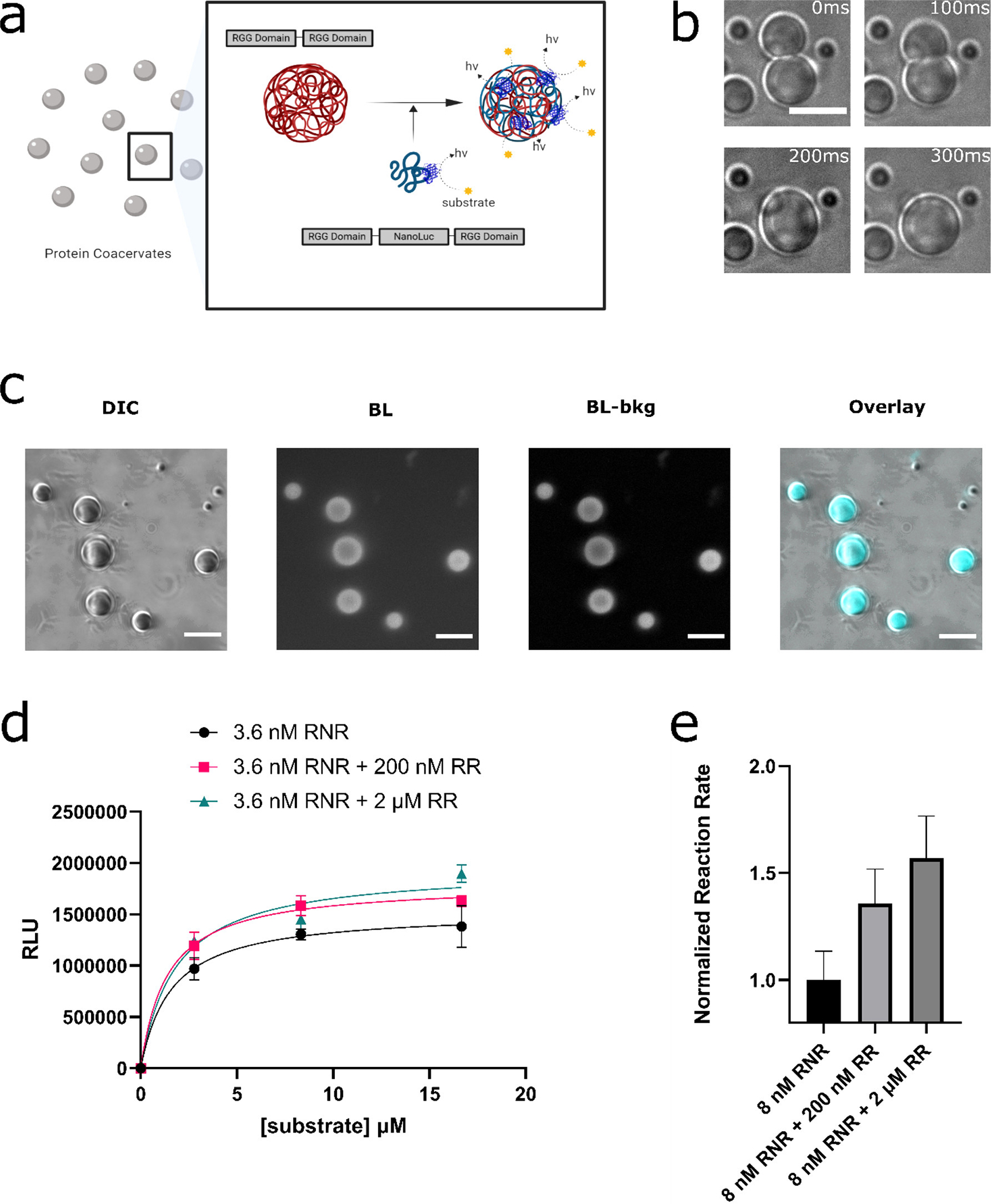
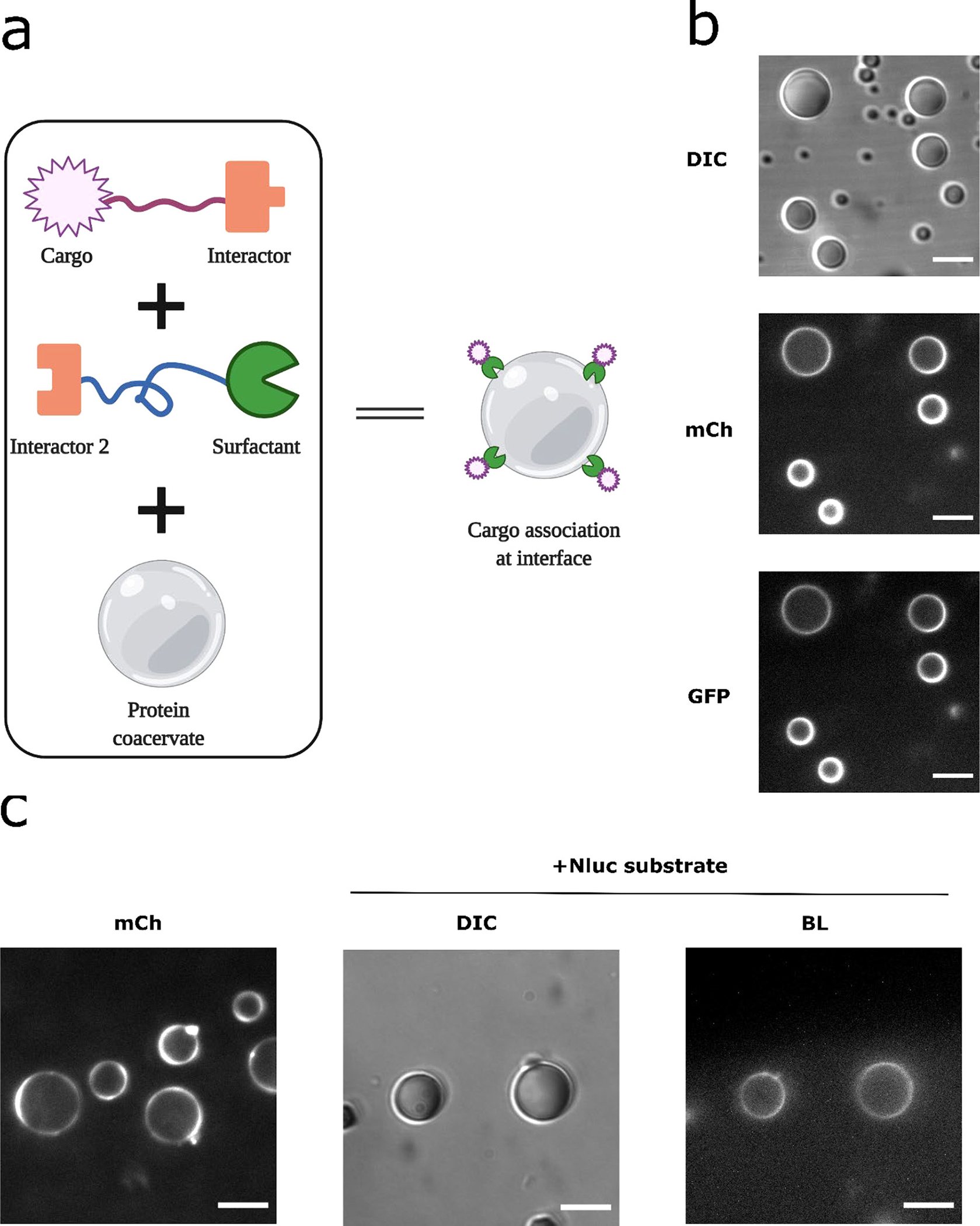
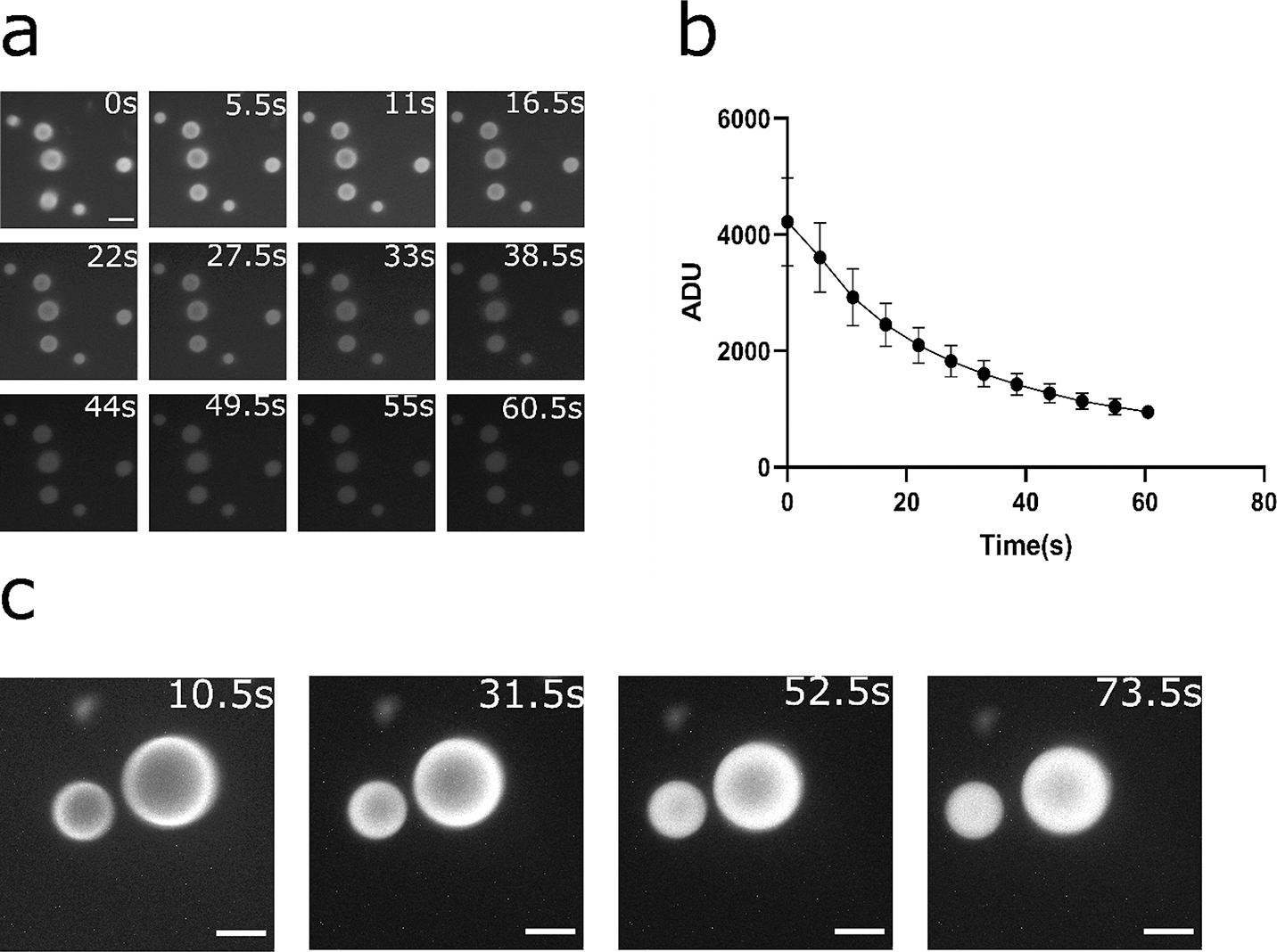
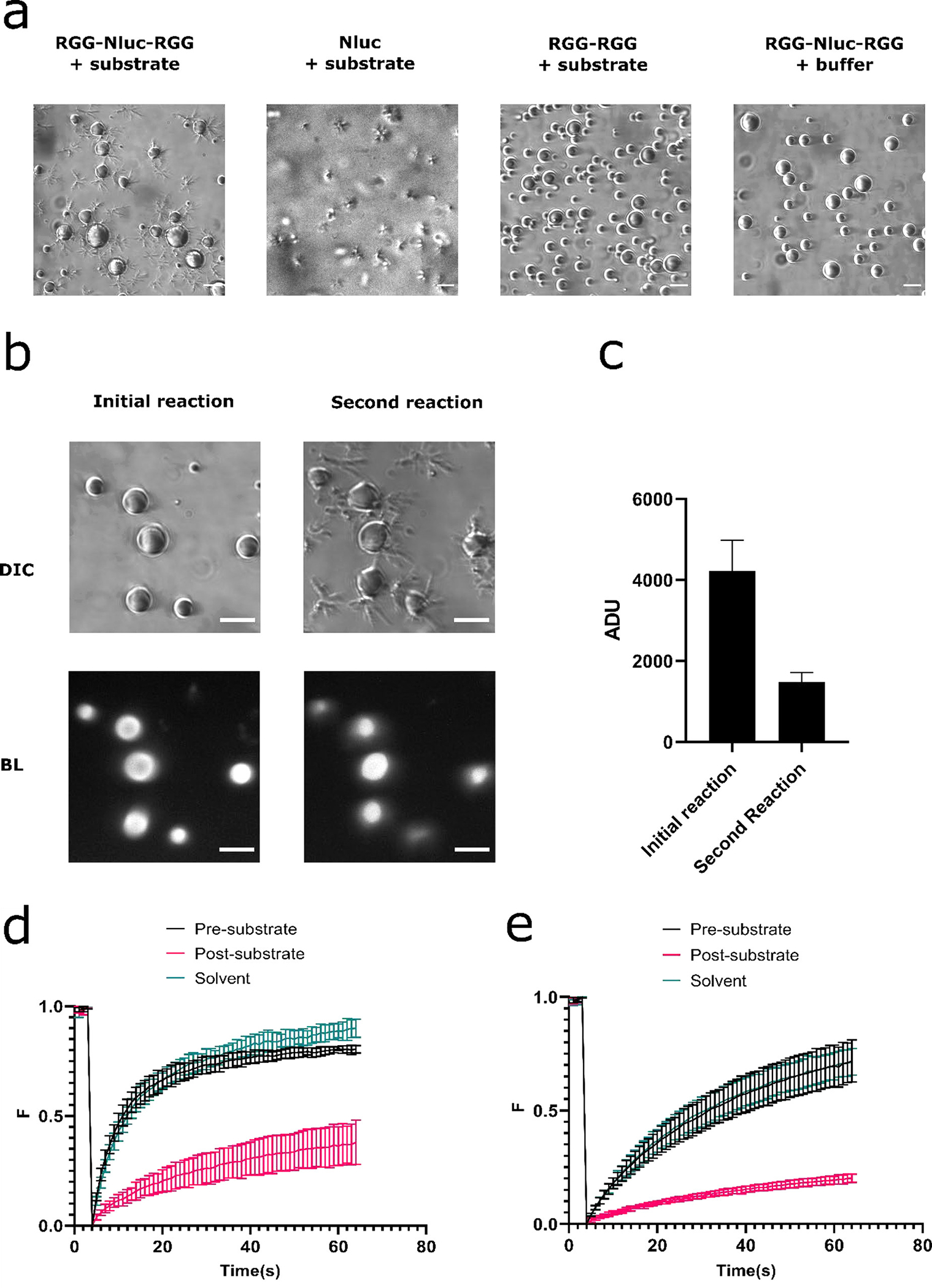
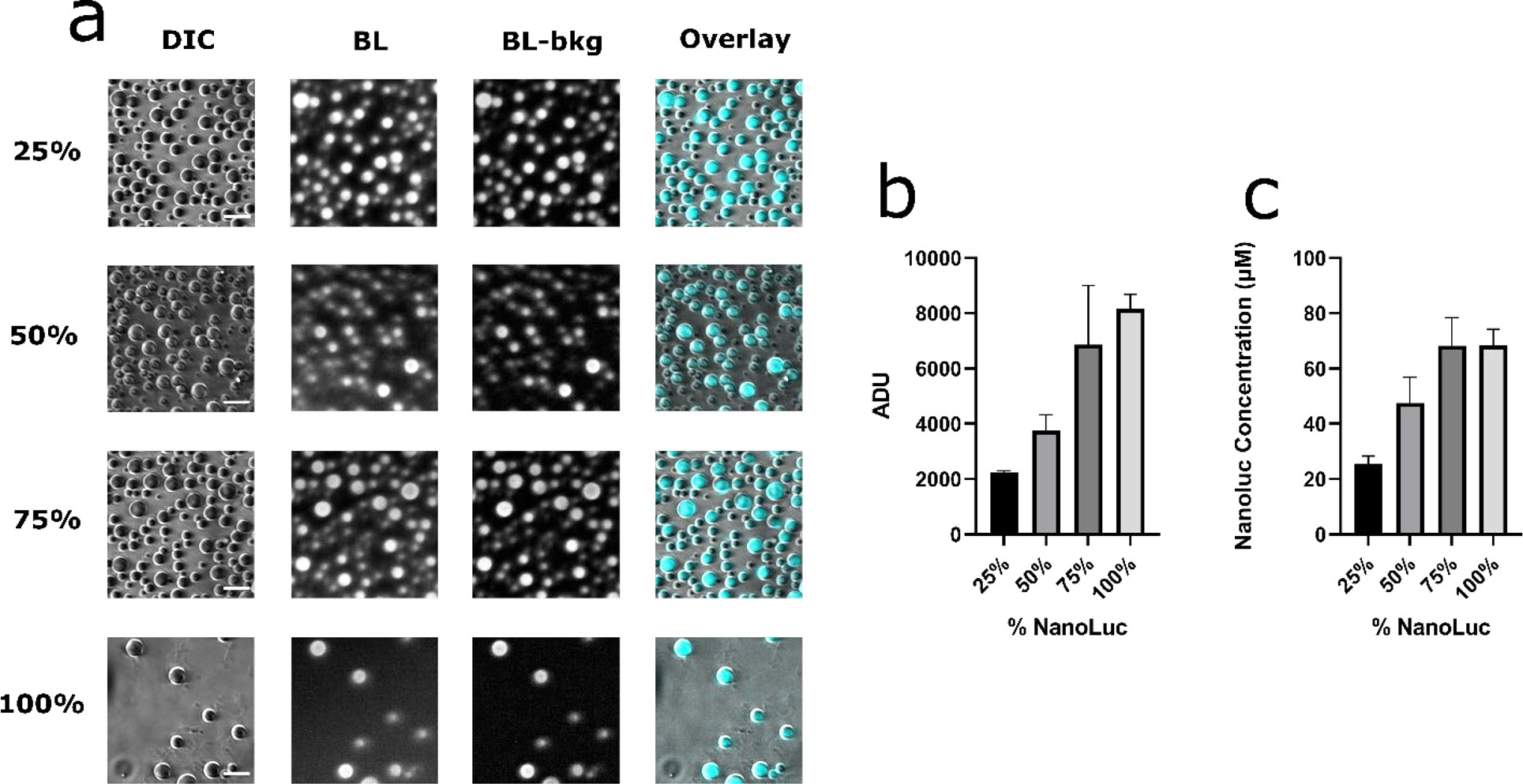
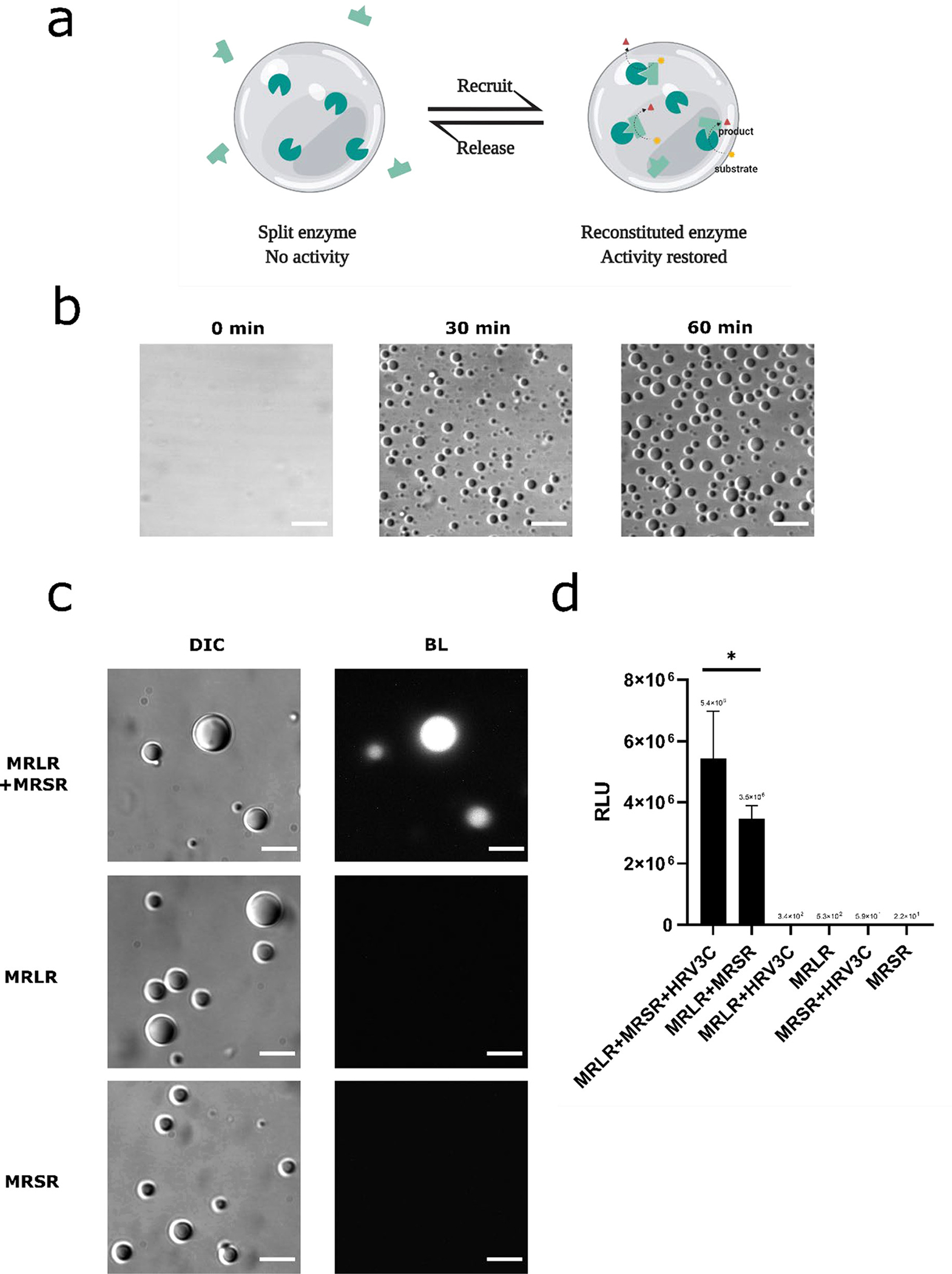
Eukaryotic cells partition enzymes and other cellular components into distinct subcellular compartments to generate specialized biochemical niches. A subclass of these compartments form in the absence of lipid membranes, via liquid-liquid phase separation of proteins to form biomolecular condensates or "membraneless organelles" such as nucleoli, stress granules, and P-bodies. Because of their propensity to form compartments from simple starting materials, membraneless organelles are an attractive target for engineering new functionalities in both living cells and protocells. In this work, we demonstrate incorporation of a novel enzymatic activity in protein coacervates with the light-generating enzyme, NanoLuc, to produce bioluminescence. Using condensates comprised of the disordered RGG domain of LAF-1, we functionalized condensates with enzymatic activity in vitro and show that enzyme localization to coacervates enhances assembly and activity of split enzymes. To build condensates that function as light-emitting reactors, we designed a NanoLuc enzyme flanked by RGG domains. The resulting condensates concentrated NanoLuc by 10-fold over bulk solution and displayed significantly increased reaction rates. We further show that condensate viscosity impacts light emission due to diffusion-limited behavior. Because our model condensates have low viscosities, we predict NanoLuc diffusion-limited behavior in most other condensates and thus propose the condensate-Nanoluc system as a potential strategy for high-throughput screening of condensate targeting drugs. By splitting the NanoLuc enzyme into its constituent components, we demonstrate that NanoLuc activity can be reconstituted via co-condensation. In addition, we demonstrate control of the spatial localization of the enzyme within condensates by targettng NanoLuc to the surface of in vitro condensates. Collectively, this work demonstrates that membraneless organelles can be endowed with localized enzymatic activity and that this activity can be spatially and temporally controlled via biochemical reconstitution and design of protein surfactants.
真核细胞将酶和其他细胞成分分配到不同的亚细胞隔室中,以产生专门的生化小生境。这些隔室中的一个亚类在没有脂质膜的情况下通过蛋白质的液-液相分离形成生物分子凝聚物或“无膜细胞器”,如核仁、应激颗粒和 P 体。由于它们具有从简单起始材料形成隔室的倾向,无膜细胞器是在活细胞和原细胞中设计新功能的有吸引力的目标。在这项工作中,我们证明了在蛋白质凝聚物中加入新的酶活性,即产生生物发光的 NanoLuc 酶。使用由 LAF-1 的无序 RGG 结构域组成的凝聚物,我们在体外对凝聚物进行了酶活性的功能化,并表明酶定位于凝聚物可增强分裂酶的组装和活性。为了构建作为发光反应器的凝聚物,我们设计了一个由 RGG 结构域侧翼的 NanoLuc 酶。由此产生的凝聚物将 NanoLuc 浓缩 10 倍于体相溶液,并显示出明显增加的反应速率。我们进一步表明,由于扩散限制行为,凝聚物的粘度会影响发光。由于我们的模型凝聚物具有低粘度,我们预测 NanoLuc 在大多数其他凝聚物中的扩散限制行为,因此提出凝聚物-Nanoluc 系统作为筛选凝聚物靶向药物的高通量筛选的潜在策略。通过将 NanoLuc 酶分割成其组成成分,我们证明了通过共凝聚可以重新构建 NanoLuc 活性。此外,我们通过将 NanoLuc 靶向体外凝聚物的表面,证明了可以控制酶在凝聚物内的空间定位。总之,这项工作表明无膜细胞器可以被赋予局部酶活性,并且可以通过生化重建和蛋白质表面活性剂的设计来对这种活性进行时空控制。