School of Chemistry, University of Bristol, Bristol, UK.
School of Biochemistry, University of Bristol, Bristol, UK.
Nat Chem. 2024 Jan;16(1):89-97. doi: 10.1038/s41557-023-01321-y. Epub 2023 Sep 14.
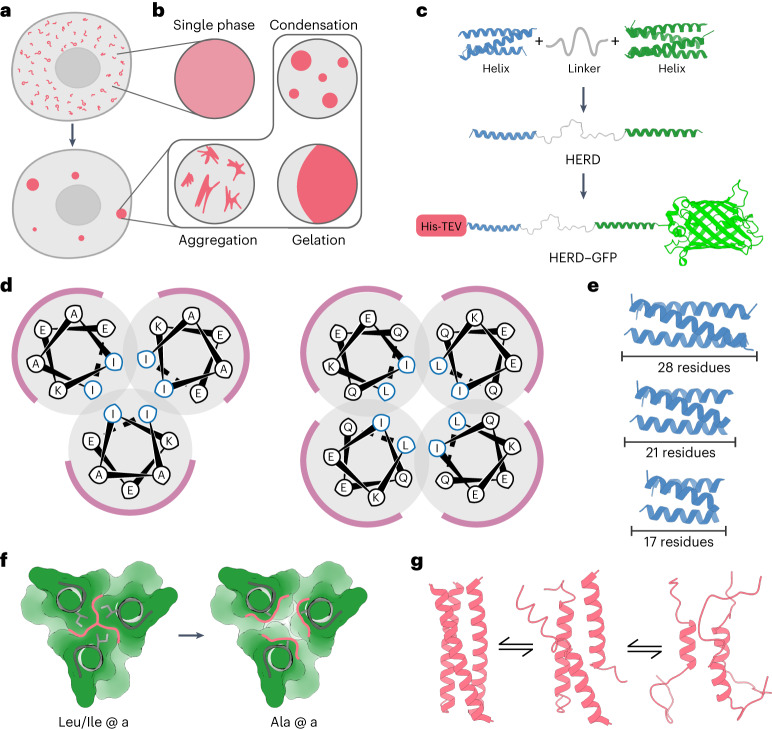
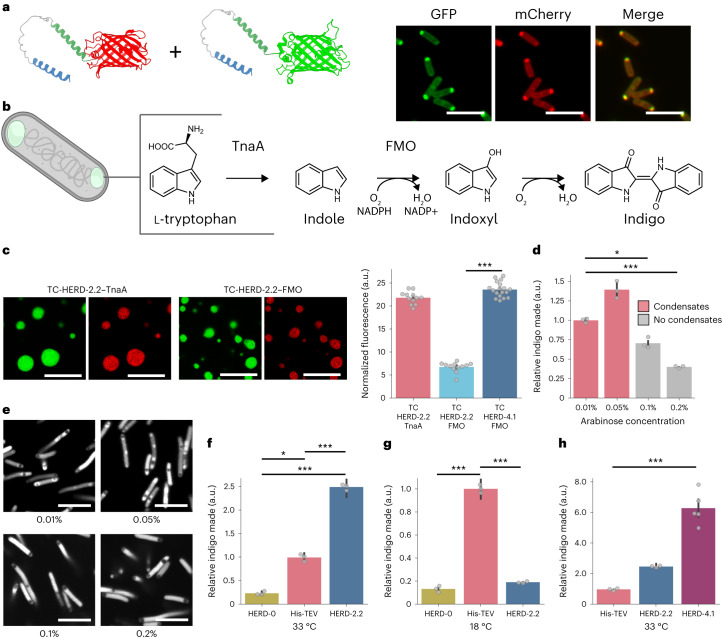
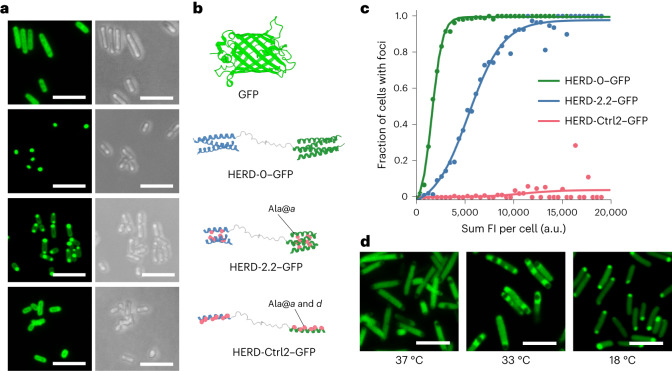
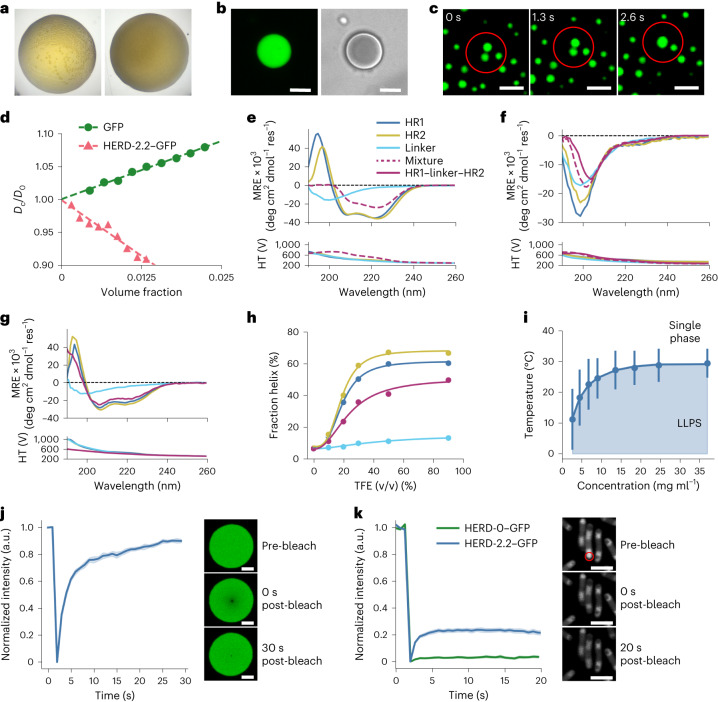
Recent advances in de novo protein design have delivered a diversity of discrete de novo protein structures and complexes. A new challenge for the field is to use these designs directly in cells to intervene in biological processes and augment natural systems. The bottom-up design of self-assembled objects such as microcompartments and membraneless organelles is one such challenge. Here we describe the design of genetically encoded polypeptides that form membraneless organelles in Escherichia coli. To do this, we combine de novo α-helical sequences, intrinsically disordered linkers and client proteins in single-polypeptide constructs. We tailor the properties of the helical regions to shift protein assembly from arrested assemblies to dynamic condensates. The designs are characterized in cells and in vitro using biophysical methods and soft-matter physics. Finally, we use the designed polypeptide to co-compartmentalize a functional enzyme pair in E. coli, improving product formation close to the theoretical limit.
近年来从头设计蛋白质领域取得了重大进展,设计出了多种多样的离散从头蛋白质结构和复合物。该领域面临的一个新挑战是直接在细胞中使用这些设计来干预生物过程并增强自然系统。自下而上设计的微隔间和无膜细胞器等自组装物体就是这样的一个挑战。在这里,我们描述了在大肠杆菌中设计无膜细胞器的方法。为此,我们将从头设计的α-螺旋序列、固有无序的连接子和客户蛋白组合在单个多肽构建体中。我们调整螺旋区域的性质,使蛋白质组装从被阻止的组装转变为动态凝聚物。这些设计在细胞内和体外都使用生物物理方法和软物质物理学进行了表征。最后,我们使用设计的多肽将功能酶对共分区化在大肠杆菌中,使产物形成接近理论极限。