Ballell Antonio, Dutel Hugo, Fabbri Matteo, Martin-Silverstone Elizabeth, Kersley Aleksandra, Hammond Chrissy L, Herrel Anthony, Rayfield Emily J
Bristol Palaeobiology Group, School of Earth Sciences, University of Bristol, Life Sciences Building, 24 Tyndall Avenue, Bristol BS8 1TQ, UK.
Université de Bordeaux, CNRS, MCC, PACEA, UMR 5199, Pessac 33615, France.
Proc Biol Sci. 2024 Dec;291(2036):20242052. doi: 10.1098/rspb.2024.2052. Epub 2024 Dec 11.
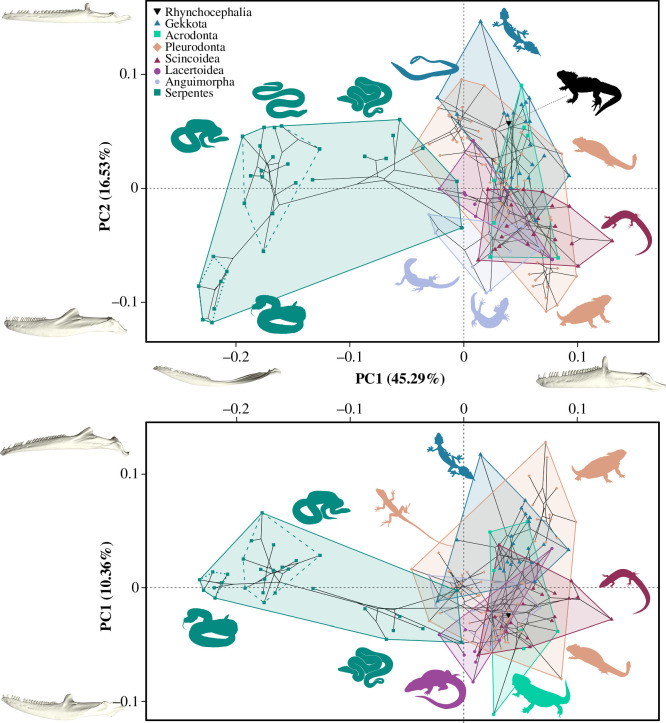
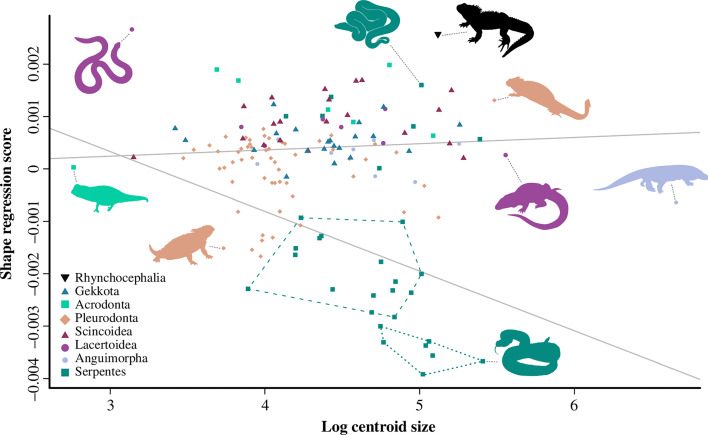
Ecology is a key driver of morphological evolution during adaptive radiations, but alternative factors like phylogeny and allometry can have a strong influence on morphology. Lepidosaurs, the most diverse clade of tetrapods, including lizards and snakes, have evolved a remarkable variety of forms and adapted to disparate ecological niches, representing an ideal case study to understand drivers of morphological evolution. Here, we quantify morphological variation in the lower jaw using three-dimensional geometric morphometrics on a broad sample of 153 lepidosaur species. Our results suggest that phylogeny has significantly influenced mandibular shape evolution, and snakes have diverged from a lizard-like jaw morphology during their evolution. Allometry and ecological factors like diet, foraging mode and substrate also appear to drive the diversification of mandibular forms. Ecological groups differ in patterns of disparity, convergence and rates of evolution, indicating that divergent evolutionary mechanisms are responsible for the acquisition of different diets and habitats. Our analyses support that lepidosaurs ancestrally use their jaws to capture prey, contrary to the traditional view favouring lingual prehension as ancestral. Specialized or ecologically diverse lineages show high rates of jaw shape evolution, suggesting that morphological innovation in the mandible has contributed to the spectacular ecomorphological diversification of lepidosaurs.
生态学是适应性辐射过程中形态进化的关键驱动力,但系统发育和异速生长等其他因素也会对形态产生强烈影响。鳞龙类是四足动物中最多样化的类群,包括蜥蜴和蛇,它们进化出了各种各样的形态,并适应了不同的生态位,是理解形态进化驱动力的理想案例研究。在这里,我们使用三维几何形态测量法对153种鳞龙类物种的广泛样本进行下颌形态变异的量化分析。我们的结果表明,系统发育对下颌形状进化有显著影响,蛇在进化过程中已从类似蜥蜴的颌骨形态分化出来。异速生长以及饮食、觅食方式和底物等生态因素似乎也推动了下颌形态的多样化。生态类群在差异模式、趋同和进化速率方面存在差异,这表明不同的进化机制导致了不同饮食和栖息地的形成。我们的分析支持,与传统观点认为舌部抓取是祖先的方式相反,鳞龙类在祖先时期就用它们的颌骨捕捉猎物。特化或生态多样的谱系显示出较高的颌骨形状进化速率,这表明下颌的形态创新促成了鳞龙类惊人的生态形态多样化。