Department of Experimental Medicine, Tor Vergata University, Rome, Italy; Department of Biomedicine and Prevention, Tor Vergata University, Rome, Italy.
Department of Experimental Medicine, Tor Vergata University, Rome, Italy; Tor Vergata University Hospital, Rome, Italy.
Int Immunopharmacol. 2021 Dec;101(Pt B):108215. doi: 10.1016/j.intimp.2021.108215. Epub 2021 Oct 4.
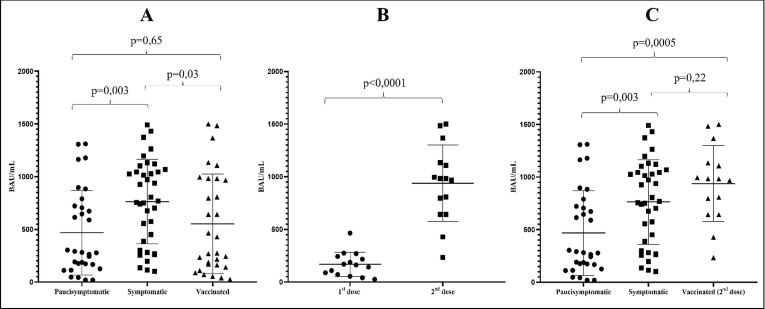
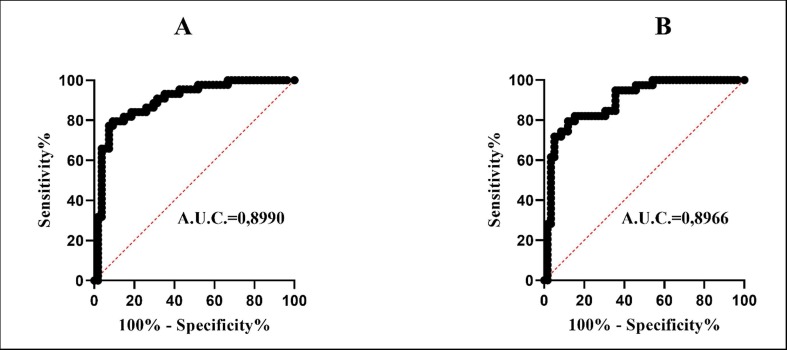
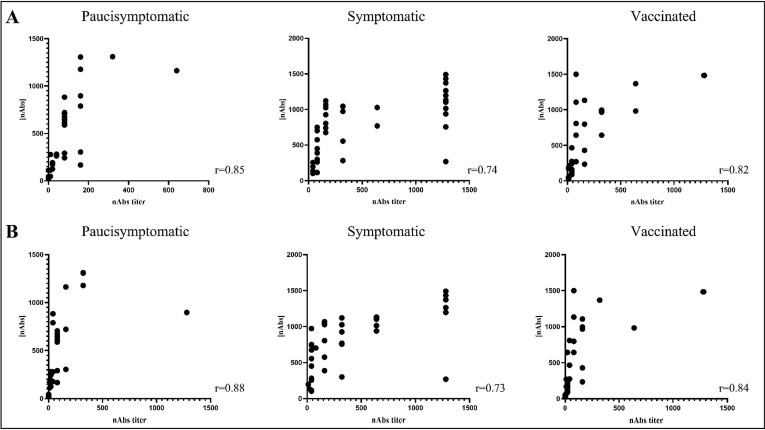
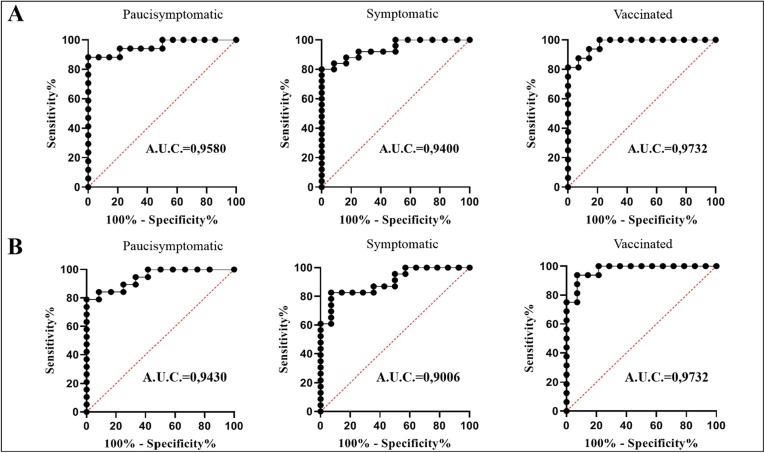
A large number of immunoassays have been developed to detect specific anti-SARS-CoV-2 antibodies; however, not always they are functional to neutralize the virus. The reference test for the anti-spike neutralizing antibodies (nAbs) ability to counteract the viral infection is the virus neutralization test (VNT). Great interest is developing on reliable serological assays allowing antibodies concentration and antibody protective titer correlation. The aim of our study was to detect nAbs serum levels in paucisymptomatic, symptomatic and vaccinated subjects, to find a cut-off value able to protect from virus infection. nAbs serum levels were detected by a competitive automated immunoassay, in association to VNT with the SARS-CoV-2 original and British variant strains. The median nAbs concentrations were: 281.3 BAU/ml for paucisymptomatics; 769.4 BAU/ml for symptomatics; 351.65 BAU/ml for the vaccinated cohort; 983 BAU/ml considering only the second dose vaccinated individuals. The original strain VNT analysis showed 1:80 median neutralization titers in paucisymptomatic and vaccinated subjects; 1:160 in symptomatic patients; 1:160 in the second dose groups. The British variant VNT analysis showed lower neutralization titers in paucisymptomatic and vaccinated groups (1:40); the same titer in symptomatic patients (1:160); the second dose group confirmed the original strain titer (1:160). In conclusion, our data showed optimal correlations with a proportional increase between neutralizing activity and antibody concentration, making nAbs detection a good alternative to virus neutralization assays, difficult to carry out in routine laboratories. Finally, ROC curve analysis established a cut-off of 408.6 BAU/ml to identify subjects with a low risk of infection.
已经开发了大量的免疫测定法来检测针对 SARS-CoV-2 的特异性抗体;然而,并非所有的抗体都具有中和病毒的功能。针对 Spike 中和抗体(nAbs)中和病毒感染能力的参考测试是病毒中和测试(VNT)。目前人们对能够定量检测抗体浓度并与抗体保护效价相关的可靠血清学检测方法非常感兴趣。我们的研究目的是检测无症状、有症状和接种疫苗的个体血清中的 nAbs 水平,寻找一个能够防止病毒感染的临界值。通过竞争自动化免疫测定法检测 nAbs 血清水平,并与 SARS-CoV-2 原始和英国变异株的 VNT 相结合。无症状个体的 nAbs 浓度中位数为 281.3 BAU/ml;有症状个体为 769.4 BAU/ml;接种疫苗个体为 351.65 BAU/ml;仅考虑第二剂接种个体时为 983 BAU/ml。原始株 VNT 分析显示无症状和接种疫苗个体的中和滴度中位数为 1:80;有症状患者为 1:160;第二剂接种个体为 1:160。英国变异株 VNT 分析显示无症状和接种疫苗个体的中和滴度较低(1:40);有症状患者的滴度相同(1:160);第二剂接种个体证实了原始株的滴度(1:160)。总之,我们的数据显示与中和活性和抗体浓度之间呈比例增加的最佳相关性,使 nAbs 检测成为病毒中和检测的良好替代方法,在常规实验室中难以进行。最后,ROC 曲线分析确定了 408.6 BAU/ml 的临界值,以识别感染风险较低的个体。