Key Laboratory for Bio-Resource and Eco-Environment of Ministry of Education, College of Life Sciences, Sichuan University, Chengdu 610065, China.
State Key Laboratory of Grassland Agro-Ecosystem, Innovation Institute of Ecology and Life Sciences, Lanzhou University, Lanzhou 730000, China.
Proc Natl Acad Sci U S A. 2021 Oct 19;118(42). doi: 10.1073/pnas.2025711118.
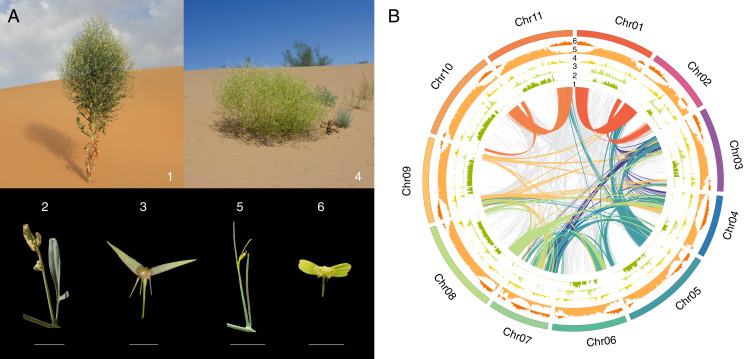
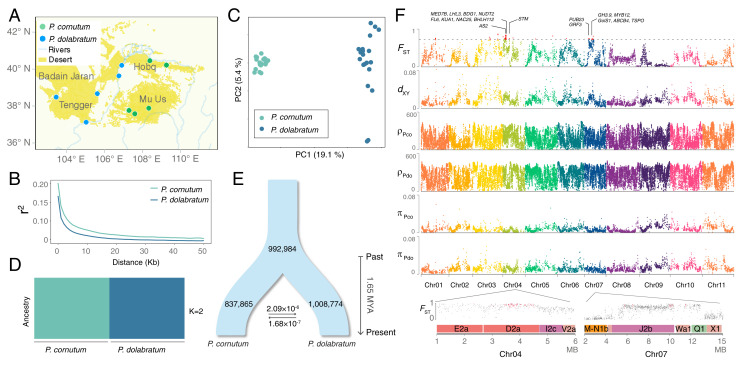
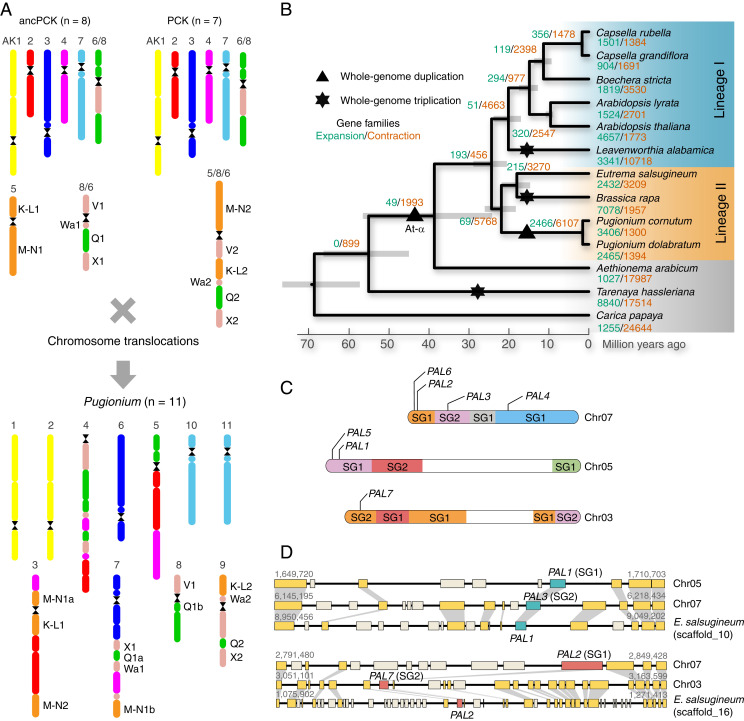
Deserts exert strong selection pressures on plants, but the underlying genomic drivers of ecological adaptation and subsequent speciation remain largely unknown. Here, we generated de novo genome assemblies and conducted population genomic analyses of the psammophytic genus (Brassicaceae). Our results indicated that this bispecific genus had undergone an allopolyploid event, and the two parental genomes were derived from two ancestral lineages with different chromosome numbers and structures. The postpolyploid expansion of gene families related to abiotic stress responses and lignin biosynthesis facilitated environmental adaptations of the genus to desert habitats. Population genomic analyses of both species further revealed their recent divergence with continuous gene flow, and the most divergent regions were found to be centered on three highly structurally reshuffled chromosomes. Genes under selection in these regions, which were mainly located in one of the two subgenomes, contributed greatly to the interspecific divergence in microhabitat adaptation.
沙漠对植物施加了强大的选择压力,但生态适应和随后物种形成的潜在基因组驱动因素在很大程度上仍然未知。在这里,我们生成了 (十字花科)沙生属的从头基因组组装,并进行了群体基因组分析。我们的结果表明,这个双特异性属经历了一次异源多倍体事件,两个亲本基因组分别来自具有不同染色体数量和结构的两个祖先谱系。与非生物胁迫反应和木质素生物合成相关的基因家族在后多倍体扩张过程中,促进了该属对沙漠生境的环境适应。对两个物种的群体基因组分析进一步揭示了它们最近的分化与持续的基因流,最具分化的区域集中在三个高度结构重排的染色体上。这些区域受选择的基因主要位于两个亚基因组之一中,对种间微生境适应的分化贡献很大。