Biomedical Research Center, Institute of Virology, Slovak Academy of Sciences, Bratislava, Slovakia.
Department of Microbiology and Virology, Faculty of Natural Sciences, Comenius University in Bratislava, Bratislava, Slovakia.
Sci Rep. 2021 Oct 14;11(1):20494. doi: 10.1038/s41598-021-99661-7.
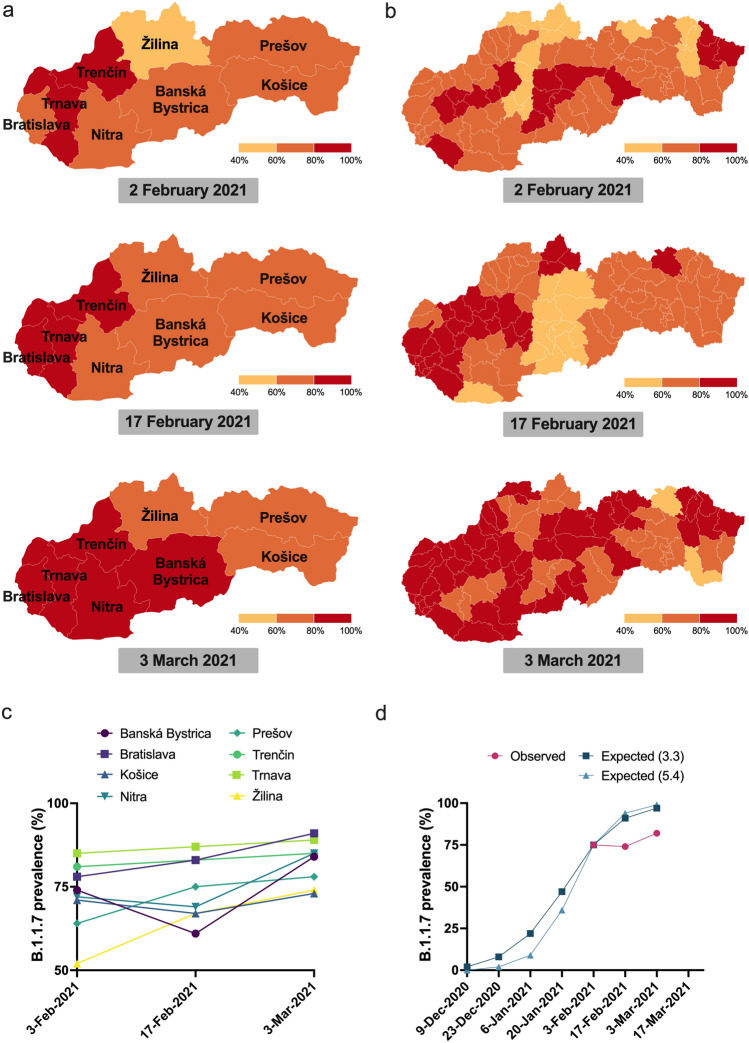
The emergence of a novel SARS-CoV-2 B.1.1.7 variant sparked global alarm due to increased transmissibility, mortality, and uncertainty about vaccine efficacy, thus accelerating efforts to detect and track the variant. Current approaches to detect B.1.1.7 include sequencing and RT-qPCR tests containing a target assay that fails or results in reduced sensitivity towards the B.1.1.7 variant. Since many countries lack genomic surveillance programs and failed assays detect unrelated variants containing similar mutations as B.1.1.7, we used allele-specific PCR, and judicious placement of LNA-modified nucleotides to develop an RT-qPCR test that accurately and rapidly differentiates B.1.1.7 from other SARS-CoV-2 variants. We validated the test on 106 clinical samples with lineage status confirmed by sequencing and conducted a country-wide surveillance study of B.1.1.7 prevalence in Slovakia. Our multiplexed RT-qPCR test showed 97% clinical sensitivity and retesting 6,886 SARS-CoV-2 positive samples obtained during three campaigns performed within one month, revealed pervasive spread of B.1.1.7 with an average prevalence of 82%. Labs can easily implement this test to rapidly scale B.1.1.7 surveillance efforts and it is particularly useful in countries with high prevalence of variants possessing only the ΔH69/ΔV70 deletion because current strategies using target failure assays incorrectly identify these as putative B.1.1.7 variants.
一种新型的 SARS-CoV-2 B.1.1.7 变体的出现引起了全球的警惕,因为它具有更高的传染性、更高的死亡率,而且疫苗效果存在不确定性,因此加速了对该变体的检测和跟踪工作。目前检测 B.1.1.7 的方法包括测序和 RT-qPCR 测试,其中包含针对该变体的目标检测,这些检测要么失败,要么导致检测灵敏度降低。由于许多国家缺乏基因组监测计划,而且失败的检测无法检测到与 B.1.1.7 变体具有相似突变的无关变体,因此我们使用等位基因特异性 PCR 和明智地放置 LNA 修饰核苷酸来开发一种 RT-qPCR 测试,该测试可以准确快速地区分 B.1.1.7 与其他 SARS-CoV-2 变体。我们在 106 份经测序确认谱系状态的临床样本上验证了该测试,并在斯洛伐克进行了 B.1.1.7 流行率的全国性监测研究。我们的多重 RT-qPCR 测试显示出 97%的临床灵敏度,并对在一个月内进行的三次活动中获得的 6886 份 SARS-CoV-2 阳性样本进行了重新测试,结果显示 B.1.1.7 广泛传播,平均流行率为 82%。实验室可以轻松实施该测试,以快速扩大 B.1.1.7 监测工作,对于具有仅存在 ΔH69/ΔV70 缺失的变体的高流行率的国家尤其有用,因为目前使用目标失败检测的策略会错误地将这些变体识别为推定的 B.1.1.7 变体。