Ng Cheuk Fan
Centre for Social Sciences, Athabasca University, Alberta, AB, Canada.
Front Psychol. 2021 Sep 28;12:635117. doi: 10.3389/fpsyg.2021.635117. eCollection 2021.
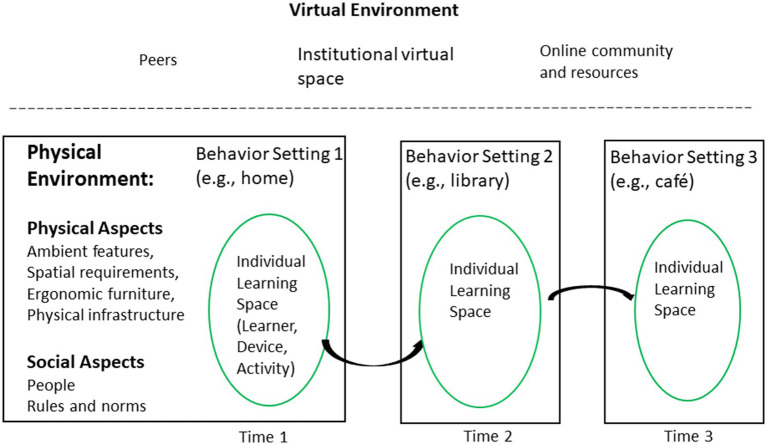
Online distance learning is offered not only in post-secondary distance education institutions but in traditional universities as well. With advances in mobile and wireless technologies, completing academic studies anywhere anytime should become feasible. Research in distance education and online learning has focused on computer-mediated communication, instructional design, learner characteristics, educational technology, and learning outcomes. However, little attention has been given to where exactly learners do their learning and studying and how the physical and social aspects of the physical environment within which the online learner is physically embedded (e.g., the home) supports and constrains learning activities. In this paper, the author proposes a conceptual model for understanding the role that the physical environment plays in online distance learning in higher education, drawing on theories and research in environmental psychology, online learning, telework and mobile work, and higher education. Several gaps in research are identified, and suggestions for future research are proposed.
在线远程学习不仅在高等远程教育学府提供,传统大学也有。随着移动和无线技术的进步,随时随地完成学业应该变得可行。远程教育和在线学习的研究集中在计算机介导的通信、教学设计、学习者特征、教育技术和学习成果上。然而,对于学习者究竟在哪里进行学习,以及在线学习者所处的物理环境(如家庭)的物理和社会方面如何支持和限制学习活动,却很少有人关注。在本文中,作者借鉴环境心理学、在线学习、远程工作和移动工作以及高等教育的理论和研究,提出了一个概念模型,以理解物理环境在高等教育在线远程学习中所起的作用。文中指出了研究中的几个空白,并提出了未来研究的建议。