Shui Jingwei, Xie Dongjie, Zhao Jianhui, Ao Cailing, Lin Hongqing, Liang Yuanhao, Wang Haiying, Dai Yingchun, Tang Shixing
Department of Epidemiology, School of Public Health, Southern Medical University, Guangzhou, China.
Wenzhou Institute, University of Chinese Academy of Sciences, Wenzhou, China.
Front Microbiol. 2021 Sep 27;12:729016. doi: 10.3389/fmicb.2021.729016. eCollection 2021.
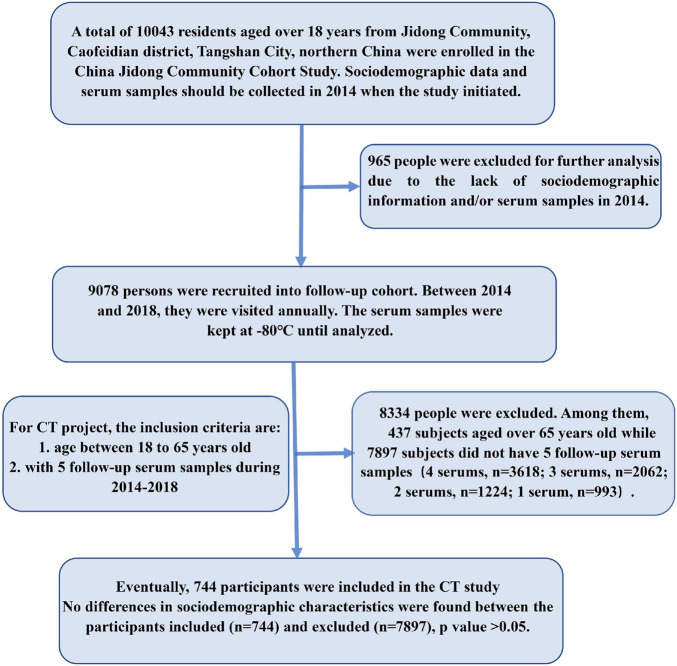
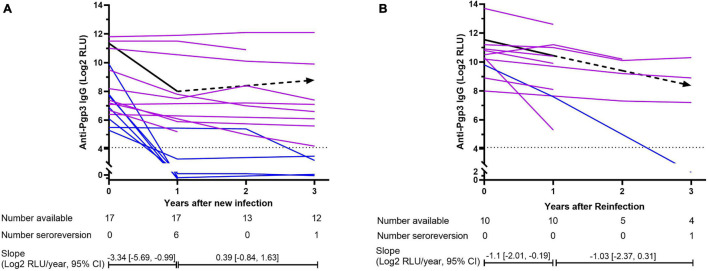
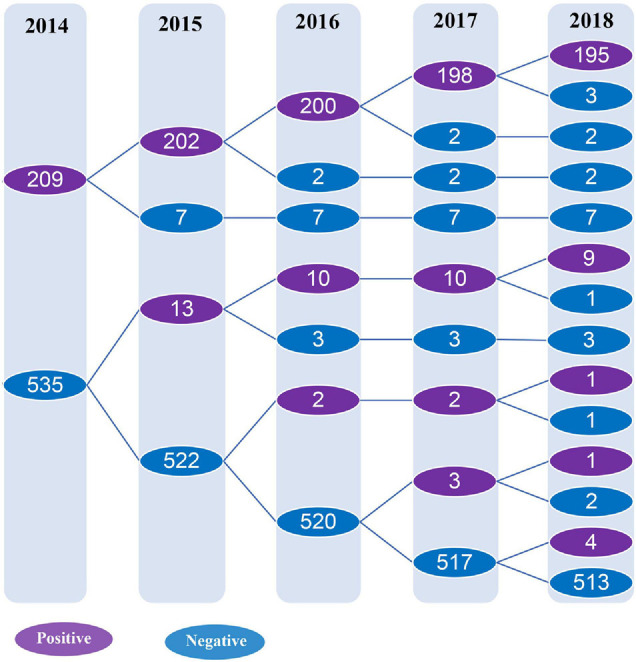
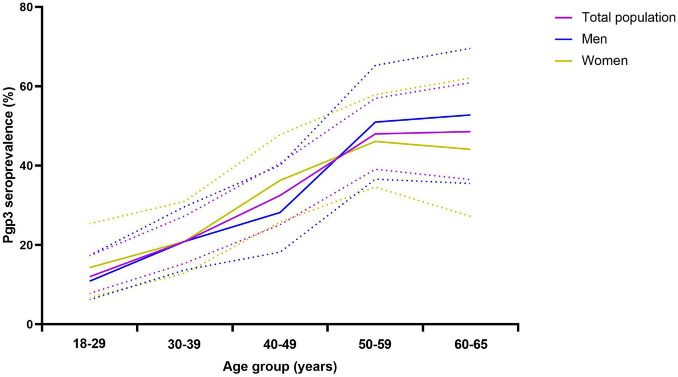
A longitudinal serological study to investigate the seropositive frequency, incidence, and antibody dynamics of infection in the general population of China is urgently needed in order to optimize the strategies for surveillance and precise prevention of infection. This longitudinal study enrolled 744 subjects aged 18-65 years from Jidong Community of Northern China from 2014 to 2018. Seropositive frequency, incidence, and reinfection of were determined by detecting antibody against Pgp3 using "in-house" luciferase immunosorbent assay (LISA). The dynamic of anti-Pgp3 antibody was analyzed using the Generalized Estimating Equation (GEE) model. The overall Pgp3 seropositive frequency among the 18-65-year-old population was 28.1% (95% CI 24.9-31.5), and significantly increased from 12.0% in those aged 18-29 years to 48.6% in the 60-65 years old. The seropositive frequency was slightly higher in women than in men (31.3% vs. 25.4%) without statistical significance. The incidence and reinfection rate were 11 and 14 per 1,000 person-years, respectively, and showed no significant difference with respect to age, gender, ethnicity, marital status, and education levels. Furthermore, anti-Pgp3 antibody remained detectable in 93.3% (195/209) of the seropositive subjects during the 5 years of follow-up. The overall decay rate for anti-Pgp3 antibody for CT-infected persons was -0.123 Log2 RLU/year, which was dramatically slower than in CT new infection (-3.34 Log2 RLU/year) or reinfection (-1.1 Log2 RLU/year). In conclusion, at least one quarter of the people aged 18-65 years have been infected with over their lifetime while all age groups are susceptible to infection in the community of Northern China. Therefore, comprehensive prevention strategies are urgently needed.
为优化感染的监测和精准预防策略,迫切需要在中国普通人群中开展一项纵向血清学研究,以调查感染的血清阳性频率、发病率和抗体动态变化。这项纵向研究于2014年至2018年在中国北方冀东社区招募了744名年龄在18 - 65岁的受试者。通过使用“内部”荧光素酶免疫吸附测定法(LISA)检测抗Pgp3抗体来确定感染的血清阳性频率、发病率和再感染情况。使用广义估计方程(GEE)模型分析抗Pgp3抗体的动态变化。18 - 65岁人群中Pgp3总体血清阳性频率为28.1%(95%CI 24.9 - 31.5),且从18 - 29岁人群中的12.0%显著增加到60 - 65岁人群中的48.6%。女性的血清阳性频率略高于男性(31.3%对25.4%),但无统计学意义。感染发病率和再感染率分别为每1000人年11例和14例,在年龄、性别、种族、婚姻状况和教育水平方面无显著差异。此外,在5年的随访期间,93.3%(195/209)的血清阳性受试者中抗Pgp3抗体仍可检测到。CT感染人群中抗Pgp3抗体的总体衰减率为 -0.123 Log2 RLU/年,这明显慢于CT新感染(-3.34 Log2 RLU/年)或再感染(-1.1 Log2 RLU/年)。总之,在中国北方社区,至少四分之一的18 - 65岁人群一生中曾感染过,且所有年龄组都易感染。因此,迫切需要综合预防策略。