
无试剂酸碱滴定法用于检测海水中的碱度。
Reagentless Acid-Base Titration for Alkalinity Detection in Seawater.
机构信息
Department of Chemistry, School of Engineering Science in Chemistry, Biochemistry and Health, KTH Royal Institute of Technology, SE-100 44 Stockholm, Sweden.
出版信息
Anal Chem. 2021 Oct 26;93(42):14130-14137. doi: 10.1021/acs.analchem.1c02545. Epub 2021 Oct 15.
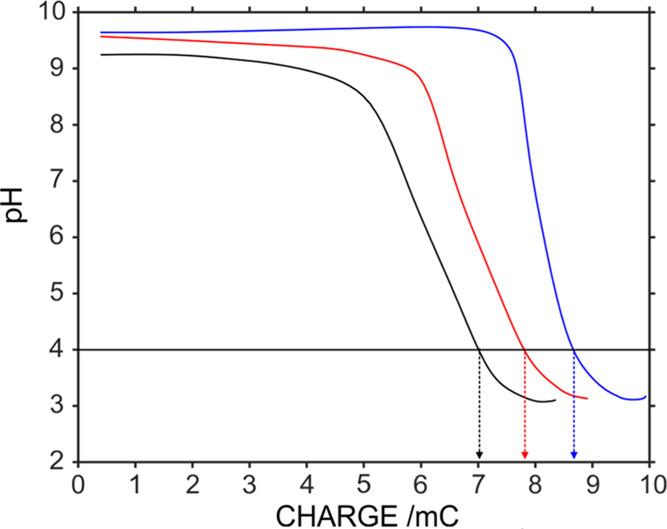
Herein, we report on a reagentless electroanalytical methodology for automatized acid-base titrations of water samples that are confined into very thin spatial domains. The concept is based on the recent discovery from our group (Wiorek, A. 2019, 91, 14951-14959), in which polyaniline (PANI) films were found to be an excellent material to release a massive charge of protons in a short time, achieving hence the efficient (and controlled) acidification of a sample. We now demonstrate and validate the analytical usefulness of this approach with samples collected from the Baltic Sea: the titration protocol indeed acts as an alkalinity sensor via the calculation of the proton charge needed to reach pH 4.0 in the sample, as per the formal definition of the alkalinity parameter. In essence, the alkalinity sensor is based on the linear relationship found between the released charge from the PANI film and the bicarbonate concentration in the sample (i.e., the way to express alkalinity measurements). The observed alkalinity in the samples presented a good agreement with the values obtained by manual (classical) acid-base titrations (discrepancies <10%). Some crucial advantages of the new methodology are that titrations are completed in less than 1 min (end point), the PANI film can be reused at least 74 times over a 2 week period (<5% of decrease in the released charge), and the utility of the PANI film to even more decrease the final pH of the sample (pH ∼2) toward applications different from alkalinity detection. Furthermore, the acidification can be accomplished in a discrete or continuous mode depending on the application demands. The new methodology is expected to impact the future digitalization of in situ acid-base titrations to obtain high-resolution data on alkalinity in water resources.
在此,我们报告了一种无试剂的电分析方法,用于自动进行水样品的酸碱滴定,这些水样品被限制在非常薄的空间域内。该概念基于我们小组的最新发现(Wiorek,A. 2019,91,14951-14959),即在短时间内,聚苯胺(PANI)薄膜被发现是一种极好的释放大量质子的材料,从而实现了样品的高效(和受控)酸化。现在,我们用从波罗的海收集的样本证明并验证了这种方法的分析有用性:通过计算样品达到 pH 4.0 所需的质子电荷,该滴定方案确实可以作为碱度传感器,根据碱度参数的正式定义。从本质上讲,碱度传感器基于从 PANI 薄膜释放的电荷与样品中碳酸氢盐浓度之间的线性关系(即表示碱度测量的方法)。观察到的样品碱度与手动(经典)酸碱滴定获得的值非常吻合(差异<10%)。这种新方法的一些关键优势在于,滴定在不到 1 分钟(终点)内完成,PANI 薄膜在 2 周内至少可重复使用 74 次(释放电荷减少<5%),并且 PANI 薄膜可用于甚至将样品的最终 pH 降低(pH∼2),以应用于除碱度检测以外的其他领域。此外,根据应用需求,可以以离散或连续模式进行酸化。该新方法有望影响未来原位酸碱滴定的数字化,以获得水资源中碱度的高分辨率数据。


 Zotero 插件