
是什么造就了你的独特性:人类大脑指纹的时间特性。
When makes you unique: Temporality of the human brain fingerprint.
作者信息
Van De Ville Dimitri, Farouj Younes, Preti Maria Giulia, Liégeois Raphaël, Amico Enrico
机构信息
Institute of Bioengineering, Center for Neuroprosthetics, EPFL, Geneva, Switzerland.
Department of Radiology and Medical Informatics, University of Geneva (UNIGE), Geneva, Switzerland.
出版信息
Sci Adv. 2021 Oct 15;7(42):eabj0751. doi: 10.1126/sciadv.abj0751.
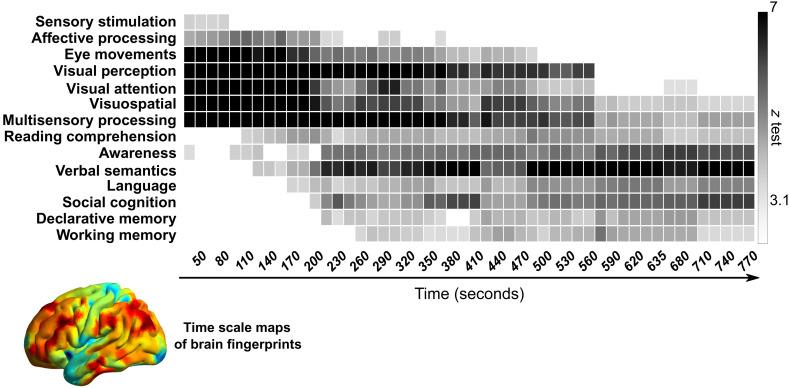
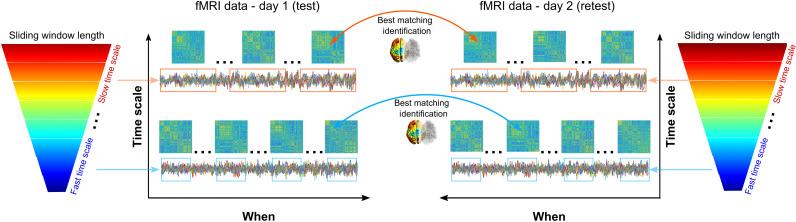
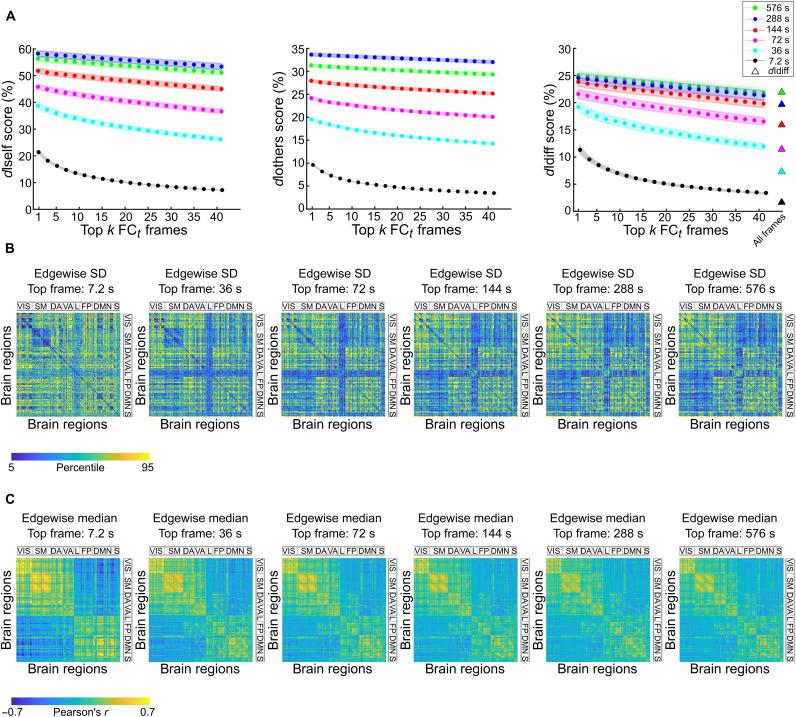
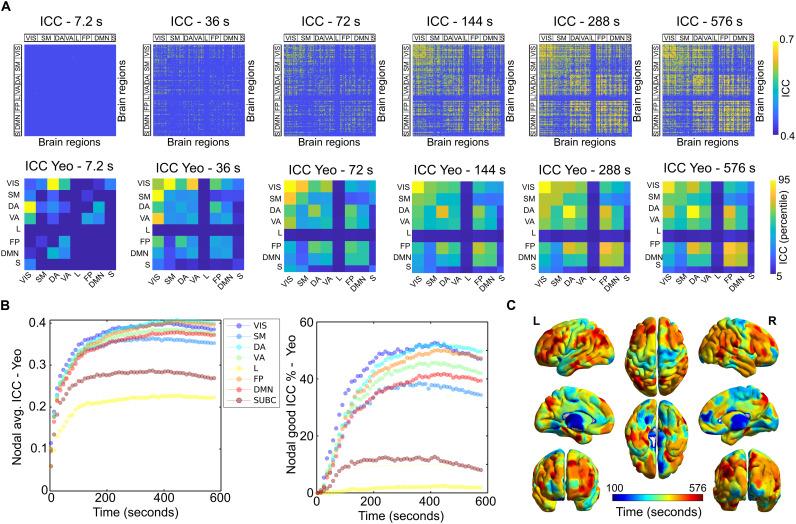
The extraction of “fingerprints” from human brain connectivity data has become a new frontier in neuroscience. However, the time scales of human brain identifiability are still largely unexplored. We here investigate the dynamics of brain fingerprints along two complementary axes: (i) What is the optimal time scale at which brain fingerprints integrate information and (ii) when best identification happens. Using dynamic identifiability, we show that the best identification emerges at longer time scales; however, short transient “bursts of identifiability,” associated with neuronal activity, persist even when looking at shorter functional interactions. Furthermore, we report evidence that different parts of connectome fingerprints relate to different time scales, i.e., more visual-somatomotor at short temporal windows and more frontoparietal-DMN driven at increasing temporal windows. Last, different cognitive functions appear to be meta-analytically implicated in dynamic fingerprints across time scales. We hope that this investigation will advance our understanding of what makes our brains unique.
从人类大脑连接数据中提取“指纹”已成为神经科学的一个新前沿领域。然而,人类大脑可识别性的时间尺度在很大程度上仍未得到探索。我们在此沿着两个互补轴研究大脑指纹的动态变化:(i)大脑指纹整合信息的最佳时间尺度是什么,以及(ii)何时能实现最佳识别。利用动态可识别性,我们发现最佳识别出现在较长的时间尺度上;然而,即使在观察较短的功能相互作用时,与神经元活动相关的短暂“可识别性爆发”仍然存在。此外,我们报告了证据表明连接组指纹的不同部分与不同的时间尺度相关,即在较短的时间窗口中更多地涉及视觉 - 躯体运动,而在不断增加的时间窗口中更多地由额顶叶 - 默认模式网络驱动。最后,不同的认知功能似乎在跨时间尺度的动态指纹中通过元分析相互关联。我们希望这项研究将增进我们对使我们的大脑独一无二的因素的理解。

 Zotero 插件