Biologics Drug Product, Technical Research and Development, Global Drug Development, Novartis, Lek D.D., Kolodvorska 27, 1234, Mengeš, Slovenia.
Faculty of Mathematics and Physics, University of Ljubljana, Ljubljana, Slovenia.
Sci Rep. 2021 Oct 15;11(1):20534. doi: 10.1038/s41598-021-99875-9.
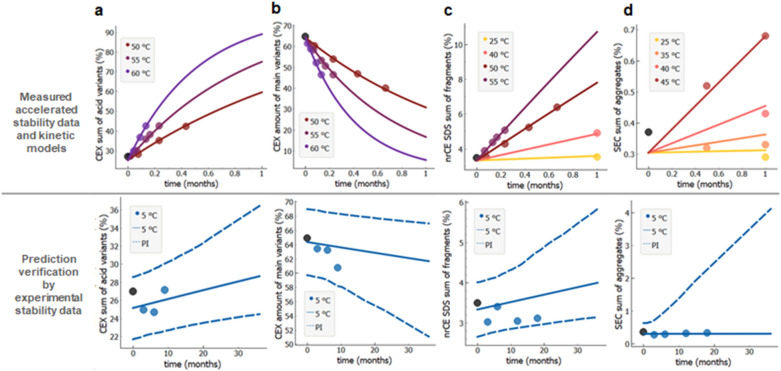
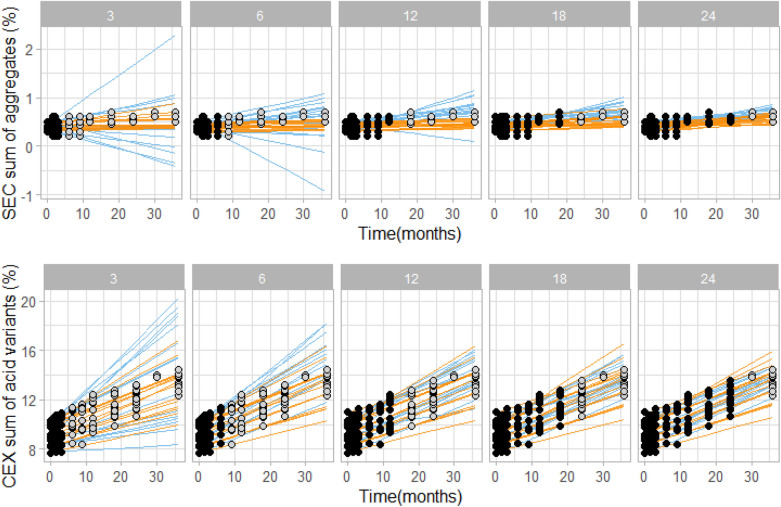
Long-term stability of monoclonal antibodies to be used as biologics is a key aspect in their development. Therefore, its possible early prediction from accelerated stability studies is of major interest, despite currently being regarded as not sufficiently robust. In this work, using a combination of accelerated stability studies (up to 6 months) and first order degradation kinetic model, we are able to predict the long-term stability (up to 3 years) of multiple monoclonal antibody formulations. More specifically, we can robustly predict the long-term stability behaviour of a protein at the intended storage condition (5 °C), based on up to six months of data obtained for multiple quality attributes from different temperatures, usually from intended (5 °C), accelerated (25 °C) and stress conditions (40 °C). We have performed stability studies and evaluated the stability data of several mAbs including IgG1, IgG2, and fusion proteins, and validated our model by overlaying the 95% prediction interval and experimental stability data from up to 36 months. We demonstrated improved robustness, speed and accuracy of kinetic long-term stability prediction as compared to classical linear extrapolation used today, which justifies long-term stability prediction and shelf-life extrapolation for some biologics such as monoclonal antibodies. This work aims to contribute towards further development and refinement of the regulatory landscape that could steer toward allowing extrapolation for biologics during the developmental phase, clinical phase, and also in marketing authorisation applications, as already established today for small molecules.
用于生物制剂的单克隆抗体的长期稳定性是其开发的关键方面。因此,尽管目前认为其不够稳健,但从加速稳定性研究中尽早预测其长期稳定性具有重要意义。在这项工作中,我们结合加速稳定性研究(长达 6 个月)和一级降解动力学模型,能够预测多种单克隆抗体制剂的长期稳定性(长达 3 年)。更具体地说,我们可以根据在不同温度下获得的长达六个月的多个质量属性数据,稳健地预测蛋白质在预期储存条件(5°C)下的长期稳定性行为,这些数据通常来自预期(5°C)、加速(25°C)和应激条件(40°C)。我们已经进行了稳定性研究,并评估了包括 IgG1、IgG2 和融合蛋白在内的几种 mAbs 的稳定性数据,并通过叠加长达 36 个月的 95%预测区间和实验稳定性数据验证了我们的模型。与目前使用的经典线性外推法相比,我们的模型显示出更好的稳健性、速度和准确性,从而证明了某些生物制剂(如单克隆抗体)的长期稳定性预测和保质期外推是合理的。这项工作旨在为进一步开发和完善监管环境做出贡献,这将有助于在生物制剂的开发阶段、临床阶段以及在营销授权申请中允许进行外推,就像今天已经为小分子所确立的那样。