Clinic and Policlinic for Internal Medicine III, School of Medicine, Technical University of Munich, Munich, Germany.
Centre for Translational Cancer Research (TranslaTUM), School of Medicine, Technical University of Munich, Munich, Germany.
J Cancer Res Clin Oncol. 2022 Feb;148(2):331-340. doi: 10.1007/s00432-021-03827-9. Epub 2021 Oct 15.
Hypereosinophilia represents a heterogenous group of severe medical conditions characterized by elevated numbers of eosinophil granulocytes in peripheral blood, bone marrow or tissue. Treatment options for hypereosinophilia remain limited despite recent approaches including IL-5-targeted monoclonal antibodies and tyrosine kinase inhibitors.
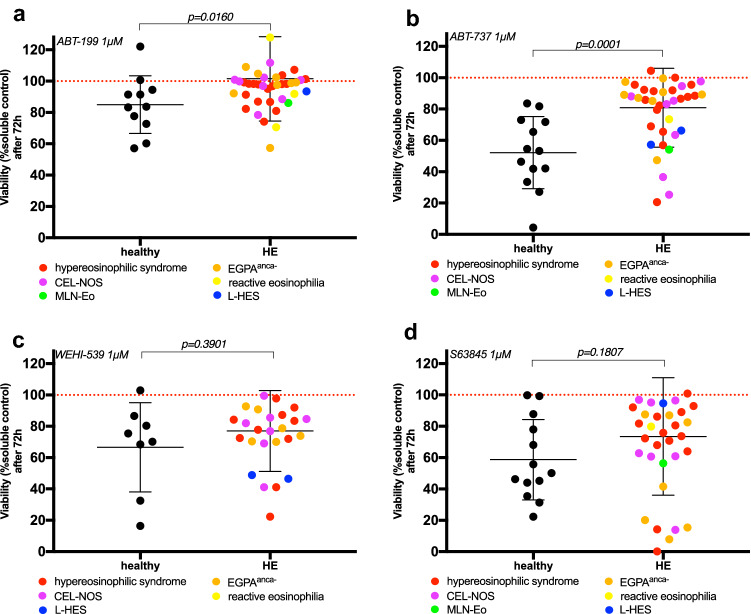
To understand aberrant survival patterns and options for pharmacologic intervention, we characterized BCL-2-regulated apoptosis signaling by testing for BCL-2 family expression levels as well as pharmacologic inhibition using primary patient samples from diverse subtypes of hypereosinophilia (hypereosinophilic syndrome n = 18, chronic eosinophilic leukemia not otherwise specified n = 9, lymphocyte-variant hypereosinophilia n = 2, myeloproliferative neoplasm with eosinophilia n = 2, eosinophilic granulomatosis with polyangiitis n = 11, reactive eosinophilia n = 3).
Contrary to published literature, we found no difference in the levels of the lncRNA Morrbid and its target BIM. Yet, we identified a near complete loss of expression of pro-apoptotic PUMA as well as a reduction in anti-apoptotic BCL-2. Accordingly, BCL-2 inhibition using venetoclax failed to achieve cell death induction in eosinophil granulocytes and bone marrow mononuclear cells from patients with hypereosinophilia. In contrast, MCL1 inhibition using S63845 specifically decreased the viability of bone marrow progenitor cells in patients with hypereosinophilia. In patients diagnosed with Chronic Eosinophilic Leukemia (CEL-NOS) or Myeloid and Lymphatic Neoplasia with hypereosinophilia (MLN-Eo) repression of survival was specifically powerful.
Our study shows that MCL1 inhibition might be a promising therapeutic option for hypereosinophilia patients specifically for CEL-NOS and MLN-Eo.
嗜酸性粒细胞增多症代表了一组严重的医学病症,其特征是外周血、骨髓或组织中嗜酸性粒细胞粒细胞数量升高。尽管最近的方法包括针对白细胞介素-5 的单克隆抗体和酪氨酸激酶抑制剂,但嗜酸性粒细胞增多症的治疗选择仍然有限。
为了了解异常的存活模式和药物干预的选择,我们通过测试 BCL-2 家族表达水平以及使用来自不同嗜酸性粒细胞增多症亚型(嗜酸性粒细胞增多综合征 n=18、非特指慢性嗜酸性白血病 n=9、淋巴细胞变异型嗜酸性粒细胞增多症 n=2、伴嗜酸性粒细胞增多的骨髓增生性肿瘤 n=2、嗜酸性粒细胞肉芽肿伴多血管炎 n=11、反应性嗜酸性粒细胞增多症 n=3)的患者样本进行药理学抑制,来描述 BCL-2 调节的细胞凋亡信号。
与已发表的文献相反,我们没有发现长链非编码 RNA Morrbid 及其靶基因 BIM 的水平有差异。然而,我们发现促凋亡的 PUMA 的表达几乎完全缺失,以及抗凋亡的 BCL-2 的减少。因此,使用 venetoclax 抑制 BCL-2 未能诱导嗜酸性粒细胞和骨髓单核细胞死亡。相比之下,在嗜酸性粒细胞增多症患者中,使用 S63845 抑制 MCL1 特异性降低了骨髓祖细胞的活力。在诊断为慢性嗜酸性粒细胞白血病(CEL-NOS)或伴嗜酸性粒细胞增多的髓系和淋巴肿瘤(MLN-Eo)的患者中,生存抑制作用尤为明显。
我们的研究表明,MCL1 抑制可能是嗜酸性粒细胞增多症患者的一种有前途的治疗选择,特别是对 CEL-NOS 和 MLN-Eo 患者。