Department of Pharmacology, Delhi Institute of Pharmaceutical Sciences and Research (DIPSAR), Delhi Pharmaceutical Sciences and Research University (DPDRU), PushpVihar Sector-3, New Delhi, 110017, India.
Mol Cell Biochem. 2022 Jan;477(1):225-240. doi: 10.1007/s11010-021-04275-2. Epub 2021 Oct 16.
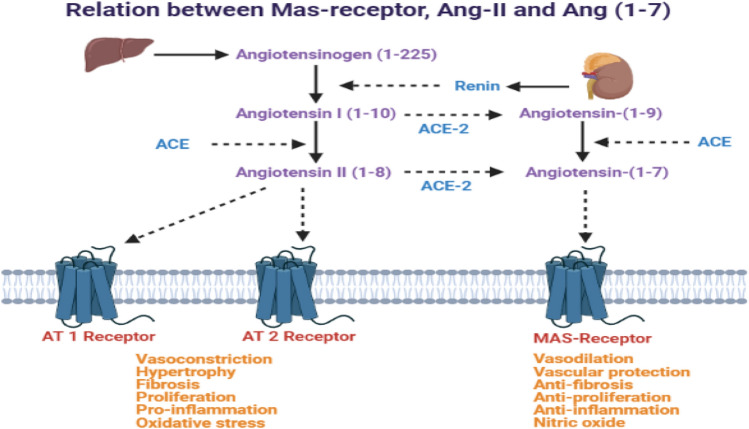
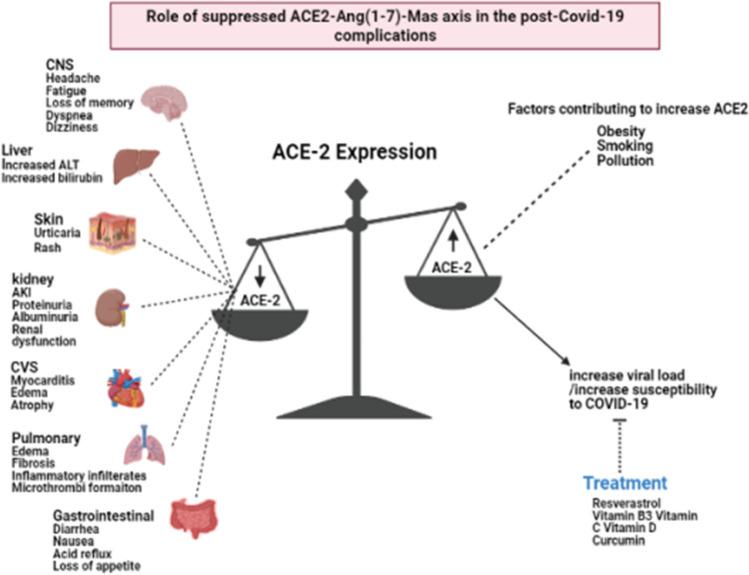
Severe acute respiratory syndrome-coronavirus-2 (COVID-19) virus uses Angiotensin-Converting Enzyme 2 (ACE2) as a gateway for their entry into the human body. The ACE2 with cleaved products have emerged as major contributing factors to multiple physiological functions and pathogenic complications leading to the clinical consequences of the COVID-19 infection Decreased ACE2 expression restricts the viral entry into the human cells and reduces the viral load. COVID-19 infection reduces the ACE2 expression and induces post-COVID-19 complications like pneumonia and lung injury. The modulation of the ACE2-Ang (1-7)-Mas (AAM) axis is also being explored as a modality to treat post-COVID-19 complications. Evidence indicates that specific food components may modulate the AAM axis. The variations in the susceptibility to COVID-19 infection and the post-COVID its complications are being correlated with varied dietary habits. Some of the food substances have emerged to have supportive roles in treating post-COVID-19 complications and are being considered as adjuvants to the COVID-19 therapy. It is possible that some of their active ingredients may emerge as the direct treatment for the COVID-19.
严重急性呼吸综合征冠状病毒 2(COVID-19)病毒利用血管紧张素转换酶 2(ACE2)作为进入人体的门户。具有切割产物的 ACE2 已成为多种生理功能和致病并发症的主要因素,导致 COVID-19 感染的临床后果。ACE2 表达减少限制了病毒进入人体细胞的能力,并降低了病毒载量。COVID-19 感染会降低 ACE2 的表达,并导致肺炎和肺损伤等 COVID-19 后并发症。ACE2-Ang(1-7)-Mas(AAM)轴的调节也被探索作为治疗 COVID-19 后并发症的一种方式。有证据表明,特定的食物成分可能调节 AAM 轴。对 COVID-19 感染的易感性和 COVID-19 后并发症的差异与不同的饮食习惯有关。一些食物物质在治疗 COVID-19 后并发症方面发挥了支持作用,并被认为是 COVID-19 治疗的辅助药物。它们的一些活性成分可能会成为 COVID-19 的直接治疗方法。