The National Clinical Research Center for Mental Disorders & Beijing Key Laboratory of Mental Disorders, Beijing Anding Hospital & the Advanced Innovation Center for Human Brain Protection, Capital Medical University, Beijing, China.
Department of Psychiatry, The Affiliated Brain Hospital of Guangzhou Medical University (Guangzhou Huiai Hospital), Guangzhou, China.
Transl Psychiatry. 2021 Oct 16;11(1):531. doi: 10.1038/s41398-021-01638-7.
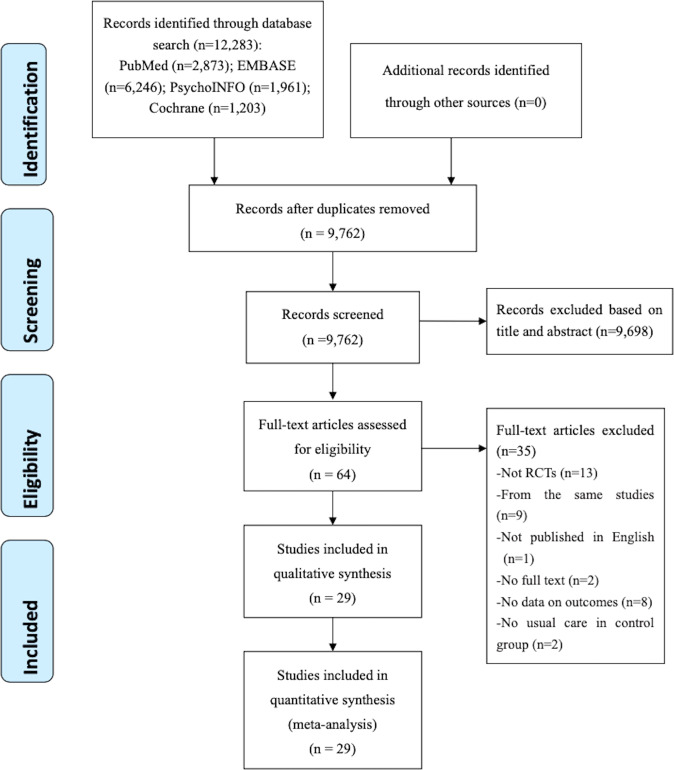
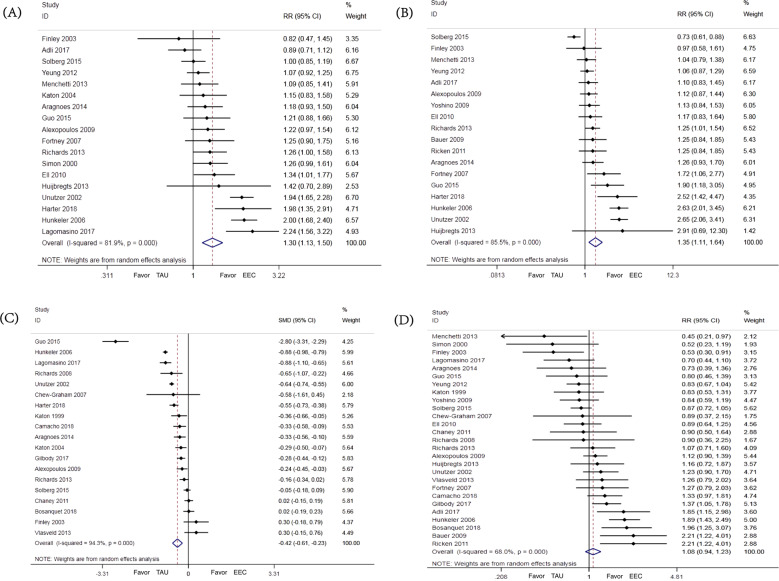
Several care models have been developed to improve treatment for depression, all of which provide "enhanced" evidence-based care (EEC). The essential component of these approaches is Measurement-Based Care (MBC). Specifically, Collaborative Care (CC), and Algorithm-guided Treatment (AGT), and Integrated Care (IC) all use varying forms of rigorous MBC assessment, care management, and/or treatment algorithms as key instruments to optimize treatment delivery and outcomes for depression. This meta-analysis systematically examined the effectiveness of EEC versus usual care for depressive disorders based on cluster-randomized studies or randomized controlled trials (RCTs). PubMed, the Cochrane Library, and PsycInfo, EMBASE, up to January 6th, 2020 were searched for this meta-analysis. The electronic search was supplemented by a manual search. Standardized mean difference (SMD), risk ratio (RR), and their 95% confidence intervals (CIs) were calculated and analyzed. A total of 29 studies with 15,255 participants were analyzed. EEC showed better effectiveness with the pooled RR for response of 1.30 (95%CI: 1.13-1.50, I = 81.9%, P < 0.001, 18 studies), remission of 1.35 (95%CI: 1.11-1.64, I = 85.5%, P < 0.001, 18 studies) and symptom reduction with a pooled SMD of -0.42 (95%CI: -0.61-(-0.23), I = 94.3%, P < 0.001, 19 studies). All-cause discontinuations were similar between EEC and usual care with the pooled RR of 1.08 (95%CI: 0.94-1.23, I = 68.0%, P = 0.303, 27 studies). This meta-analysis supported EEC as an evidence-based framework to improve the treatment outcome of depressive disorders.Review registration: PROSPERO: CRD42020163668.
已经开发出几种护理模式来改善抑郁症的治疗效果,这些模式都提供了“强化”循证护理(EEC)。这些方法的基本组成部分是基于测量的护理(MBC)。具体而言,协作护理(CC)、算法引导治疗(AGT)和综合护理(IC)都使用不同形式的严格 MBC 评估、护理管理和/或治疗算法作为优化抑郁症治疗效果的关键手段。本荟萃分析系统地研究了 EEC 与常规护理相比对抑郁障碍的有效性,这些研究基于聚类随机研究或随机对照试验(RCT)。这项荟萃分析检索了 PubMed、Cochrane 图书馆和 PsycInfo、EMBASE,截至 2020 年 1 月 6 日。电子检索辅以手动检索。计算并分析标准化均数差(SMD)、风险比(RR)及其 95%置信区间(CI)。共分析了 29 项研究,涉及 15255 名参与者。EEC 的效果更好,反应的汇总 RR 为 1.30(95%CI:1.13-1.50,I=81.9%,P<0.001,18 项研究),缓解的汇总 RR 为 1.35(95%CI:1.11-1.64,I=85.5%,P<0.001,18 项研究),症状减轻的汇总 SMD 为-0.42(95%CI:-0.61-(-0.23),I=94.3%,P<0.001,19 项研究)。EEC 和常规护理的全因停药率相似,汇总 RR 为 1.08(95%CI:0.94-1.23,I=68.0%,P=0.303,27 项研究)。这项荟萃分析支持 EEC 作为一种循证框架,可改善抑郁障碍的治疗效果。
PROSPERO:CRD42020163668。