Kang Dae Yun, Kim Bo-Hyun, Lee Tae Ho, Shim Jae Won, Kim Sungmin, Sung Ha-Jun, Chang Kee Joo, Kim Tae Geun
School of Electrical Engineering, Korea University, Seoul, 02841, Republic of Korea.
Department of Advanced Materials Engineering, Kongju National University, Cheonan, 31080, Republic of Korea.
Nanomicro Lett. 2021 Oct 16;13(1):211. doi: 10.1007/s40820-021-00735-y.
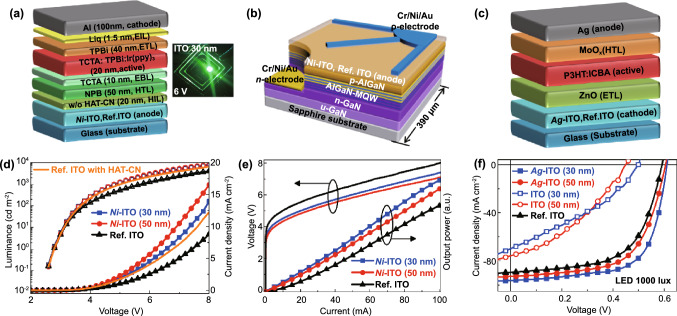
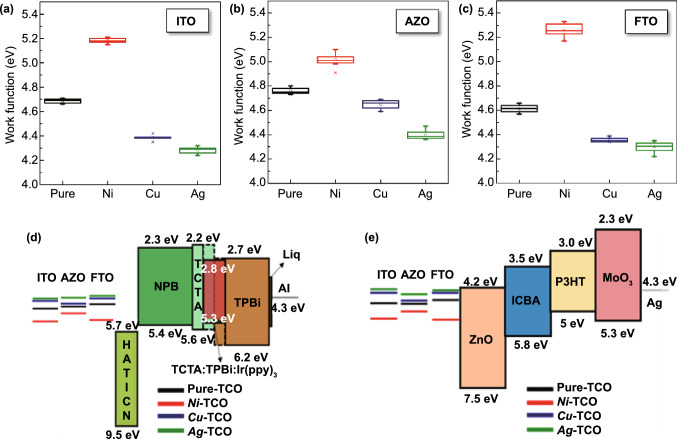
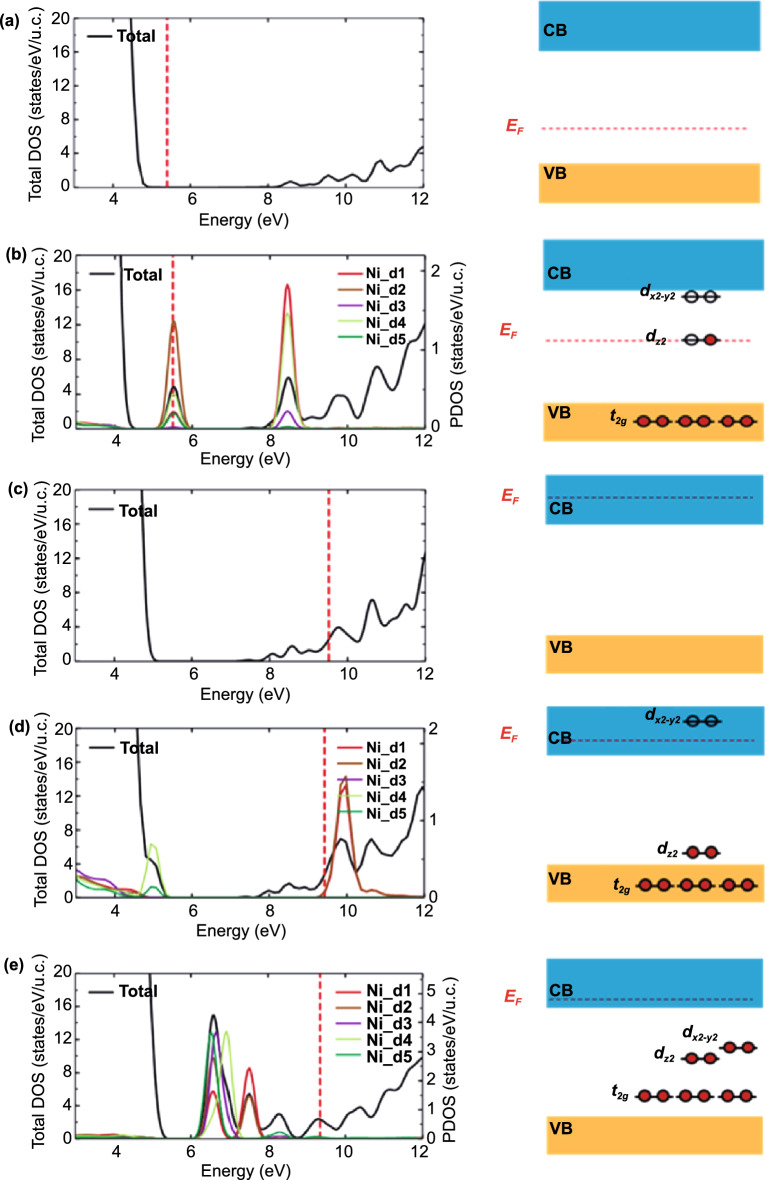
Ultrathin film-based transparent conductive oxides (TCOs) with a broad work function (WF) tunability are highly demanded for efficient energy conversion devices. However, reducing the film thickness below 50 nm is limited due to rapidly increasing resistance; furthermore, introducing dopants into TCOs such as indium tin oxide (ITO) to reduce the resistance decreases the transparency due to a trade-off between the two quantities. Herein, we demonstrate dopant-tunable ultrathin (≤ 50 nm) TCOs fabricated via electric field-driven metal implantation (m-TCOs; m = Ni, Ag, and Cu) without compromising their innate electrical and optical properties. The m-TCOs exhibit a broad WF variation (0.97 eV), high transmittance in the UV to visible range (89-93% at 365 nm), and low sheet resistance (30-60 Ω cm). Experimental and theoretical analyses show that interstitial metal atoms mainly affect the change in the WF without substantial losses in optical transparency. The m-ITOs are employed as anode or cathode electrodes for organic light-emitting diodes (LEDs), inorganic UV LEDs, and organic photovoltaics for their universal use, leading to outstanding performances, even without hole injection layer for OLED through the WF-tailored Ni-ITO. These results verify the proposed m-TCOs enable effective carrier transport and light extraction beyond the limits of traditional TCOs.
具有宽功函数(WF)可调性的基于超薄膜的透明导电氧化物(TCO)对于高效能量转换器件具有很高的需求。然而,由于电阻迅速增加,将膜厚度减小到50nm以下受到限制;此外,向诸如氧化铟锡(ITO)的TCO中引入掺杂剂以降低电阻会由于这两个量之间的权衡而降低透明度。在此,我们展示了通过电场驱动的金属注入制备的掺杂剂可调超薄(≤50nm)TCO(m-TCO;m = Ni、Ag和Cu),而不会损害其固有的电学和光学性能。m-TCO表现出宽的WF变化(0.97eV)、在紫外到可见光范围内的高透过率(在365nm处为89-93%)和低方块电阻(30-60Ω·cm)。实验和理论分析表明,间隙金属原子主要影响WF的变化,而不会导致光学透明度的大幅损失。m-ITO因其通用性而被用作有机发光二极管(LED)、无机紫外LED和有机光伏的阳极或阴极电极,即使对于通过功函数定制的Ni-ITO的OLED,在没有空穴注入层的情况下也能带来出色的性能。这些结果证明了所提出的m-TCO能够实现超越传统TCO限制的有效载流子传输和光提取。