Department of Diagnostic Radiology, Yokohama City University Graduate School of Medicine, Yokohama, Japan.
Department of Cardiology, Kanagawa Cardiovascular and Respiratory Center, Yokohama, Japan.
J Cardiovasc Magn Reson. 2021 Oct 18;23(1):112. doi: 10.1186/s12968-021-00807-3.
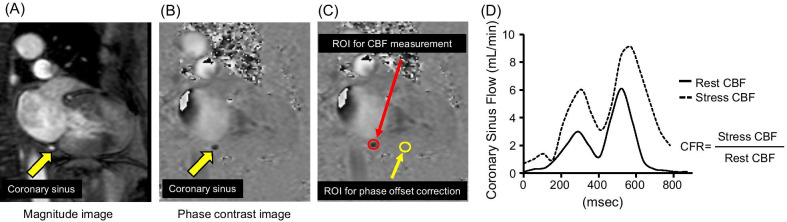
Coronary microvascular dysfunction (CMD) has been proposed as a novel mechanism for the pathophysiology of heart failure (HF) with preserved ejection fraction (HFpEF). Recent studies have suggested the potential utility of coronary flow reserve (CFR) as a marker of CMD in patients with HFpEF. Phase contrast (PC) cine cardiovascular magnetic resonance (CMR) of the coronary sinus has emerged as a non-invasive method to quantify CFR. We aimed to investigate the prognostic value of CMR-derived CFR in patients with HFpEF.
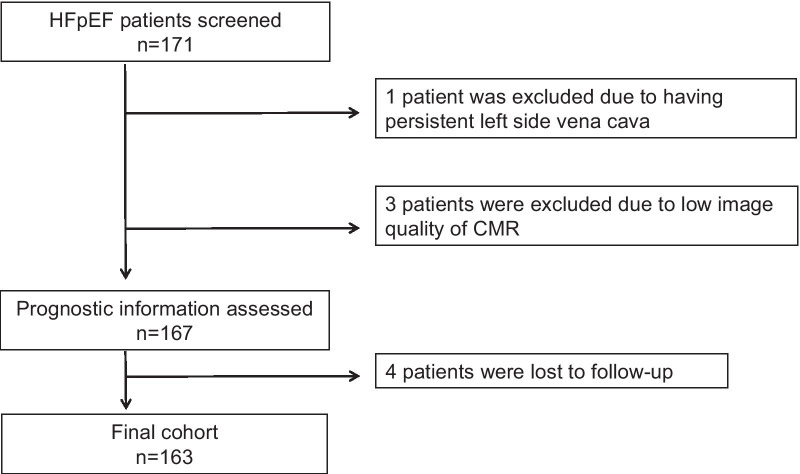
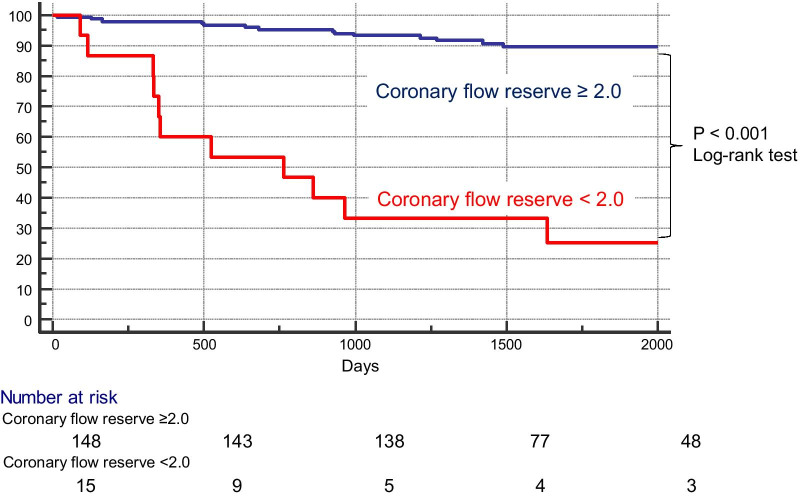
Data from 163 HFpEF patients (73 ± 9 years; 86 [53%] female) were retrospectively analyzed. Coronary sinus blood flow was measured in all patients, and myocardial blood flow was calculated as coronary sinus blood flow divided by left ventricular mass. CFR was calculated as the myocardial blood flow during adenosine triphosphate infusion divided by that at rest. Adverse events were defined as all-cause death and hospitalization due to HF exacerbation. Event-free survival stratified according to CFR < 2.0 was estimated with Kaplan-Meier survival methods and Log-rank test.
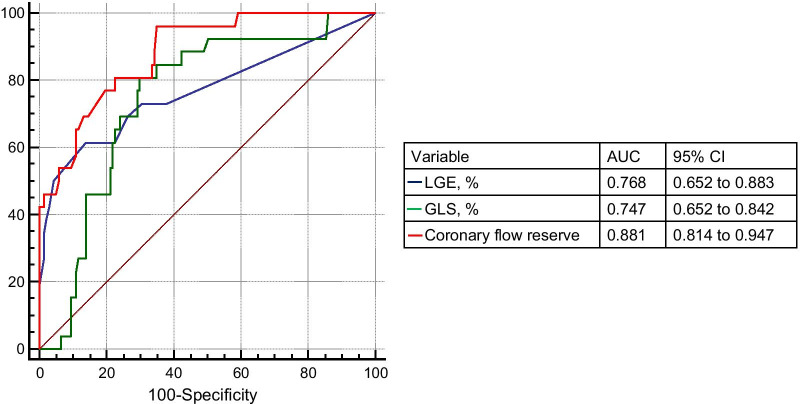
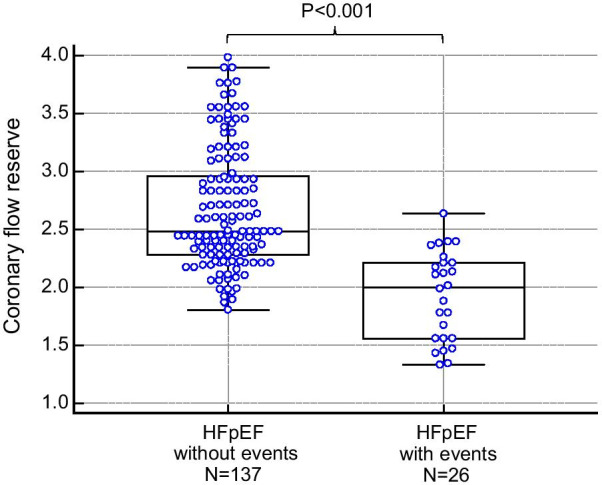
During a median follow-up of 4.1 years, 26 patients (16%) experienced adverse events. CMR-derived CFR was significantly lower in HFpEF with adverse events compared with those without (1.93 ± 0.38 vs. 2.67 ± 0.52, p < 0.001). On a Kaplan Meier curve, the rates of adverse events were significantly higher in HFpEF patients with CFR < 2.0 compared with HFpEF with CFR ≥ 2.0 (p < 0.001). The area under the curve of CFR for predicting adverse events was significantly higher than that of LGE (0.881 vs. 0.768, p = 0.037) and GLS (0.881 vs. 0.747, p = 0.036).
CFR assessed using coronary sinus PC cine CMR may be useful as a non-invasive prognostic marker for HFpEF patients.
冠状动脉微血管功能障碍(CMD)被认为是射血分数保留型心力衰竭(HFpEF)病理生理学的一种新机制。最近的研究表明,冠状动脉血流储备(CFR)作为 HFpEF 患者 CMD 的标志物具有潜在的应用价值。相位对比(PC)电影心血管磁共振(CMR)冠状动脉窦的出现为定量 CFR 提供了一种非侵入性方法。我们旨在研究 HFpEF 患者 CMR 衍生 CFR 的预后价值。
回顾性分析了 163 例 HFpEF 患者(73±9 岁;86 [53%] 为女性)的数据。所有患者均测量冠状动脉窦血流,心肌血流计算为冠状动脉窦血流除以左心室质量。CFR 计算为腺苷三磷酸输注时的心肌血流除以休息时的心肌血流。不良事件定义为全因死亡和因 HF 恶化而住院。根据 CFR<2.0 分层的无事件生存用 Kaplan-Meier 生存方法和 Log-rank 检验进行估计。
在中位随访 4.1 年期间,26 名患者(16%)发生不良事件。与无不良事件的 HFpEF 患者相比,HFpEF 患者的 CMR 衍生 CFR 明显较低(1.93±0.38 比 2.67±0.52,p<0.001)。在 Kaplan-Meier 曲线上,CFR<2.0 的 HFpEF 患者的不良事件发生率明显高于 CFR≥2.0 的 HFpEF 患者(p<0.001)。CFR 预测不良事件的曲线下面积明显高于 LGE(0.881 比 0.768,p=0.037)和 GLS(0.881 比 0.747,p=0.036)。
使用冠状动脉窦 PC 电影 CMR 评估的 CFR 可能是 HFpEF 患者有用的非侵入性预后标志物。