Department of Biochemistry and Molecular Biology, Pennsylvania State University, PA, 16802, University Park, USA.
Bioinformatics and Genomics Program, Huck Institute of the Life Sciences, Pennsylvania State University, University Park, PA, 16802, USA.
Genome Med. 2021 Oct 18;13(1):163. doi: 10.1186/s13073-021-00982-z.
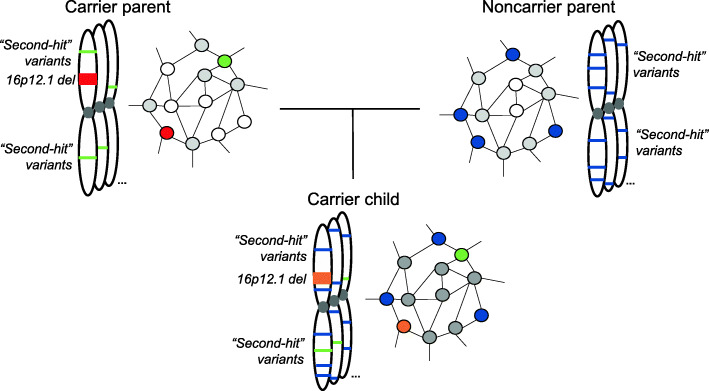
Recent studies have suggested that individual variants do not sufficiently explain the variable expressivity of phenotypes observed in complex disorders. For example, the 16p12.1 deletion is associated with developmental delay and neuropsychiatric features in affected individuals, but is inherited in > 90% of cases from a mildly-affected parent. While children with the deletion are more likely to carry additional "second-hit" variants than their parents, the mechanisms for how these variants contribute to phenotypic variability are unknown.
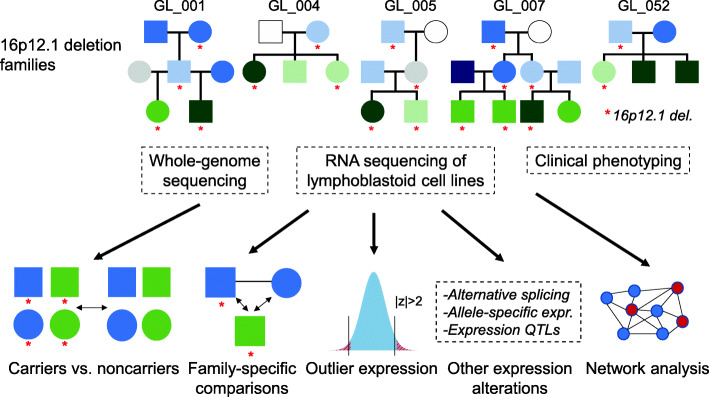
We performed detailed clinical assessments, whole-genome sequencing, and RNA sequencing of lymphoblastoid cell lines for 32 individuals in five large families with multiple members carrying the 16p12.1 deletion. We identified contributions of the 16p12.1 deletion and "second-hit" variants towards a range of expression changes in deletion carriers and their family members, including differential expression, outlier expression, alternative splicing, allele-specific expression, and expression quantitative trait loci analyses.
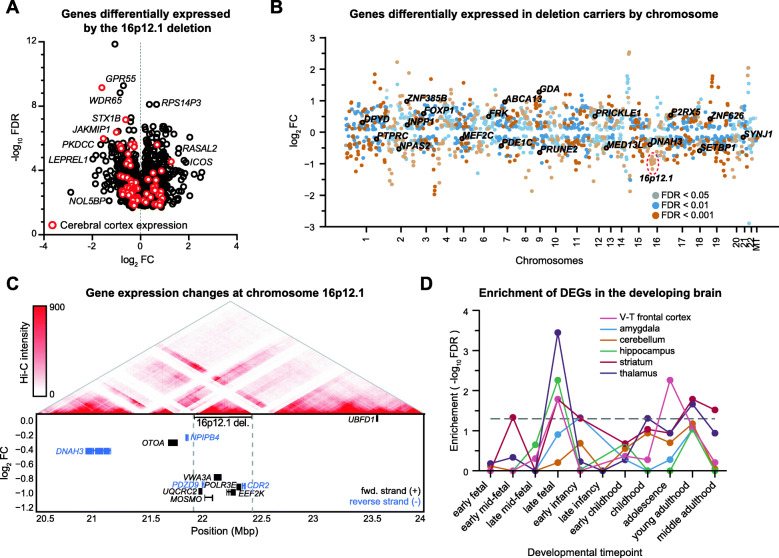
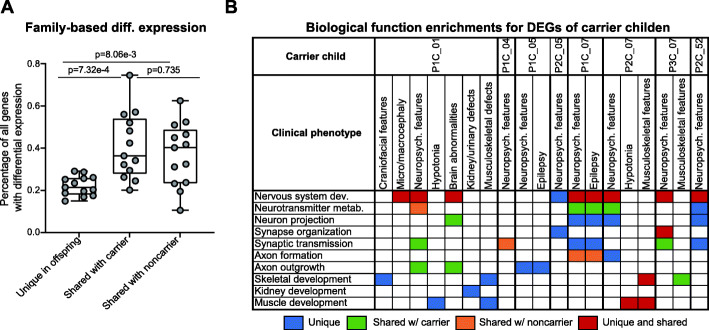
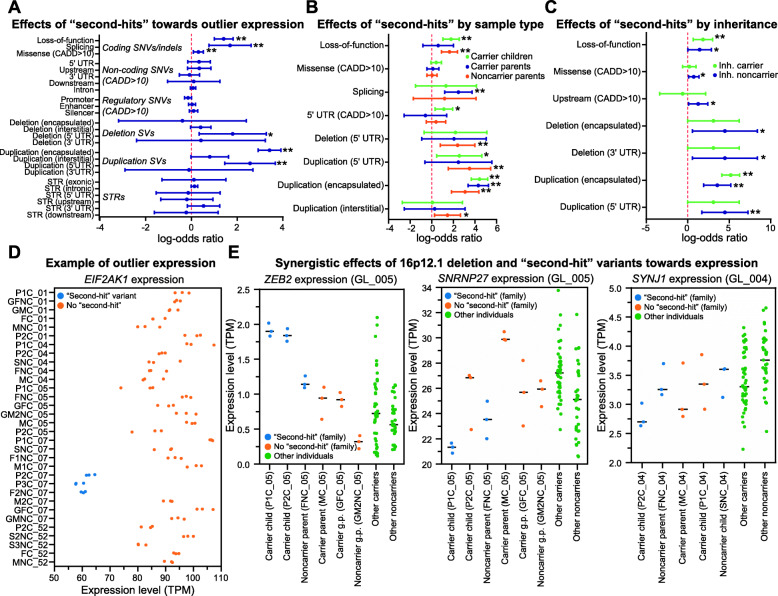
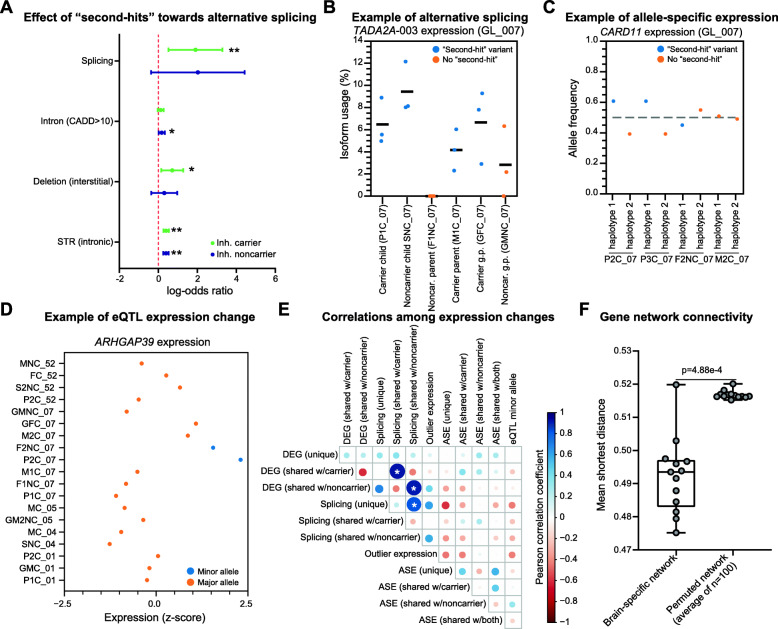
We found that the deletion dysregulates multiple autism and brain development genes such as FOXP1, ANK3, and MEF2. Carrier children also showed an average of 5323 gene expression changes compared with one or both parents, which matched with 33/39 observed developmental phenotypes. We identified significant enrichments for 13/25 classes of "second-hit" variants in genes with expression changes, where 4/25 variant classes were only enriched when inherited from the noncarrier parent, including loss-of-function SNVs and large duplications. In 11 instances, including for ZEB2 and SYNJ1, gene expression was synergistically altered by both the deletion and inherited "second-hits" in carrier children. Finally, brain-specific interaction network analysis showed strong connectivity between genes carrying "second-hits" and genes with transcriptome alterations in deletion carriers.
Our results suggest a potential mechanism for how "second-hit" variants modulate expressivity of complex disorders such as the 16p12.1 deletion through transcriptomic perturbation of gene networks important for early development. Our work further shows that family-based assessments of transcriptome data are highly relevant towards understanding the genetic mechanisms associated with complex disorders.
最近的研究表明,个体变体不足以解释复杂疾病中观察到的表型的可变性。例如,16p12.1 缺失与受影响个体的发育迟缓和神经精神特征有关,但在 > 90%的情况下,该缺失是从轻度受影响的父母那里遗传的。虽然携带缺失的儿童比他们的父母更有可能携带额外的“二次打击”变体,但这些变体如何导致表型变异性的机制尚不清楚。
我们对五个有多个携带 16p12.1 缺失的成员的大家庭中的 32 个人进行了详细的临床评估、全基因组测序和淋巴母细胞系的 RNA 测序。我们确定了 16p12.1 缺失和“二次打击”变体对缺失携带者及其家庭成员的一系列表达变化的贡献,包括差异表达、异常表达、选择性剪接、等位基因特异性表达和表达数量性状基因座分析。
我们发现缺失会使 FOXP1、ANK3 和 MEF2 等多个自闭症和大脑发育基因失调。携带者儿童与一个或两个父母相比,平均有 5323 个基因表达变化,这与 33/39 个观察到的发育表型相匹配。我们在表达变化的基因中发现了 13/25 类“二次打击”变体的显著富集,其中 4/25 类变体仅在从非携带者父母那里遗传时富集,包括功能丧失性 SNV 和大片段重复。在 11 个实例中,包括 ZEB2 和 SYNJ1,携带者儿童中的缺失和遗传“二次打击”协同改变了基因表达。最后,大脑特异性相互作用网络分析显示,携带“二次打击”的基因与缺失携带者中转录组改变的基因之间存在强烈的连接。
我们的结果表明,“二次打击”变体通过对早期发育重要的基因网络的转录组扰动,调节复杂疾病(如 16p12.1 缺失)表型可变性的潜在机制。我们的工作进一步表明,基于家庭的转录组数据分析对于理解与复杂疾病相关的遗传机制非常重要。