Da Silva Thais Bento Lima, Ordonez Tiago Nascimento, Bregola Allan Gustavo, Bahia Valéria Santoro, Cecchini Mário Amore, Guimarães Henrique Cerqueira, Gambogi Leandro Boson, Caramelli Paulo, Balthazar Marcio Luiz Figueredo, Damasceno Benito Pereira, Brucki Sonia Maria Dozzi, de Souza Leonardo Cruz, Nitrini Ricardo, Yassuda Monica Sanches
Department of Neurology, Faculty of Medicine, University of São Paulo, São Paulo, Brazil.
Gerontology, School of Arts, Sciences, and Humanities, University of São Paulo, São Paulo, Brazil.
Front Neurol. 2021 Sep 30;12:728108. doi: 10.3389/fneur.2021.728108. eCollection 2021.
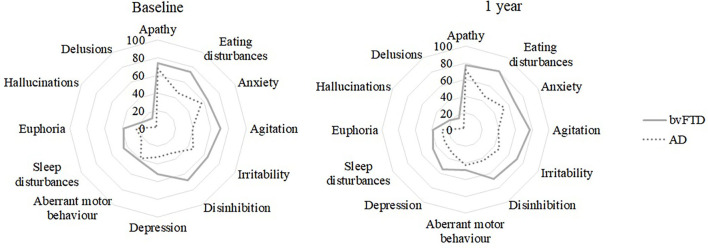
Neuropsychiatric symptoms in patients with frontotemporal dementia (FTD) are highly prevalent and may complicate clinical managements. To test whether the Neuropsychiatry Inventory (NPI) could detect change in neuropsychiatric symptoms and caregiver's distress in patients diagnosed with behavioral variant frontotemporal dementia (bvFTD) and Alzheimer's disease (AD) from baseline to a 12-month follow-up and to investigate possible predictors of change in NPI scores. The sample consisted of 31 patients diagnosed with bvFTD and 28 patients with AD and their caregivers. The Mini-Mental State Examination (MMSE), Addenbrooke's Cognitive Examination Revised (ACE-R), the INECO Frontal Screening (IFS), the Frontal Assessment Battery (FAB), the Executive Interview (EXIT-25) and the NPI were applied. Descriptive statistics, Mann-Whitney U test, Wilcoxon test, Chi square (χ) test and Linear Regression Analysis were used. NPI total and caregiver distress scores were statistically higher among bvFTD patients at both assessment points. MMSE, ACE-R scores significantly declined and NPI Total and Distress scores significantly increased in both groups. In the bvFTD group, age was the only independent predictor variable for the NPI total score at follow up. In the AD group, ACE-R and EXIT-25, conjunctively, were associated with the NPI total score at follow up. In 12 months, cognition declined and neuropsychiatric symptoms increased in bvFTD and AD groups. In the AD group only, cognitive impairment was a significant predictor of change in neuropsychiatric symptoms.
额颞叶痴呆(FTD)患者的神经精神症状非常普遍,可能会使临床管理复杂化。为了测试神经精神科问卷(NPI)能否检测出行为变异型额颞叶痴呆(bvFTD)和阿尔茨海默病(AD)患者从基线到12个月随访期间神经精神症状的变化以及照顾者的痛苦程度,并调查NPI评分变化的可能预测因素。样本包括31例诊断为bvFTD的患者、28例AD患者及其照顾者。应用简易精神状态检查表(MMSE)、修订版Addenbrooke认知检查表(ACE-R)、INECO额叶筛查量表(IFS)、额叶评估量表(FAB)、执行功能访谈(EXIT-25)和NPI。采用描述性统计、Mann-Whitney U检验、Wilcoxon检验、卡方(χ)检验和线性回归分析。在两个评估点,bvFTD患者的NPI总分和照顾者痛苦评分在统计学上均较高。两组的MMSE、ACE-R评分显著下降,NPI总分和痛苦评分显著增加。在bvFTD组中,年龄是随访时NPI总分的唯一独立预测变量。在AD组中,ACE-R和EXIT-25联合起来与随访时的NPI总分相关。在12个月内,bvFTD组和AD组的认知能力下降,神经精神症状增加。仅在AD组中,认知障碍是神经精神症状变化的显著预测因素。