Wang Zhaoqin, Huang Yan, Wang Di, Wang Rumeng, Li Kunshan, Qi Qin, Ma Zhe, Gu Muen, Zheng Handan, Lu Yuan, Wu Luyi
Department of Aeronautics and Astronautics, Shanghai Key Laboratory of Acupuncture Mechanism and Acupoint Function, Fudan University, Shanghai 200433, China.
Shanghai Research Institute of Acupuncture and Meridian, Shanghai 200030, China.
Evid Based Complement Alternat Med. 2021 Oct 8;2021:9945121. doi: 10.1155/2021/9945121. eCollection 2021.
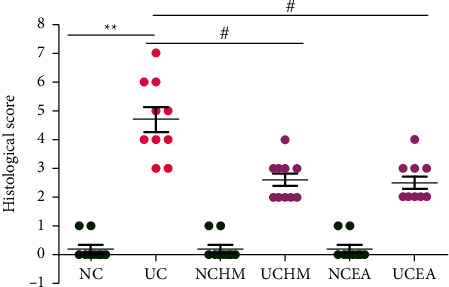
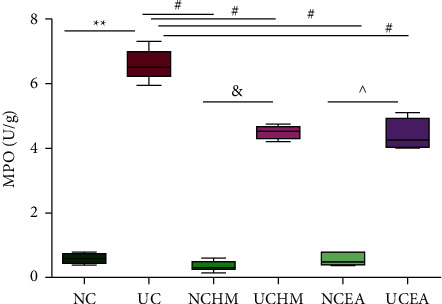
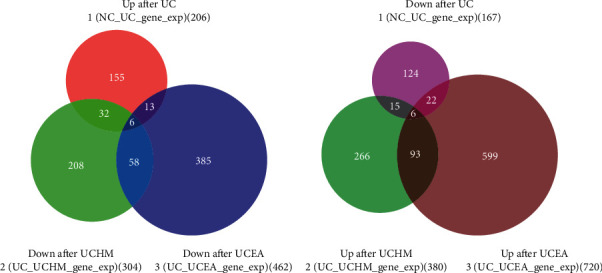
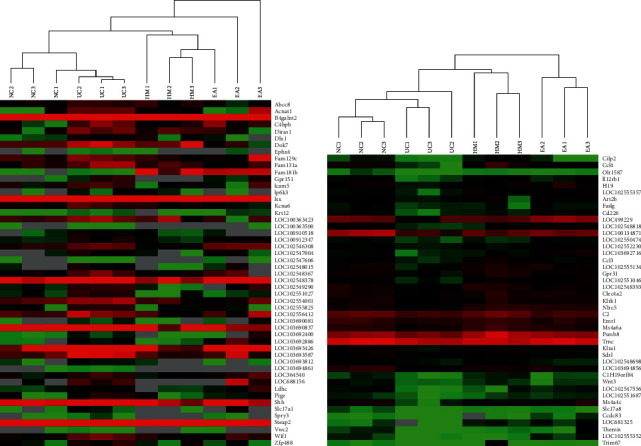
Acupuncture and moxibustion have definite clinical effects on treating ulcerative colitis (UC), but their mechanism is still unclear. To investigate the molecular mechanisms, we applied herb-partitioned moxibustion or electroacupuncture at the Tianshu (ST25) points on UC rats and used RNA sequencing to identify molecular consequences. Male Sprague Dawley (SD) rats were divided into 6 groups randomly: the normal control (NC) group, the control + herb-partitioned moxibustion (NCHM) group, the control + electroacupuncture (NCEA) group, the model (UC) group, the model + herb-partitioned moxibustion (UCHM) group, and the model + electroacupuncture (UCEA) group. Compared to the UC group, HE staining in the UCHM group and UCEA group indicated that colitis was relieved, the histopathological score and MPO were both significantly reduced, and the serum hs-CRP concentration was decreased significantly. The results of RNA-seq suggested that, compared to the NC group, 206 upregulated genes and 167 downregulated genes were identified in colon tissues from the UC group; compared to the UC group, the expression levels of some genes were both affected in the UCHM group and the UCEA group (684 differentially expressed genes were identified in the UCHM group, and 1182 differentially expressed genes were identified in the UCEA group). KEGG signal pathway analysis indicated that the differentially expressed genes in the UCHM group were associated with the JAK-STAT signaling pathway and cell adhesion molecule (CAM); the differentially expressed genes in the UCEA group were associated with the NF-B signaling pathway, the toll-like receptor signaling pathways, the PI3K-Akt signaling pathway, the MAPK signaling pathway, and the Wnt signaling pathway. This is the first study to reveal the gene expression characteristics of the anti-inflammatory effect of UC rats from the perspective of acupuncture and moxibustion control, which provide a clue for further investigation into the molecular mechanisms of UC treatment by acupuncture and moxibustion.
针灸对溃疡性结肠炎(UC)具有确切的临床疗效,但其作用机制尚不清楚。为探究其分子机制,我们对UC大鼠的天枢穴(ST25)进行隔药灸或电针治疗,并采用RNA测序来确定分子效应。将雄性Sprague Dawley(SD)大鼠随机分为6组:正常对照组(NC)、对照+隔药灸组(NCHM)、对照+电针组(NCEA)、模型(UC)组、模型+隔药灸组(UCHM)和模型+电针组(UCEA)。与UC组相比,UCHM组和UCEA组的HE染色显示结肠炎得到缓解,组织病理学评分和MPO均显著降低,血清hs-CRP浓度也显著下降。RNA-seq结果表明,与NC组相比,UC组结肠组织中鉴定出206个上调基因和167个下调基因;与UC组相比,UCHM组和UCEA组中一些基因的表达水平均受到影响(UCHM组鉴定出684个差异表达基因,UCEA组鉴定出1182个差异表达基因)。KEGG信号通路分析表明,UCHM组差异表达基因与JAK-STAT信号通路和细胞粘附分子(CAM)相关;UCEA组差异表达基因与NF-κB信号通路、Toll样受体信号通路、PI3K-Akt信号通路、MAPK信号通路和Wnt信号通路相关。这是首次从针灸调控角度揭示UC大鼠抗炎作用的基因表达特征,为进一步研究针灸治疗UC的分子机制提供了线索。