Yamaguchi Ai, Kawagoe Izumi, Inoue Shigeaki, Kochiyama Tsukasa, Fukuda Masataka, Saito Masafumi, Hayashida Masakazu
Department of Anesthesiology and Pain Medicine, Juntendo University School of Medicine, Tokyo, Japan.
Department of Disaster and Emergency and Critical Care Medicine, Kobe University Graduate School of Medicine, Kobe, Japan.
J Thorac Dis. 2021 Sep;13(9):5430-5438. doi: 10.21037/jtd-21-878.
Anaesthetics generally have an immunosuppressive effect, which may be related to prognosis. We conducted to clarify the relationship between peri-operative immunosuppression and anaesthetic agents in patients undergoing lung cancer surgery, resulting in better selection of intraoperative anaesthesia.
Prospective randomized controlled study was performed in single-University hospital. Patients with lung cancer who were scheduled to undergo lung cancer resection between June 2018 and July 2019. Patients were randomly divided to three groups: desflurane (group D), sevoflurane (group S), and propofol (group P) groups. Peripheral blood mononuclear cells were separated from the blood samples. CD4+ and CD8+ T cells, programmed death 1 (PD-1) on CD4+ and CD8+ T cells, and regulatory T cells were measured by flow cytometry. The Wilcoxon signed rank sum test was used to compare pre- and post-operative values for each anaesthesia.
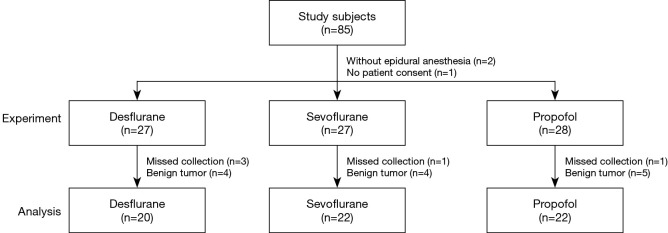
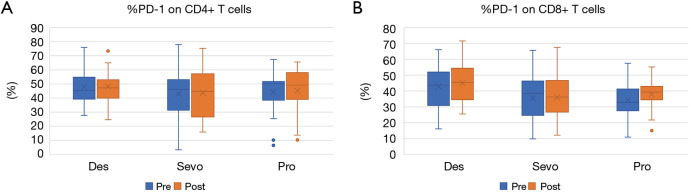
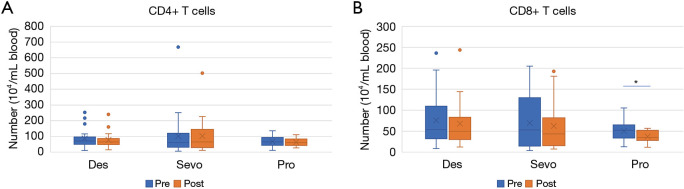
Eighty-two patients were enrolled; samples from 64 individuals (20 in group D, 22 in group S, and 22 in group P) were analysed after exclusion. The number of CD8+ T cells was significantly lower after the operation than before the operation in the group P (P<0.05). The proportion of regulatory T cells was significantly increased after surgery, compared with before surgery in the group S (P<0.05). There was no difference in PD-1 on CD4+ and CD8+ T cells after lung surgery among the three groups.
Propofol decreased the number of CD8+ T cells, while sevoflurane increased the proportion of regulatory T cells in patients after lung surgery; however, propofol, sevoflurane, and desflurane did not increase the proportion of PD-1 on CD4+ and CD8+ T cells after lung surgery. Sevoflurane and propofol may cause immunosuppression via different mechanisms after lung cancer surgery.
UMIN-CTR: UMIN000031911.
麻醉剂通常具有免疫抑制作用,这可能与预后相关。我们旨在阐明肺癌手术患者围手术期免疫抑制与麻醉剂之间的关系,从而更好地选择术中麻醉方式。
在单所大学医院进行前瞻性随机对照研究。纳入2018年6月至2019年7月期间计划接受肺癌切除术的肺癌患者。患者被随机分为三组:地氟醚组(D组)、七氟醚组(S组)和丙泊酚组(P组)。从血样中分离外周血单个核细胞。通过流式细胞术检测CD4⁺和CD8⁺T细胞、CD4⁺和CD8⁺T细胞上的程序性死亡1(PD - 1)以及调节性T细胞。采用Wilcoxon符号秩和检验比较每种麻醉方式术前和术后的值。
共纳入82例患者;排除后对64例个体(D组20例、S组22例、P组22例)的样本进行分析。P组术后CD8⁺T细胞数量显著低于术前(P<0.05)。S组术后调节性T细胞比例较术前显著增加(P<0.05)。三组肺癌手术后CD4⁺和CD8⁺T细胞上的PD - 1无差异。
肺癌手术后,丙泊酚降低了CD8⁺T细胞数量,而七氟醚增加了调节性T细胞比例;然而,丙泊酚、七氟醚和地氟醚并未增加肺癌手术后CD4⁺和CD8⁺T细胞上PD - 1的比例。七氟醚和丙泊酚在肺癌手术后可能通过不同机制导致免疫抑制。
UMIN - CTR:UMIN000031911。