Belei Oana, Ancusa Oana, Mara Adelina, Olariu Laura, Amaricai Elena, Folescu Roxana, Zamfir Carmen Lacramioara, Gurgus Daniela, Motoc Andrei G, Stânga Livia Claudia, Strat Liliana, Marginean Otilia
First Pediatric Clinic, Disturbance of Growth and Development on Children Research Center, "Victor Babes" University of Medicine and Pharmacy, Timisoara, Romania.
Fifth Department of Internal Medicine, "Victor Babes" University of Medicine and Pharmacy, Timisoara, Romania.
Front Pediatr. 2021 Sep 30;9:721918. doi: 10.3389/fped.2021.721918. eCollection 2021.
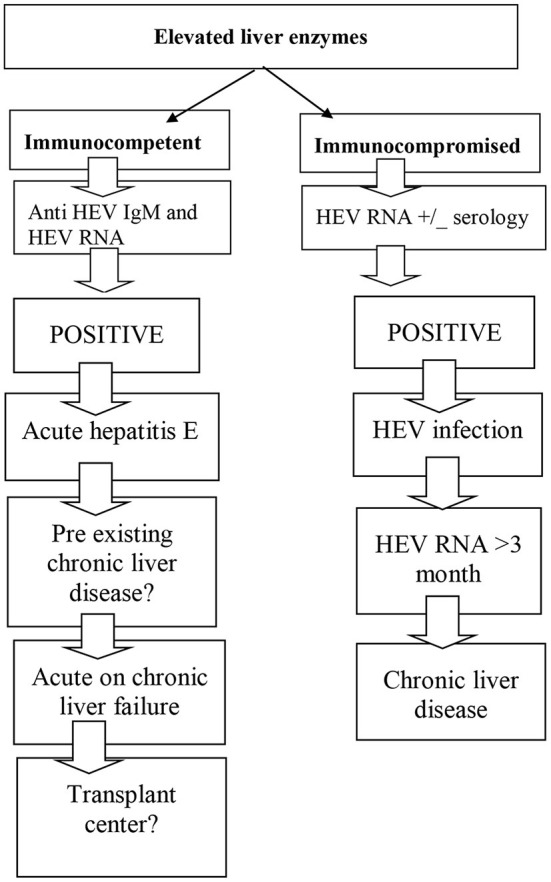
Hepatitis E virus (HEV) infection is a polymorphic condition, present throughout the world and involving children and adults. Multiple studies over the last decade have contributed to a better understanding of the natural evolution of this infection in various population groups, several reservoirs and transmission routes being identified. To date, acute or chronic HEV-induced hepatitis has in some cases remained underdiagnosed due to the lower accuracy of serological tests and due to the evolutionary possibility with extrahepatic manifestations. Implementation of diagnostic tests based on nucleic acid analysis has increased the detection rate of this disease. The epidemiological and clinical features of HEV hepatitis differ depending on the geographical areas studied. HEV infection is usually a self-limiting condition in immunocompetent patients, but in certain categories of vulnerable patients it can induce a sudden evolution toward acute liver failure (pregnant women) or chronicity (immunosuppressed patients, post-transplant, hematological, or malignant diseases). In acute HEV infections in most cases supportive treatment is sufficient. In patients who develop chronic hepatitis with HEV, dose reduction of immunosuppressive medication should be the first therapeutic step, especially in patients with transplant. In case of unfavorable response, the initiation of antiviral therapy is recommended. In this review, the authors summarized the essential published data related to the epidemiological, clinical, paraclinical, and therapeutic aspects of HEV infection in adult and pediatric patients.
戊型肝炎病毒(HEV)感染是一种多态性疾病,在全球范围内存在,涉及儿童和成人。过去十年的多项研究有助于更好地了解这种感染在不同人群中的自然演变,已确定了多种宿主和传播途径。迄今为止,由于血清学检测准确性较低以及存在肝外表现的演变可能性,急性或慢性HEV引起的肝炎在某些情况下仍未得到充分诊断。基于核酸分析的诊断测试的应用提高了该疾病的检出率。HEV肝炎的流行病学和临床特征因所研究的地理区域而异。HEV感染在免疫功能正常的患者中通常是一种自限性疾病,但在某些易感染患者类别中,它可导致病情突然演变为急性肝衰竭(孕妇)或慢性肝炎(免疫抑制患者、移植后患者、血液系统疾病或恶性疾病患者)。在大多数急性HEV感染病例中,支持性治疗就足够了。对于发展为慢性HEV肝炎的患者,降低免疫抑制药物剂量应是首要治疗步骤,尤其是对于移植患者。如果反应不佳,建议开始抗病毒治疗。在这篇综述中,作者总结了已发表的有关成人和儿童患者HEV感染的流行病学、临床、辅助检查和治疗方面的重要数据。