State Key Laboratory of Lithospheric Evolution, Institute of Geology and Geophysics, Chinese Academy of Sciences, Beijing, China.
Key Laboratory of Lunar and Deep Space Exploration, National Astronomical Observatories, Chinese Academy of Sciences, Beijing, China.
Nature. 2021 Dec;600(7887):54-58. doi: 10.1038/s41586-021-04100-2. Epub 2021 Oct 19.
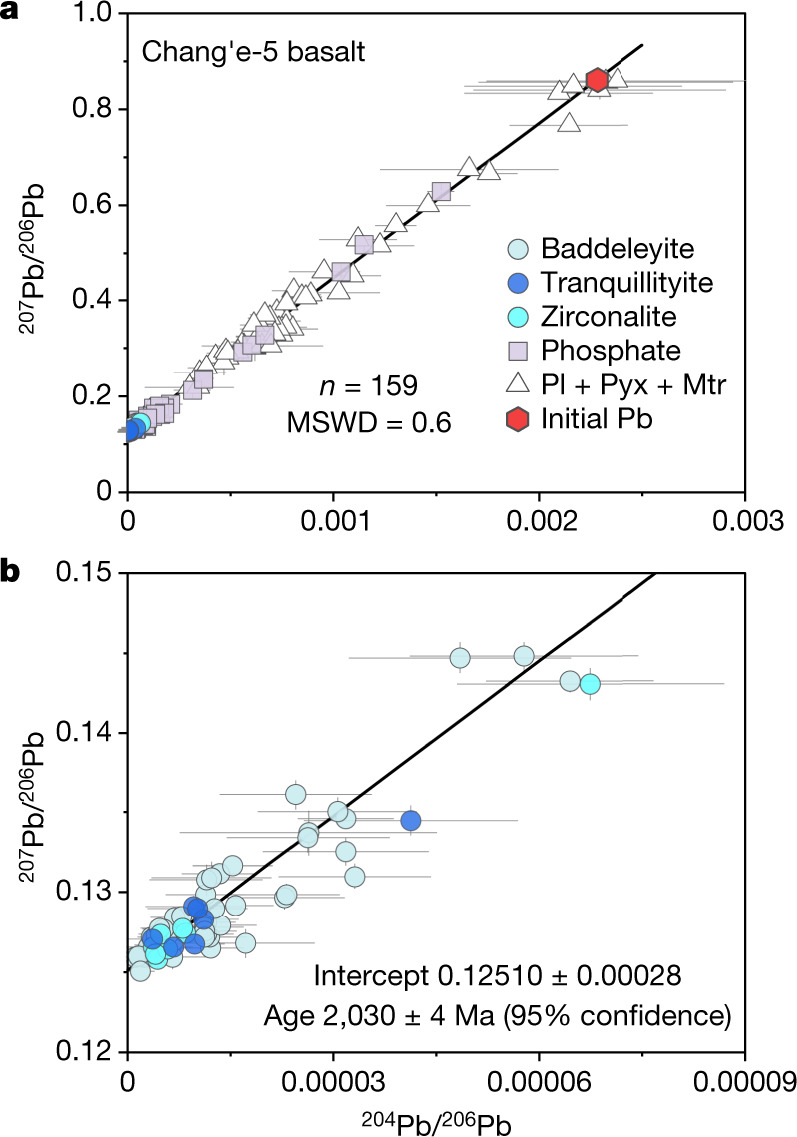
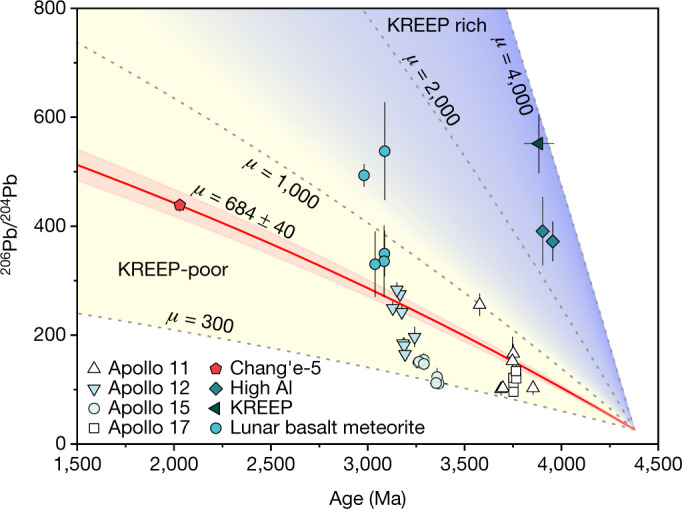
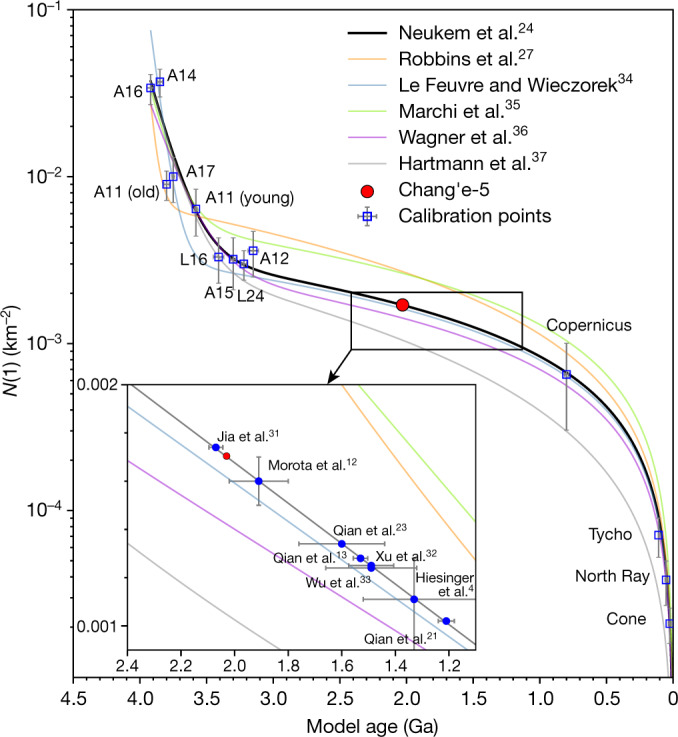
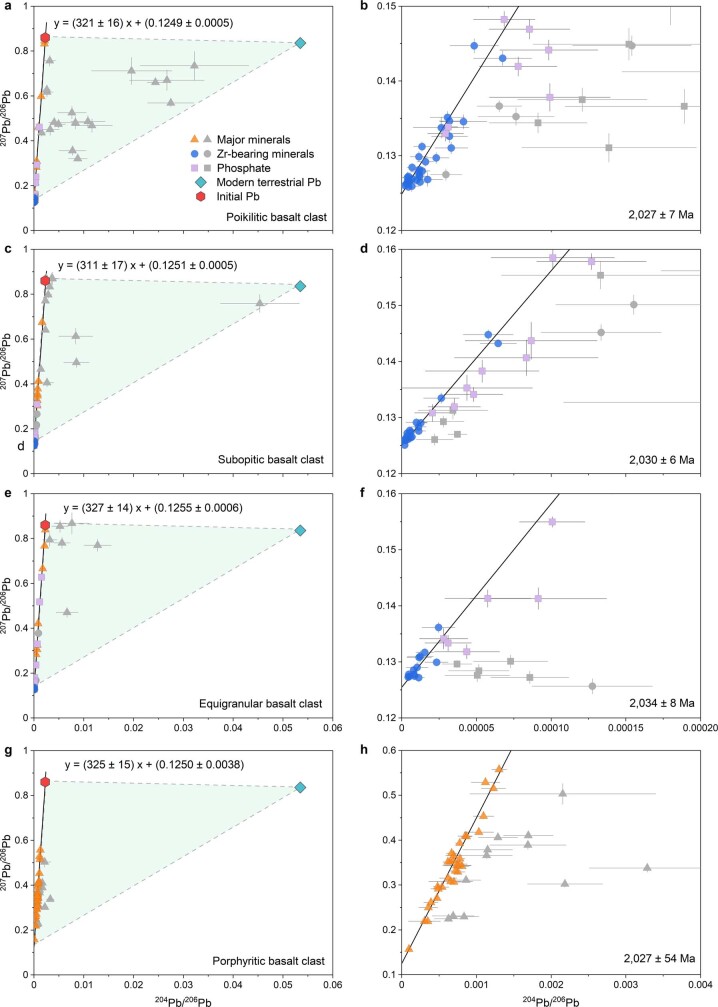
The Moon has a magmatic and thermal history that is distinct from that of the terrestrial planets. Radioisotope dating of lunar samples suggests that most lunar basaltic magmatism ceased by around 2.9-2.8 billion years ago (Ga), although younger basalts between 3 Ga and 1 Ga have been suggested by crater-counting chronology, which has large uncertainties owing to the lack of returned samples for calibration. Here we report a precise lead-lead age of 2,030 ± 4 million years ago for basalt clasts returned by the Chang'e-5 mission, and a U/Pb ratio (µ value) of about 680 for a source that evolved through two stages of differentiation. This is the youngest crystallization age reported so far for lunar basalts by radiometric dating, extending the duration of lunar volcanism by approximately 800-900 million years. The µ value of the Chang'e-5 basalt mantle source is within the range of low-titanium and high-titanium basalts from Apollo sites (µ value of about 300-1,000), but notably lower than those of potassium, rare-earth elements and phosphorus (KREEP) and high-aluminium basalts (µ value of about 2,600-3,700), indicating that the Chang'e-5 basalts were produced by melting of a KREEP-poor source. This age provides a pivotal calibration point for crater-counting chronology in the inner Solar System and provides insight on the volcanic and thermal history of the Moon.
月球的岩浆和热历史与类地行星明显不同。对月球样本的放射性同位素测年表明,大多数月球玄武岩岩浆作用在 29 亿至 28 亿年前(Ga)左右停止,尽管根据撞击坑计数年代学,在 3Ga 至 1Ga 之间有更年轻的玄武岩,但由于缺乏返回样本进行校准,因此存在很大的不确定性。在这里,我们报告了嫦娥五号任务返回的玄武岩碎屑的精确的铅-铅年龄为 2030±4 百万年,以及一个源的 U/Pb 比值(µ 值)约为 680,该源经历了两个阶段的分化。这是迄今为止通过放射性测年报告的月球玄武岩的最年轻的结晶年龄,将月球火山活动的持续时间延长了约 8 亿至 9 亿年。嫦娥五号玄武岩幔源的 µ 值在阿波罗站点的低钛和高钛玄武岩范围内(µ 值约为 300-1000),但明显低于钾、稀土元素和磷(KREEP)和高铝玄武岩(µ 值约为 2600-3700),表明嫦娥五号玄武岩是由 KREEP 贫源的熔融产生的。这个年龄为内太阳系撞击坑计数年代学提供了一个关键的校准点,并为月球的火山和热历史提供了深入了解。