Ramakrishnan Sivasubramanian, Ghati Nirmal, Ahuja Ramandeep Singh, Bhatt Kinjal Niranjan, Sati Hem Chandra, Saxena Anita, Kothari Shyam Sunder
Department of Cardiology, All India Institute of Medical Sciences, New Delhi, India.
Department of Cardiology, Jai Prakash Narayan Apex Trauma Centre, All India Institute of Medical Sciences, New Delhi, India.
Ann Pediatr Cardiol. 2021 Jul-Sep;14(3):331-340. doi: 10.4103/apc.APC_94_21. Epub 2021 Aug 11.
The utility of beta-blocker therapy in infants with heart failure (HF) due to significant left-to-right shunt lesions is not known. The study aimed to assess the efficacy and safety of propranolol in infants with HF due to moderate-to-large ventricular septal defect (VSD).
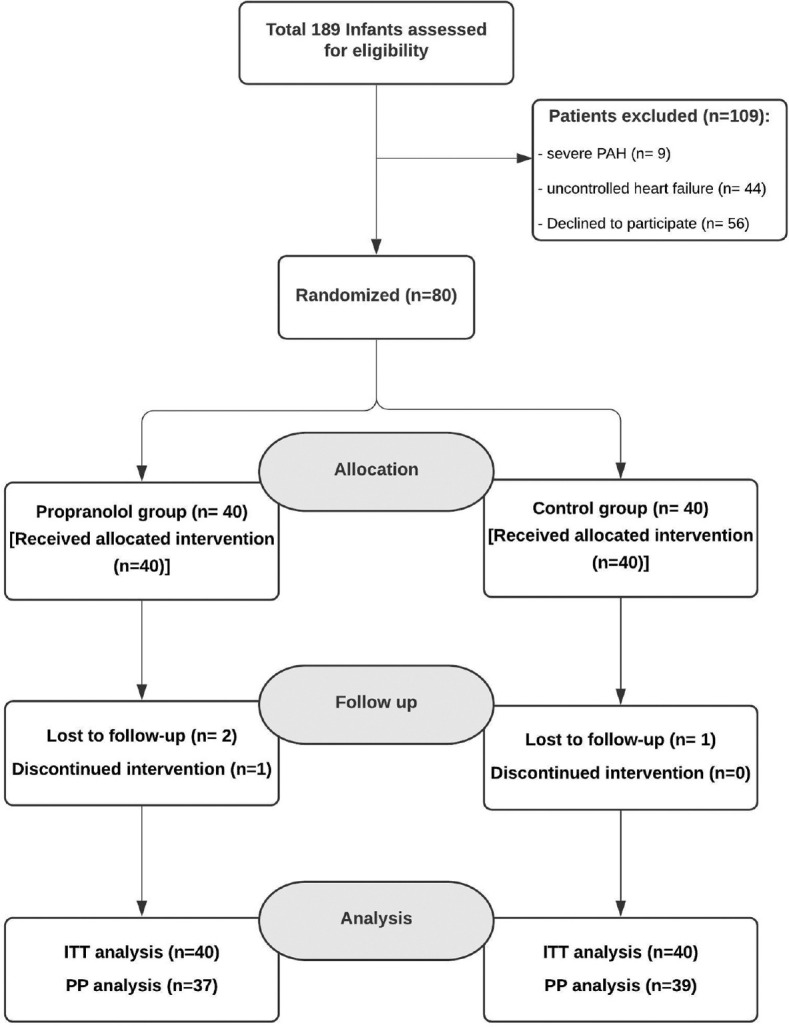
The prospective randomized trial included 80 infants with HF and moderate-to-large VSD, randomly allocated to receive either conventional therapy alone ( = 40) or propranolol plus conventional therapy ( = 40). The primary endpoint was a composite of all-cause mortality, hospitalization for HF and/or chest infection, and referral for surgery. The secondary clinical outcomes were the individual components of the composite endpoint. In addition, the patients were followed up to detect safety outcomes, for example, bronchospasm, bradyarrhythmia, and worsening HF symptoms.
The addition of propranolol therapy to the conventional medications did not result in significant improvement in the primary composite endpoint (32.50% vs. 52.50%; = 0.07). There was a trend toward improvement, but the study is underpowered for this important question. However, propranolol therapy significantly decreased the risk of hospitalization (12.50% vs. 32.50%; = 0.03) and worsening of Ross HF class (5.41% vs. 28.21%; = 0.01) as compared to conventional therapy (estimated number needed to treat = 5). Propranolol did not result in any significant safety concerns in these infants except bronchospasm in an infant.
Propranolol therapy in infants with significant left-to-right shunt may prevent worsening in HF symptoms and hospitalization and is well tolerated. However, it does not reduce mortality or need for surgery.
β受体阻滞剂疗法在因显著左向右分流性病变导致心力衰竭(HF)的婴儿中的效用尚不清楚。本研究旨在评估普萘洛尔在因中到大型室间隔缺损(VSD)导致HF的婴儿中的疗效和安全性。
这项前瞻性随机试验纳入了80例因中到大型VSD导致HF的婴儿,随机分配为单独接受传统治疗(n = 40)或普萘洛尔加传统治疗(n = 40)。主要终点是全因死亡率、因HF和/或胸部感染住院以及手术转诊的综合指标。次要临床结局是综合终点的各个组成部分。此外,对患者进行随访以检测安全性结局,例如支气管痉挛、缓慢性心律失常和HF症状恶化。
在传统药物治疗基础上加用普萘洛尔疗法并未使主要综合终点有显著改善(32.50% 对52.50%;P = 0.07)。虽有改善趋势,但该研究针对这个重要问题的效能不足。然而,与传统治疗相比,普萘洛尔疗法显著降低了住院风险(12.50% 对32.50%;P = 0.03)以及罗斯HF分级恶化的风险(5.41% 对28.21%;P = 0.01)(估计治疗所需人数 = 5)。除一名婴儿出现支气管痉挛外,普萘洛尔在这些婴儿中未导致任何显著的安全性问题。
对有显著左向右分流的婴儿使用普萘洛尔疗法可能预防HF症状恶化和住院且耐受性良好。然而,它并不能降低死亡率或手术需求。