Castro Díez Cristina, Khalil Feras, Schwender Holger, Dalinghaus Michiel, Jovanovic Ida, Makowski Nina, Male Christoph, Bajcetic Milica, van der Meulen Marijke, de Wildt Saskia N, Ablonczy László, Szatmári András, Klingmann Ingrid, Walsh Jennifer, Läer Stephanie
Institute of Clinical Pharmacy and Pharmacotherapy, Heinrich-Heine-University Düsseldorf, Düsseldorf, Germany.
Mathematical Institute, Heinrich-Heine-University Düsseldorf, Düsseldorf, Germany.
BMJ Paediatr Open. 2019 Jan 31;3(1):e000365. doi: 10.1136/bmjpo-2018-000365. eCollection 2019.
To characterise heart failure (HF) maintenance pharmacotherapy for children across Europe and investigate how angiotensin-converting enzyme inhibitors (ACE-I) are used in this setting.
A Europe-wide web-based survey was conducted between January and May 2015 among European paediatricians dedicated to cardiology.
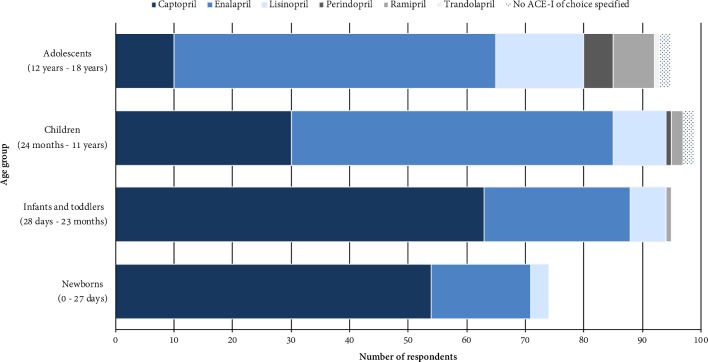
Out of 200-eligible, 100 physicians representing 100 hospitals in 27 European countries participated. All participants reported prescribing ACE-I to treat dilated cardiomyopathy-related HF and 97% in the context of congenital heart defects; 87% for single ventricle physiology. Twenty-six per cent avoid ACE-I in newborns. Captopril was most frequently selected as first-choice for newborns (73%) and infants and toddlers (66%) and enalapril for children (56%) and adolescents (58%). Reported starting and maintenance doses varied widely. Up to 72% of participants follow formal creatinine increase limits for decision-making when up-titrating; however, heterogeneity in the cut-off points selected existed. ACE-I formulations prescribed by 47% of participants are obtained from more than a single source. Regarding symptomatic HF maintenance therapy, 25 different initial drug combinations were reported, although 79% select a regimen that includes ACE-I and diuretic (thiazide and/or loop), 61% ACE-I and aldosterone antagonist; 44% start with beta-blocker, 52% use beta-blockers as an add-on drug. Of the 89 participants that prescribe pharmacotherapy to asymptomatic patients, 40% do not use ACE-I monotherapy or ACE-I-beta-blocker two-drug only combination.
Despite some reluctance to use them in newborns, ACE-I seem key in paediatric HF treatment strategies. Use in single ventricle patients seems frequent, in apparent contradiction with current paediatric evidence. Disparate dosage criteria and potential formulation-induced variability suggest significant differences may exist in the risk-benefit profile children are exposed to. No uniformity seems to exist in the drug regimens in use. The information collected provides relevant insight into real-life clinical practice and may facilitate research to identify the best therapeutic options for HF children.
描述欧洲儿童心力衰竭维持期药物治疗情况,并调查血管紧张素转换酶抑制剂(ACE-I)在此情况下的使用方式。
2015年1月至5月间,在欧洲范围内对专注于心脏病学的儿科医生进行了基于网络的调查。
在200名符合条件的医生中,来自27个欧洲国家100家医院的100名医生参与了调查。所有参与者均报告使用ACE-I治疗扩张型心肌病相关心力衰竭,97%用于先天性心脏病相关心力衰竭;87%用于单心室生理情况。26%的人避免在新生儿中使用ACE-I。卡托普利最常被选为新生儿(73%)以及婴幼儿(66%)的首选药物,依那普利则是儿童(56%)和青少年(58%)的首选。报告的起始剂量和维持剂量差异很大。高达72%的参与者在增加剂量时遵循正式设定的肌酐升高限制来做决策;然而,所选的临界点存在异质性。47%的参与者所开具的ACE-I制剂来自不止一个来源。关于有症状心力衰竭的维持治疗,报告了25种不同的初始药物组合,尽管79%的人选择包括ACE-I和利尿剂(噻嗪类和/或袢利尿剂)的方案,61%选择ACE-I和醛固酮拮抗剂;44%以β受体阻滞剂开始治疗,52%将β受体阻滞剂作为附加药物使用。在89名给无症状患者开药物治疗的参与者中,40%不使用ACE-I单药治疗或仅使用ACE-I与β受体阻滞剂的两药联合治疗。
尽管在新生儿中使用ACE-I存在一些顾虑,但ACE-I似乎是儿童心力衰竭治疗策略的关键。在单心室患者中使用似乎很常见,这与当前儿科证据明显矛盾。不同的剂量标准和潜在的制剂诱导变异性表明,儿童所面临的风险效益情况可能存在显著差异。所用药物方案似乎不存在一致性。所收集的信息为实际临床实践提供了相关见解,并可能有助于开展研究以确定儿童心力衰竭的最佳治疗选择。