Fatigue and Exercise Laboratory, School of Sport and Health Sciences, University of Brighton, Brighton, East Sussex, UK.
Department of Clinical Neurosciences, Cumming School of Medicine, University of Calgary, Calgary, AB, Canada.
Cogn Affect Behav Neurosci. 2022 Apr;22(2):215-228. doi: 10.3758/s13415-021-00958-x. Epub 2021 Oct 19.
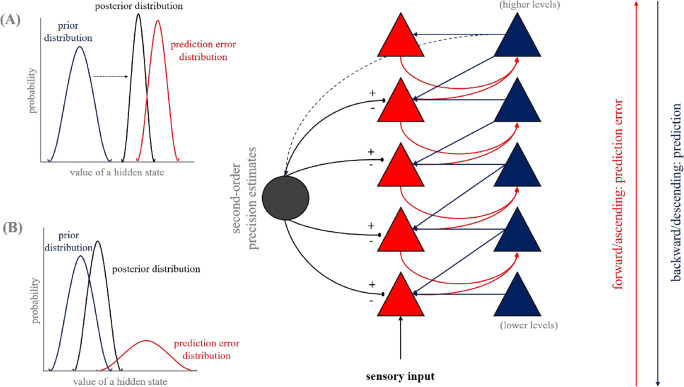
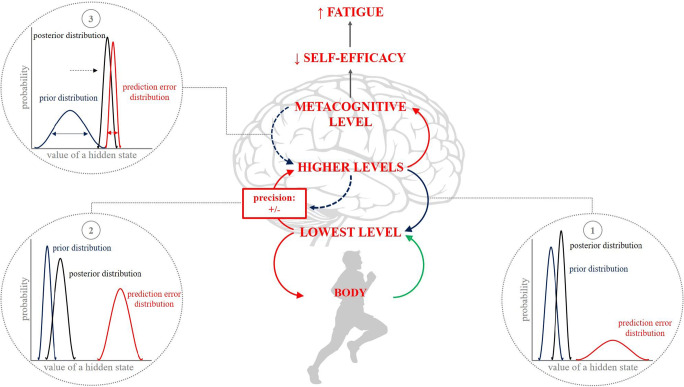
Fatigue is a common experience in both health and disease. Yet, pathological (i.e., prolonged or chronic) and transient (i.e., exertional) fatigue symptoms are traditionally considered distinct, compounding a separation between interested research fields within the study of fatigue. Within the clinical neurosciences, nascent frameworks position pathological fatigue as a product of inference derived through hierarchical predictive processing. The metacognitive theory of dyshomeostasis (Stephan et al., 2016) states that pathological fatigue emerges from the metacognitive mechanism in which the detection of persistent mismatches between prior interoceptive predictions and ascending sensory evidence (i.e., prediction error) signals low evidence for internal generative models, which undermine an agent's feeling of mastery over the body and is thus experienced phenomenologically as fatigue. Although acute, transient subjective symptoms of exertional fatigue have also been associated with increasing interoceptive prediction error, the dynamic computations that underlie its development have not been clearly defined. Here, drawing on the metacognitive theory of dyshomeostasis, we extend this account to offer an explicit description of the development of fatigue during extended periods of (physical) exertion. Accordingly, it is proposed that a loss of certainty or confidence in control predictions in response to persistent detection of prediction error features as a common foundation for the conscious experience of both pathological and nonpathological fatigue.
疲劳是健康和疾病中常见的体验。然而,病理性(即延长或慢性)和短暂性(即劳累性)疲劳症状传统上被认为是不同的,这加剧了疲劳研究领域之间的分离。在临床神经科学中,新兴的框架将病理性疲劳定位为通过分层预测处理得出的推论的产物。动态平衡失调的元认知理论(Stephan 等人,2016 年)指出,病理性疲劳源于元认知机制,在该机制中,先前内脏预测与上行感觉证据(即预测误差)之间持续不匹配的检测会发出内部生成模型证据不足的信号,这会破坏主体对身体的掌控感,因此在现象学上表现为疲劳。尽管急性、短暂的劳累性主观疲劳症状也与增加的内脏预测误差有关,但支持其发展的动态计算尚未明确界定。在这里,我们借鉴动态平衡失调的元认知理论,将其扩展到对长时间(身体)劳累期间疲劳发展的明确描述。因此,有人提出,对控制预测的信心或确定性的丧失,以响应对预测误差特征的持续检测,是病理性和非病理性疲劳的意识体验的共同基础。